Mark Hailwood
I went to a conference, and all I got was this lousy blog post.
That’s right, this is one of those blog posts thought up whilst staring pensively out of a train window on a journey home from three days at a wonderfully stimulating and sociable conference – in this instance, on ‘Gender, Power and Materiality in Early Modern Europe’, at the University of Plymouth. Back in April. Of 2016. Still, better late than never.
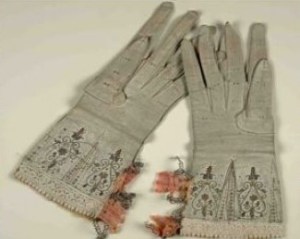
Gloves: they fit the conference theme
I signed up for said conference, despite my lack of familiarity with the field of early modern material culture studies, to try out a paper on the spatial division of labour in rural England, 1500-1700, based on material coming out of the Women’s Work Project. The paper went well enough, and over the course of the conference as a whole I learnt a huge amount about the material culture of the period, and about the sophisticated methodologies used by the reflective practitioners of material cultural history. It whet my appetite for the study of material culture. But it also left me hungry for more of a particular type of material culture history – one focused on the common people of the sixteenth and seventeenth centuries. In what will come as no surprise to readers of this blog, I wanted more material culture ‘from below’.
The conference offered a rich diet of papers focused on the gentry and aristocracy of early modern Europe, but was light on the material things that populated the worlds of their social inferiors. Not for the first time as a social historian I found myself experiencing ‘modernist envy’, as my mind turned to examples of research into the material culture of the working class in the industrial age – Ruth Mather on working class homes in the period 1780-1830; Julie-Marie Strange’s focus on ‘father’s chair’ as a way into the domestic relationships of the Victorian working class; Carolyn Steedman’s wonderful essay on the meanings of a rag rug.[1] And how about the insights into working class material culture to be gleaned from Lark Rise to Candleford? Continue reading
 If you want to know more about employability then the
 The digested version is that comments tended to fall into three categories: those who were prompted to reflect on periodisation in relation to their own research; those who offered a transnational perspective; and those who added an interdisciplinary slant to the discussion. Whilst debates on this topic are a constant of historical research, social media has the benefit of creating a more diverse conversation which encourages broader perspectives and raises new complications. If the debate continues I intend to add to the story in due course, so please do join the conversation.