After Iconophobia?

After Iconophobia? An Online Symposium

Tara Hamling and Jonathan Willis

aiIn 1985, Patrick Collinson delivered Reading University’s Stenton lecture on the topic ‘From Iconoclasm to Iconophobia: the Cultural Impact of the Second English Reformation.’ More than thiry years on, this essay (published in pamphlet form in 1986 and in revised form as Chapter 4 of The Birthpangs of Protestant England) has gone on to shape a generation of scholarly enquiry into the impact of religion on culture, and of culture on religion, in post-reformation England.  Scholars have accepted, rejected, and modified Collinson’s arguments, but one way or another they continue to exert a powerful influence over reformation studies today.

If you haven’t read Collinson’s original article/chapter, we would certainly encourage you to do so, although reasons of copyright prevent us from uploading a copy on the public internet.  Still, the definitions of his two key terms may well be of interest:

iconophobia definitions

Continue reading

Asking questions of speakers: top tips

Laura Sangha

Presentation ‘season’ has just begun at my University, where group and individual talks are part of the assessment for modules at every undergraduate level. Public speaking is apparently once of the most feared aspects of modern life, yet it is also a skill that students may well need in their future workplace, so it makes sense that all are called upon to regularly research, write and deliver presentations, building experience and confidence.

fear-of-public-speaking-40035

Many people aren’t fans of public speaking

At Exeter, the marking criteria is focused around preparation, content, structure, creativity and delivery, but students are also assessed on their handling of questions in a Q&A segment after they have presented. And it is this that has inspired this post. Of course, a presenter needs some good questions in order to be able to demonstrate the depth and scope of their knowledge in a Q&A session, but I have found that people can struggle to formulate queries and that they can as a result be a bit hesitant to raise their hand. So I have come up with some suggestions about the sorts of things that it might make sense to ask about, as a teaching resource I can point my students to. Please do add your own below the line. Continue reading

All ancient history now: England’s damaging Reformation

Laura Sangha

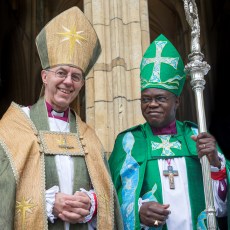
On Tuesday 16 January, in the year of the 500th anniversary of the Reformation, the Archbishops and Canterbury and York issued a joint statement on ‘the damage done five centuries ago to the unity of the Church’. It reads:

The Reformation was a process of both renewal and division amongst Christians in Europe. In this Reformation Anniversary year, many Christians will want to give thanks for the great blessings they have received to which the Reformation directly contributed…

…Many will also remember the lasting damage done five centuries ago to the unity of the Church, in defiance of the clear command of Jesus Christ to unity in love. Those turbulent years saw Christian people pitted against each other, such that many suffered persecution and even death at the hands of others claiming to know the same Lord. A legacy of mistrust and competition would then accompany the astonishing global spread of Christianity in the centuries that followed.

MANDATORY CAPTION: (C) Keith Blundy / Aegies Associates

For a Reformation historian this was a fascinating moment. It was also humorous (in a sort of bitter, 2017 way), since the Daily Mail immediately took offence at this show of remorse, declaring that since Henry VIII’s ‘war with the Pope’ began 500 years ago, and that it wasn’t even a required subject for the National Curriculum, it was hardly a ‘burning issue’. Ann Widdecombe, a former Tory minister and Strictly Come Dancing Star provided a quote, saying:

These gestures are pointless. The Archbishop has not put anyone to death, as far as I know… Modern Christians are not responsible for what happened in the Reformation… You might as well expect the Italians to apologise for Pontius Pilate.

I’m looking forward to discussing all this with my students this term. There’s certainly a lot to be said of the way that the media are reporting this statement as an ‘apology’, as well as to ponder in the emphasis on unity and the healing of past divisions. Of course, Widdecombe is right that modern Christians are not individually responsible for what happened in the Reformation, but I disagree with the implicit argument underpinning the Mail article, that the Reformation is ancient history, and nothing to do with ‘us’. Since our understanding of the past and of where we came from is intimately tied to the way we conceptualise our contemporary identities, the way that we think of and interpret that past has a direct and immediate importance for the present. Members of the Church of England today are informed by, and understand their institution with reference to the past, so it seems appropriate to reflect on the evolution of the Church and to reconsider contemporary responses to it in this anniversary year. Continue reading

‘At Christmas we banquet, the rich with the poor’: Christmas Dinner in Tudor & Stuart England

Mark Hailwood

screen-shot-2012-12-18-at-8-19-47-pmChristmas dinner is undoubtedly one of the most popular Yuletide rituals in Britain today – but what is its history? If you like, as any good historian would, to have a bit of historical context up your sleeve to bore your relatives with over the Christmas period, then I offer up to you the following morsels about the ritual meal’s sixteenth and seventeenth century character…

A cycle of midwinter celebration was established in Britain in the early part of the Middle Ages, so by the sixteenth century the Twelve Days of Christmas – running from 25th December to 5th January – had already been the focus of festivities for centuries. The holidays kicked off with Christmas Day itself, and after attending an early morning church service the attention quickly turned to feasting. From Advent Sunday, the fourth before Christmas Day, people were encouraged by the Church to restrict their diet, with Christmas Eve kept as a strict fast day on which meat, cheese and eggs were all forbidden. Come Christmas Day then, appetites had been sharpened for the first unrestricted meal in weeks.

So, a big dinner was already central to Christmas Day ritual by the start of the sixteenth century, and by the first half of the seventeenth century we start to find evidence of certain foods having a close association with Christmas celebrations. The ‘minced pie’ – then a mixture of meat, fruit and spice baked in pastry case – appears in seventeenth century records. So too does ‘plum porridge’ – a beef broth with prunes, raisins and currants in it. For the main meat dish beef or brawn (meat from a pig or calf head), both stuck with rosemary, were the favoured options. Continue reading

Fake news: a very (early) modern problem

Fake news and misinformation have hit the headlines recently as concerns grow about its extent and impact. In this guest post, Dr Francis Young examines the parallels between contemporary digital fake news and English civil war newsbooks. Dr Young is a historian of early modern England and the Catholic Record Society’s Volumes Editor. You can follow him on twitter @SuffolkRecusant.

In the immediate aftermath of the US election, Facebook came under fire for allowing ‘fake news’ to dominate its platform, and there was much lamenting that traditional print media – which, in theory, at least tries to verifies sources and stories – has been replaced by social media as the source of ‘news’ for many people. The ‘fake news’ problem raises many profound and interesting questions about what ‘news’ really is, and what makes it ‘real’ as opposed to ‘fake’, but commentators have perhaps been too hasty in assuming facebook-fakesthat fake news is something new and something alien to the ‘traditional print media’. In fact, the pattern of user-generated news that we see on contemporary social media platforms is closer to the original pattern of dissemination of news in the first age of print.

Defining what counts as ‘fake news’ is not straightforward, given the traditional print media’s overt political bias, spinning of rumours, wilful misinterpretation of statistical data, and editorial decisions to foreground minor stories and ignore many newsworthy ones. However, a strict definition of ‘fake news’ would exclude speculative stories that might be true and are supported by anonymous sources. The reporting of such stories with the implication that they are fact may be dubious journalism, but it is the longstanding practice of the tabloid press. ‘Fake news’, in the strict sense, would have to be the kind of story that no conventional newspaper or news website would run because it directly contradicts easily verifiable fact: for instance, the report that Donald Trump won the popular vote in the US election as well as the votes of the electoral college. No conventional media would run with a story that is demonstrably false; to do so would run the risk of being discredited as a news outlet or sullying the ‘brand’ of a conventional newspaper. Continue reading

Addressing Authority: some concluding thoughts

Brodie Waddell

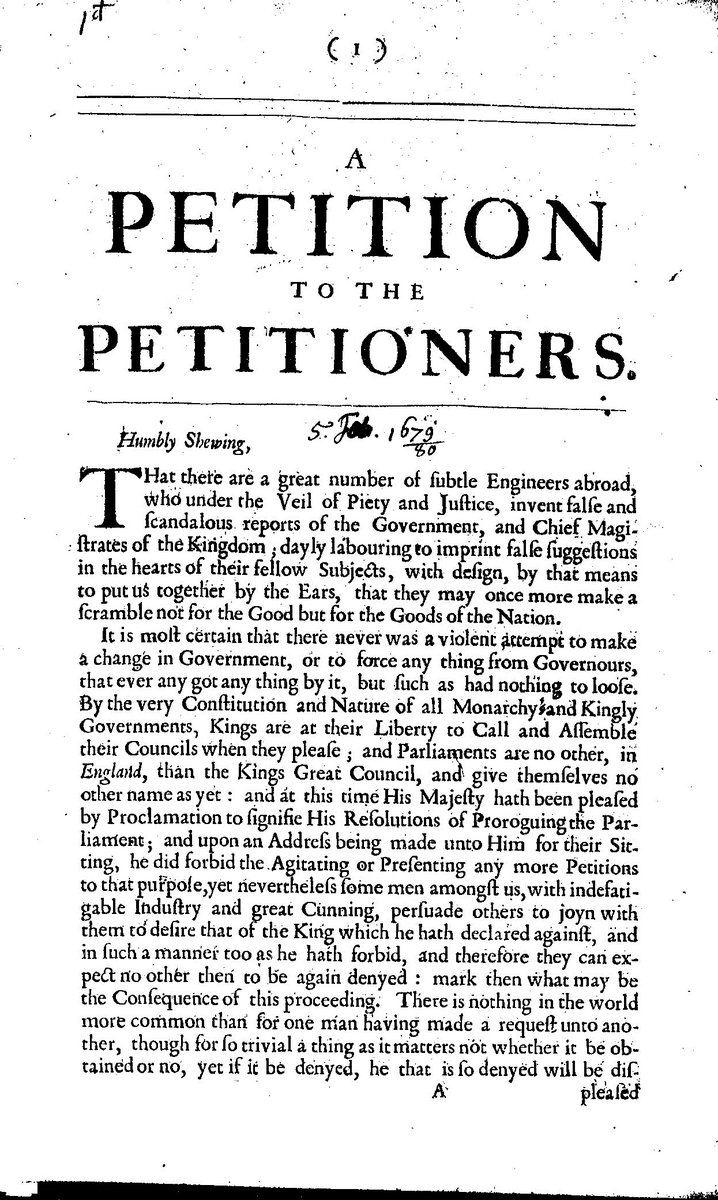
petition-to-the-petitioners-1679-80Petitions and supplications have been flying thick and fast over the past month. Contributors to the Addressing Authority Online Symposium have spotted them asking for permission to print a broadsheet about conjoined twins in sixteenth-century Nuremberg, decrying Charles I’s religious policy in seventeenth-century Scotland, and seeking a tax exception in eighteenth-century London. On twitter, they could be found claiming that mariners had been forced into cannibalism and that their complaints were justified by the example of Queen Esther. One was even seen petitioning ‘to the Petitioners’ during the Popish Plot scare of 1680.

It would be silly to try to sum up all the brilliant contributions by both the authors and commenters over the course of the symposium. However, I will take the opportunity to try to briefly highlight three issues that came up in the papers and discussion that I hadn’t properly considered before. Continue reading

Petitions, Information and Governance in 15th and Early 16th-Century Sforza Milan

This post in our Addressing Authority Online Symposium comes from Giacomo Giudici, who recently completed his PhD at Birkbeck, University of London, as part of the ERC funded project ‘ARCHIves – a History of Archives in Late Medieval and Early Modern Italy‘. Here he shows how petitions could be an engine for pre-modern governance, providing a precious source of information to the Milanese authorities.

The Sforza are the dynasty that ruled Milan and its duchy continuously from 1450 to 1499, and then, only intermittently, between 1500 and 1535.[1] Like all the rulers of the time, they relied on petitions to administer their dominion. In the Sforzesco archive, located in Milan, hundreds and hundreds of original petitions are to be found mingled with other documents in two huge collections, called Comuni (literally “Towns”) and Famiglie (“Families”), created from scratch by nineteenth-century archivists. Previous scholars have, therefore, focused their attention on these collections.[2]

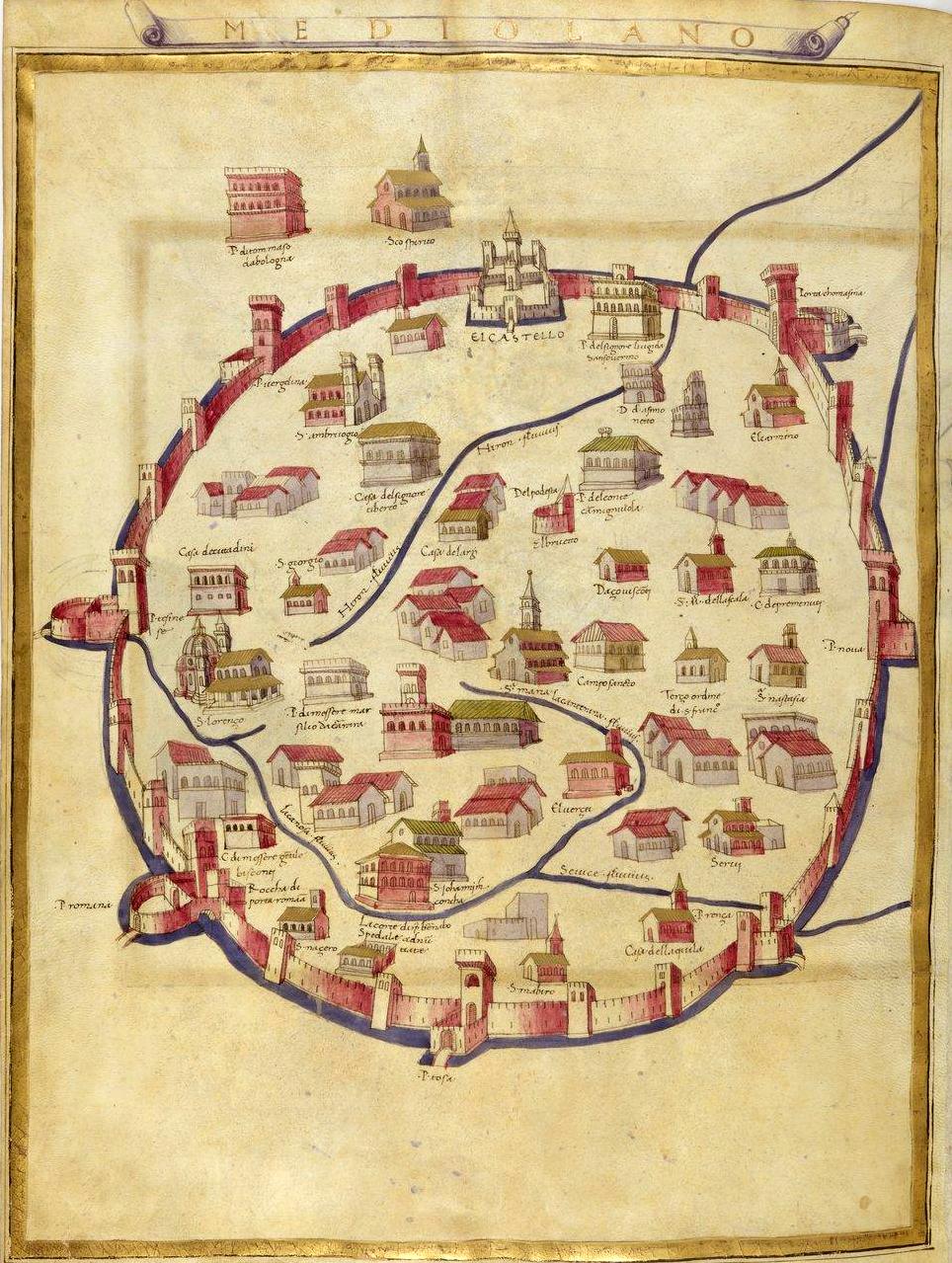
Milan, c.1470

Milan, c.1470

However, historians have ignored another source displaying petitions: the Registri delle missive, chancery copybooks in which the outgoing Sforza correspondence with subjects (peripheral officers, subject communities, individual subjects) was registered. The reason of this lacuna is simple. In the copybooks, the petitions are hidden in plain sight. Ducal letters originating from the receipt of a petition mention it briefly at some point, usually at the beginning – for example: “We have received a petition from the agents of the men of our land of Pizzighettone (…) we order you to (…)”.[3] It is easy to miss the tiny note, or to think that little can be done with it. Are we sure this is true, though?

Original petitions – or those reproduced in registers in their entirety – are, of course, mines of historical evidence. They lend themselves to the most diverse research perspectives: political history, social history, the history of justice, but also linguistics and, more generally, anthropology. Yet, in the case of our copybooks, we get the chance to observe petitions in a bigger picture. We can grasp how, and how heavily, petitions featured in the communication flows between the centre and the peripheries of the duchy of Milan – the character and function of such communication flows being veritable “shapers” of polities and politics, just like new social media set the tone and contents of today’s political debate.[4] In other words, even though in the Registri delle missive we lose the strict contents and wording of the petitions sent to the Sforza, we crucially gain a systemic perspective on their use. Continue reading

Supplications and Civic Rule in Sixteenth-Century Nuremberg

Our next post for the Addressing Authority Online Symposium comes from Hannah Murphy, a Junior Research Fellow at Oriel College, Oxford. Here she shows how early modern rulers could turn supplications into tools of governance by using the expectation of petitioning to monitor the activities of their subjects.

On 26 July 1550, the printer and painter Steffan Hamer was thrown in Nuremberg’s dreaded city jail, “because he had printed wonder-books without permission and against his oath.”[i] Although he was only incarcerated for two days (he was released on the 28th and had his tools returned to him), Hamer’s career never recovered. In September he was refused permission to print a broadsheet of conjoined twins, and had to watch the lucrative sale go to a competitor. [ii]  A year later, on 28 August, 1551, he was refused permission to print a figure of dancing children.[iii] On 25 September, 1551, he was allowed to print a portrait of the siege of Magdeburg, as long he refrained from adding his name.[iv] On 26 March 1552, he was refused permission to publish the ‘three suns and rainbow’ which had appeared over Antdorf.[v] Nuremberg’s council granted permission for something to be printed on average twice a week; but Hamer never again received permission. He disappeared from the city minutes and from Germany’s printing history without a trace.

Steffan Hamer had broken no written law in the way that we might understand it today. Rather, his silent transgression and punishment was indicative of a quiet development in Nuremberg’s city politics, one present only in the accumulated volumes of the council’s meetings, and the format in which they were recorded: the growth of supplications as a hidden tool in the management of people. His punishment was the result of his failure to seek permission from Nuremberg’s council, and his continued fall from grace demonstrates the city’s reliance on petitions as a mechanism of information-gathering and control.

If petitions, in the way that they are often understood, were directed upwards, my work looks at the way in which they could also ‘reach down’. I work on early modern Nuremberg, where the practical act of petitioning in person was a ubiquitous part of civic government. What I have found, by looking at the archives of the city council, is that most city decisions were made in response to a petition.  The city relied on citizens bringing requests to them, not just in order to enforce rules, but also as a means of information-gathering, literally to find out what rules needed enforcing in the first place.

Printed petitions and formal supplications are often linked to the origins of democracy, and other entries in this symposium show how writing petitions could empower subjects in many different ways. But in the face-to-face system of government that characterized early modern German cities, petitions were also a kind of governance. They permit us an insight into the kind of political practices that rulers engaged in when they governed, practices which I think often had to do with information and control and which weren’t necessarily articulated in political treatises, or even in written codes of law.
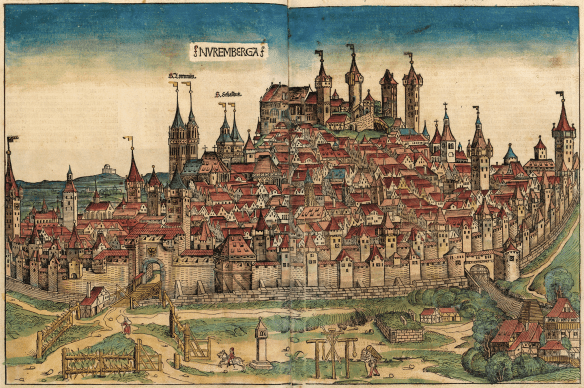
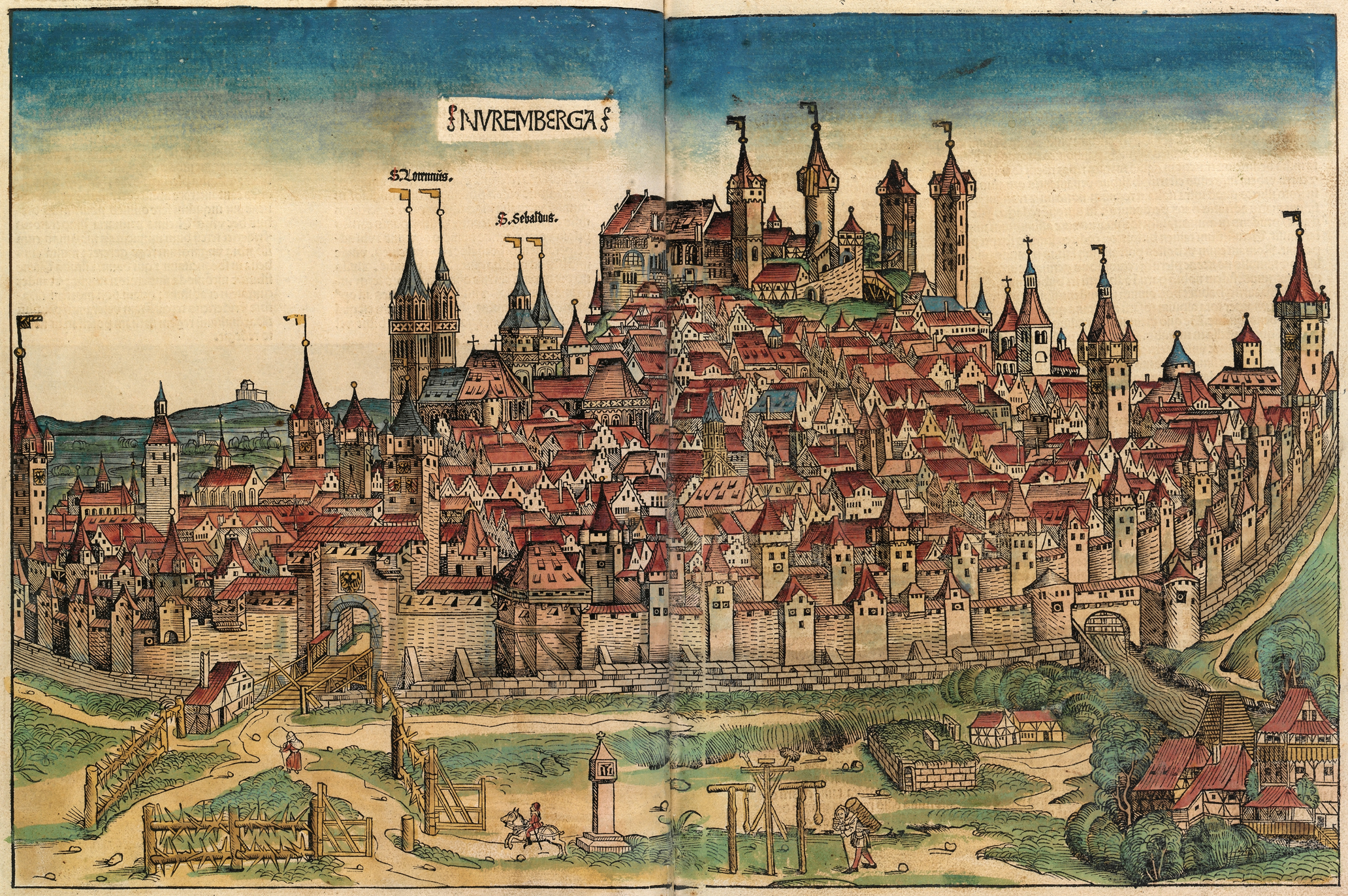
Nuremberg. Michael Wohlgemut & Wilhelm Pleydenwurff, View of Nuremberg, in Hartmann Schedel, Weltchronik. (Nuremberg Chronicle), Nuremberg. Anton Koberger, 1493 (Wikipedia Commons)

Nuremberg. Michael Wohlgemut & Wilhelm Pleydenwurff, View of Nuremberg, in Hartmann Schedel, Weltchronik. (Nuremberg Chronicle), Nuremberg. Anton Koberger, 1493 (Wikipedia Commons)

Early modern Nuremberg was one of the richest and most important cities in Europe. Jean Bodin called it ‘the best ordered’ of all Germany’s cities. Nuremberg was a ‘free city’, a self-governing city-state within the Holy Roman Empire. That meant that the thirty-two members of its most powerful governing body, its ‘Inner Council’, were responsible for a population of around 25,000. Every day, these men made their way to the town hall, where they met and made decisions. How they came to those decisions, however, is difficult to find out. The practice of politics was shrouded in secrecy. As William Smith, an Englishman who had lived for many years in Nuremberg lamented: ‘For that the noble and worthy senators of this cittie, are very jealouse, and will not suffer any description either of their cittie or countries.”[vi]

Continue reading

‘Thair is na offence to supplicat’: Presbyterian petitioning in early modern Scotland

Our next post for the Addressing Authority Online Symposium has been written by Laura Stewart of the University of York. She brings to our attention the important role of petitions in the mobilisation of opinion against King Charles I’s religious policies in Scotland, but also point to the problems of identifying the extent of popular participation and suggests that petitioning did not inevitably lead to a more open or ‘democratic’ mode of politics.

Scholars of early modern England have made a strong case for the significance of petitioning as one of the means by which new political associations and practices came into being. Petitions had long been seen as a legitimate political tool but, according to David Zaret, it was the combination of this practice with the move into print that mattered. Printed petitions were nothing less than the harbinger of ‘public opinion’ and, hence, modern democratic politics.

Although Zaret’s work has generated fruitful debate, his thesis has been heavily critiqued by historians. The likes of Jason Peacey, amongst others, have sited petitioning amongst a far wider range of other practices and media, not all of which aimed ‘to publicize a case in the public sphere’. For Peacey, petitions were part of a process in which a wider cross-section of society was able not only to engage more fully and deeply with parliamentary politics, but also to appropriate such practices for its own uses. The key issue here is less whether such activity furthered the emergence of a ‘public sphere’ – some of it clearly did not – than the ways in which print technology facilitated widening participation in politics.[1]

Peacey’s shift of emphasis is useful to historians of those parts of Europe in which precious few signs of the emergence of Zaret’s ‘democratic culture’ can be found prior to the eighteenth century. Scotland is one of those places. In an important book on the debates surrounding the Union of 1707, Karin Bowie argued that it was only in the closing moments of the seventeenth century that the conditions for the emergence of ‘public opinion’ finally obtained in Scotland. Petitioning generated debate throughout society and ‘set new precedents for the engagement of public opinion’.[2] This may well have been the case, but it raises questions about earlier periods.

There may not have been either ‘public opinion’ or a ‘public sphere’ before 1699, but – following Peacey – I would like to suggest that petitions offer other ways of thinking about subtle, yet important, developments in the nature of political participation during the era of the Scottish Revolution. Continue reading

Petitions and the Duality of Structure: Lobbying in the Seventeenth-Century Dutch Atlantic

Our next post in the Addressing Authority Online Symposium comes from Joris van den Tol of Leiden University. Here he shows how networks of individuals involved in the Dutch Atlantic trade used petitions to lobby metropolitan institutions and perhaps contributed to the formation of a ‘public sphere’.

‘We all know that a monopoly is the most odious thing in the world and the most harmful practice of all’, wrote the directors of the Amsterdam chamber of the Dutch West India Company (WIC) in January 1637.[1] This is an interesting standpoint for a group at that moment enjoying the exclusive trading rights to and from the Company’s colonies in the Atlantic. So, why did the Amsterdam chamber decide to advocate giving up the WIC monopoly in the Atlantic? Who or what influenced their decision? How did individuals lobby both the Company and the highest political levels for their own interest in regard to free trade, religious freedom, authority, military assistance, or other issues? Moreover, why did these interest groups decide to lobby – as opposed to fighting the Company in court for example?

The history of the Dutch in the Atlantic in the seventeenth century used to be a story of a Company chartered in 1621 that was institutionally weaker than its competitors or its East Indian counterpart (VOC) and thus deservedly fell behind, lost large parts of its colonial possessions, and went bankrupt in 1674.[2] However, more recent work has shown that the Dutch Atlantic was built on loosely organized personal networks rather than centralized metropolitan institutions.[3] These networks were self-organized, often pluri-religious, multi-ethnic, and cross-cultural, but more importantly had intersecting interests.[4] Moreover, they cooperated pro-actively to try to influence the structures, institutions, and policy that shaped their world.

There was a duality of structure between the individuals and the structure; the structures at the same time enabled and limited the actions of the agents, as well as being comprised of the actions from the agents. This process of structuration is what I call lobbying, and indicates a hermeneutic relationship between the agents and the institutions.[5] Lobbying removes the impetus for historical actions in the Dutch Atlantic from the Company or the ‘state’ and puts it in the hands of individuals and organized interests.

Lobbying by petition

Lobbying happened in two ways: direct, with the aim of convincing the political mandataries[6]; and outside, with the aim of pressuring the political mandataries through public opinion.[7] Direct lobbying can be studied through petitions, correspondence, presentations, journals and social capital.[8] Outside lobbying is studied through petition drives and pamphlets.[9] Petitions have been largely neglected in Dutch historiography – both in relation to the Atlantic and as a means of studying lobbying.[10] A study of the mechanisms of lobbying treats all of the different sources not just as repositories of historical facts, but analyses the function that these objects had for the individuals that created them. Continue reading