Samuel Clarke’s Martyrology: images of religious violence

Laura Sangha

On Friday, one of my fellow tweeters, Early Modern World @EMhistblog, retweeted an image from a 1651 martyrology that I had originally posted last year. Here’s the tweet:
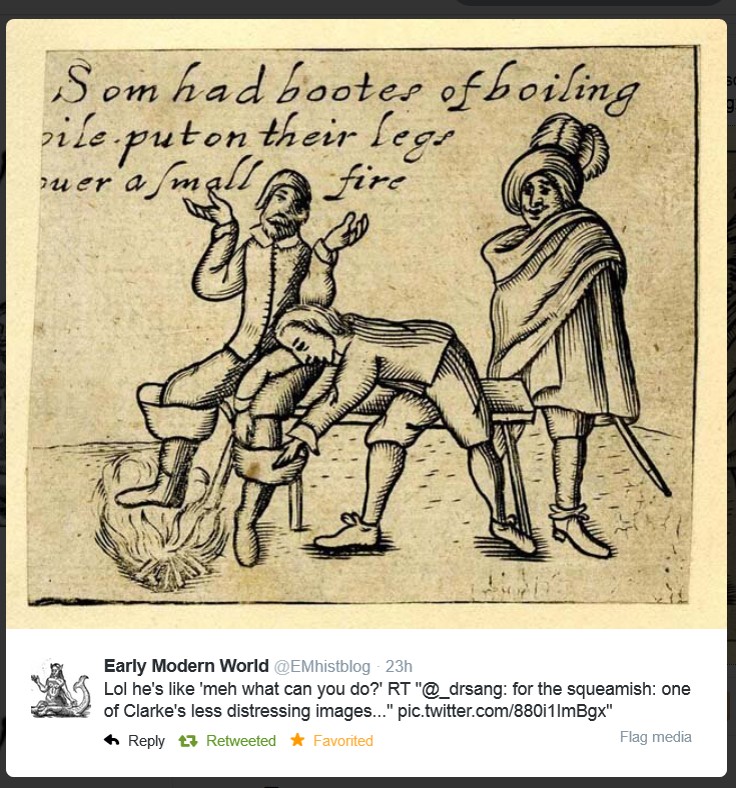
Original tweetIt proved popular, so I wanted to post the full details of the original work and author here (though I make no claim to be an expert on early modern martyrologies). Click on images for enlargements.

Clarke’s Martyrology

The image is one of many graphic illustrations in Samuel Clarke, A generall martyrologie containing a collection of all the greatest persecutions which have befallen the church of Christ from the creation to our present times (London, 1651), Wing / C4513. Clarke’s compilation was first published in 1651. A second edition in 1660, and a third in 1677 suggests that the work was popular. The Martyrology is almost entirely derived from John Foxe’s Actes and Monuments (1563). Indeed, in the preface to the third edition, Clarke defended himself against the claim that his work was a superfluous repetition of Foxe’s monumental work – Clark argued that Foxe’s was a general history of the church, not just a martyrology, and he also claimed that he had ‘turned over many other Authors’ to supply what was wanting in ‘Master Fox’ – although a cursory perusal of the work suggests this claim is false. Probably closer to the truth was Clarke’s assertion that:

in these times many want money to buy, and leasure to read larger Volumes, who yet may find both money, and time to purchase, and to peruse so small a Volume as this is. (Preface, A2r).

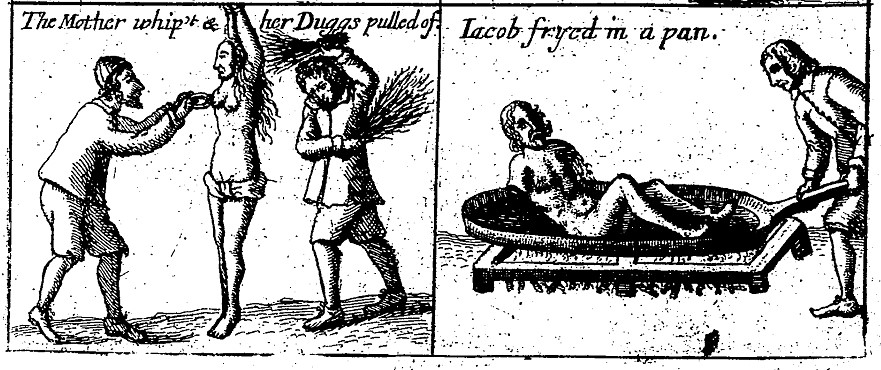
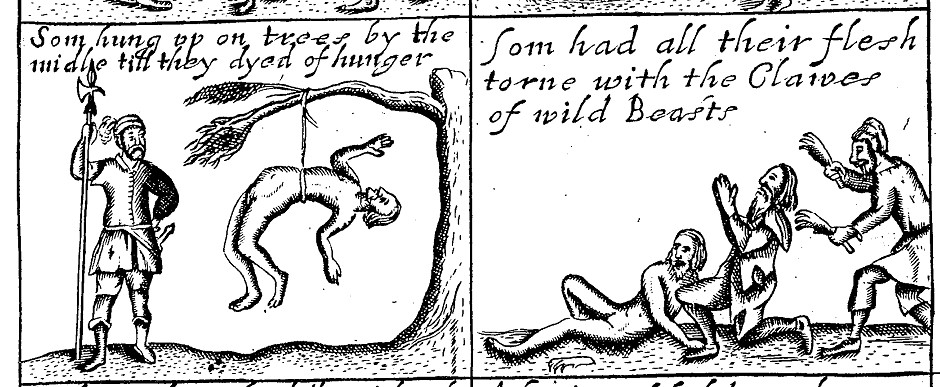
Though even this should be taken with a pinch of salt, because later editions of Clarke would have been reasonably expensive – the third edition was more than 700 pages long; and it contained many illustrations, making it an object of prestige as well as a marker of preferred churchmanship. That said, the images are certainly cruder and less sophisticated than in the large, expensive editions of Foxe. The original image that I tweeted can be seen in context here, bottom right (p. 125, 1677 edn.)Original pic in contextThere were twelve of these plates in the book, each depicting the sufferings of the martyrs in extremely graphic detail. The reader can gaze upon the brutality of religious persecution and be struck by the ingenious capacity of humans to inflict ever more horrible suffering upon their fellows. The enormous variety of types of torture, and the inventiveness of punishments is constantly surprising. Page 18Page 18bpage 52 hung and animal clawsFor the modern viewer, the crude images probably provoke a variety of conflicting emotions. Organised in (what looks to us) a comic book style, the presentation, and the poses and expressions of the victims and torturers often seem terribly mismatched against the outrageous violence that the images depict. The result is both shocking, but at the same time it can also be humorous – as with the nonchalant chap in the ‘boiling oil’ boots. We are used to a extraordinary level of realism in modern media: high definition reproductions of crime scenes, the aftermath of terrorist attacks, the devastating effects of modern warfare. Early modern efforts can seem basic, stiff and even silly, by comparison.
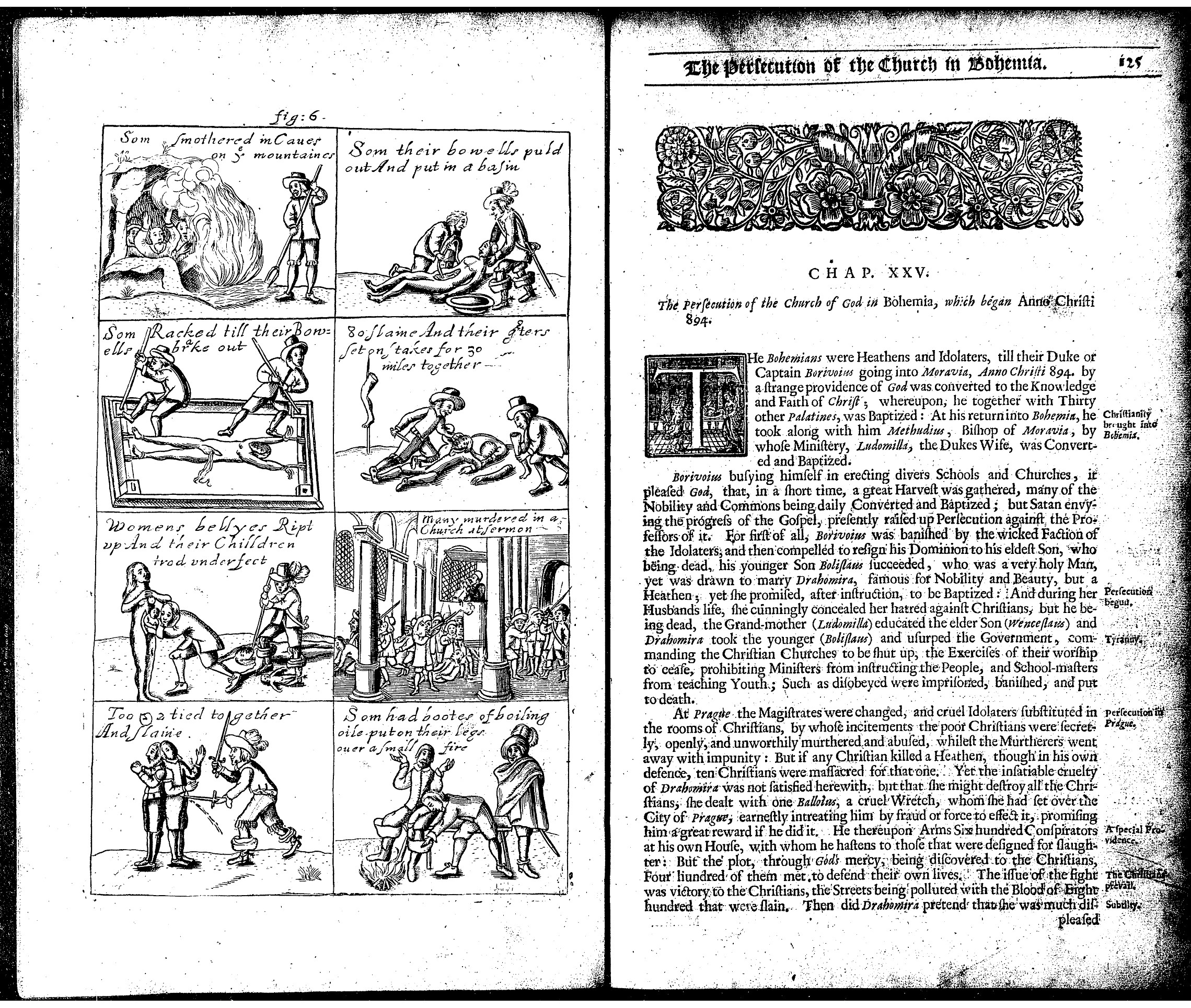
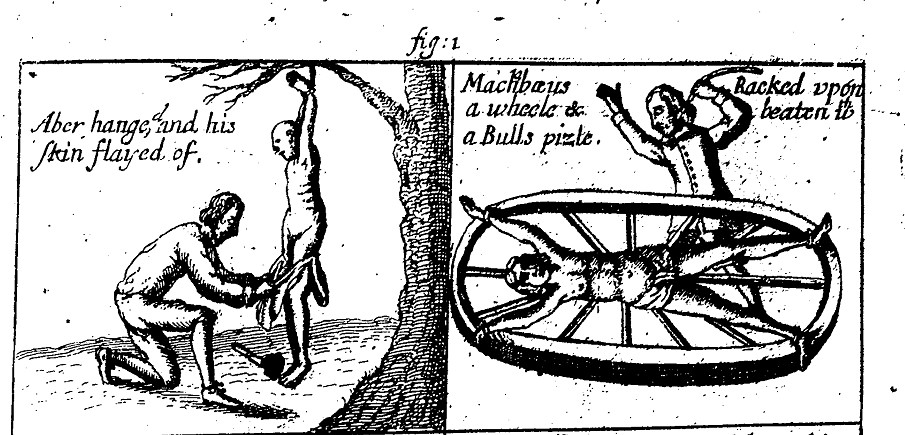
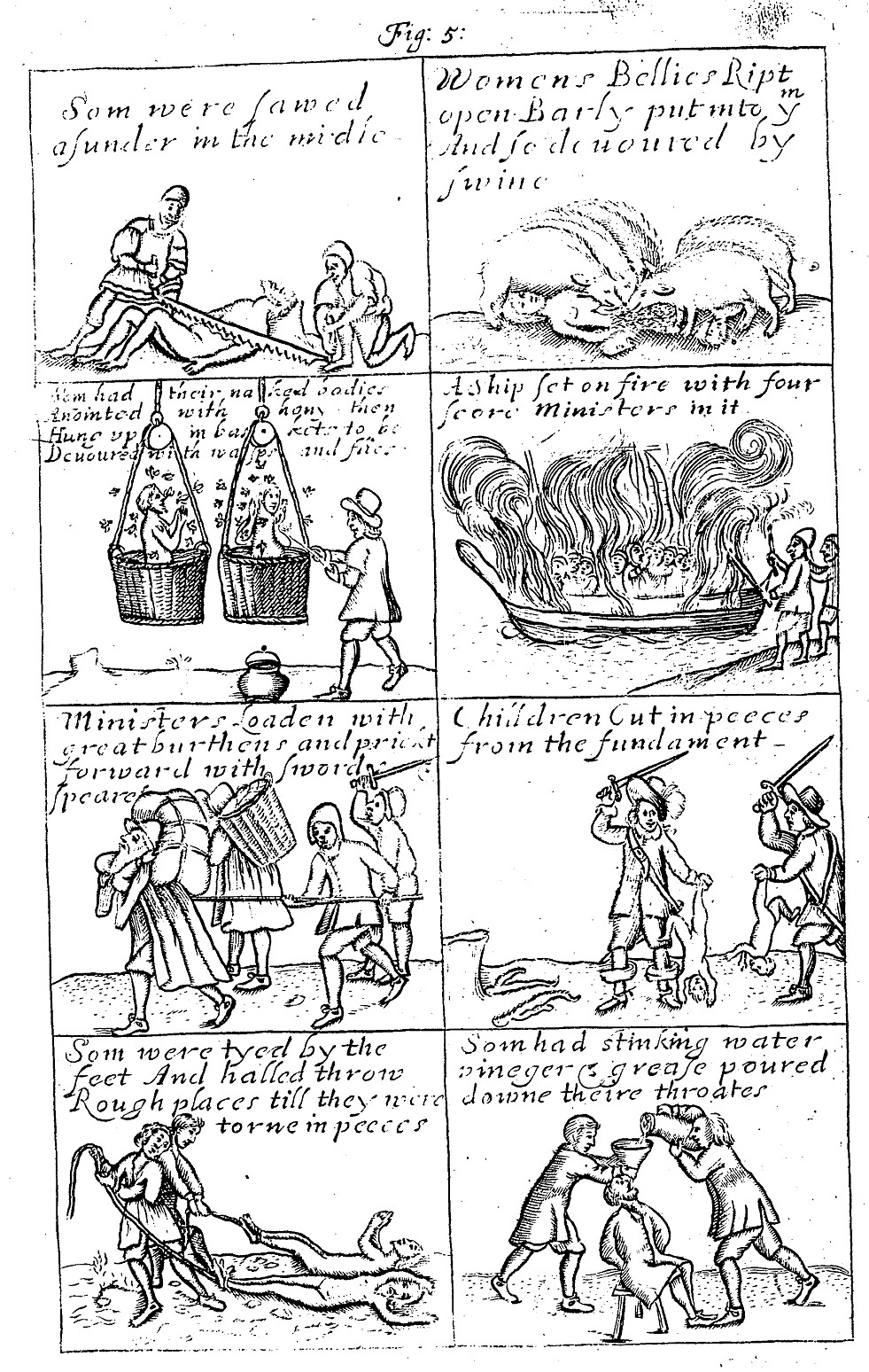
page 74 full page

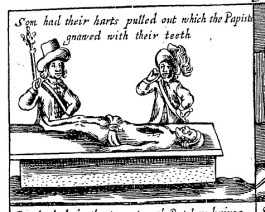
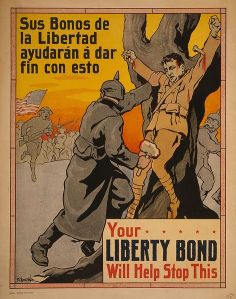
ATROCITY PROPAGANDApage 242 papist hearts


The images also provoke a sense of disbelief – we would prefer to think that this is religious polemic, on a par with the atrocity propaganda of the First World War. Surely no Catholics actually ate a Protestant heart, and the Hun didn’t really crucify a Canadian soldier in Belgium? Though we accept terrible violence happens, the presumption is often that these acts have been exaggerated for greater effect – though countless atrocities throughout history offer plenty of evidence to the contrary.

At other times, the violence is so absurd or extreme that humour is almost a logical response:
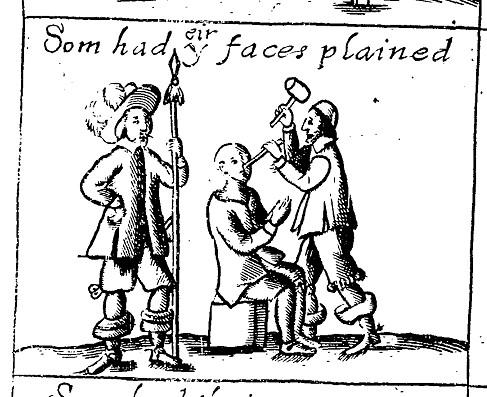
page 220 face plainedIt’s not really possible to ‘plain’ someone’s face off is it?
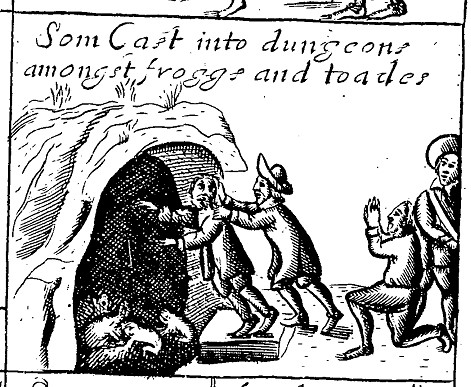
page 220 frogs and toadsBeing thrown in a cave with some toads and frogs hardly seems comparable to some of these other tortures, does it?
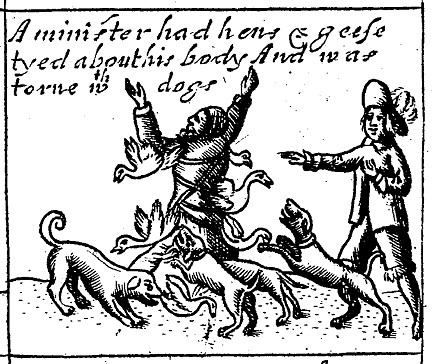
page 180 geeseHow long did it take them to tie those geese and hens on?

Undoubtedly martyrologies are a form of religious polemic and we shouldn’t assume that the atrocities they depict happened. As with all source material we must recognise the cultural dynamics that have shaped the content and presentation of the material. But of course we mustn’t assume that the viewing experience was the same for the early modern person. Early modernists were used to sub-standard or less accomplished woodcuts, and these visuals would presumably have represented the events they depicted to their imagination as effectively as a photograph does to us today. Early modern readings of these images would also have been informed by their own visceral experiences of religious violence – in the mid-seventeenth century, England had suffered about a 3.7 percent loss of population during the Civil Wars (more than during World War I, around 2 percent) and religious violence was part of everyday existence. Thus in their historical context, these images would perhaps have been just as affecting as Azadeh Akhlaghi recreations of Iran’s most notorious murders are to us today, though in the future they may also be seen as amateurish and slightly absurd.

The Author[1]

Samuel Clarke (1599-1682) was born in Sam Clarke headshotWarwickshire, the son of a vicar, and he grew up in a notably Puritan parish. He was well educated – first at Coventry school, and then Emmanuel College, Cambridge. In February 1626 he married Katherine Overton, with whom he had six children.
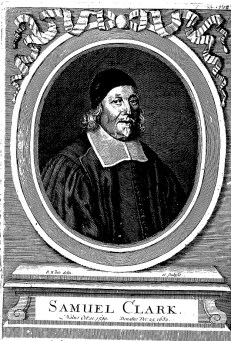
Following his education Clarke had a successful career as a clergyman. He was constantly in trouble for his nonconformity (his refusal to wear the surplice and omitting some of the ceremonies in the Book of Common Prayer), although he was pleased with the reformation that he achieved at Alcester in the 1630s – according to Clarke, as a result of his ministry the town ‘which before was called drunken Alcester, was now exemplary and eminent for religion’.[2]

Clarke campaigned against Laudian innovations in Church government and theology, and witnessed the suffering that the Civil War bought to the Midlands in the 1640s. In 1643 he moved to London, becoming minister at St Benet Fink and getting involved in London Presbyterian circles. In the 1650s he was a more moderate voice, prepared to work with the Cromwellian regime, and he initially welcomed the restoration of the monarchy in 1660. However, the religious settlement of 1662 was too conformist for Clarke’s tastes, and he was ejected from his position in the Church, along with two of his sons.

Excluded from the Church, Clarke then dedicated his time to writing and publishing works that would promote his religious beliefs, including A Generall martyrologie. Clarke specialised in compiling biographies, gathering his material from already published works and the manuscript writings of other godly ministers. His other works included: The Lives of Thirty-Two English Divines, appended to the third edition of A Generall Martyrology (1677) and Lives of Sundry Eminent Persons in this Later Age (1683).

[1] The information about Samuel Clarke is from: Ann Hughes, ‘S. Clarke (1599-1682)’, Oxford Dictionary of National Biography (OUP, 2004); online edn. May 2007 [http://0-www.oxforddnb.com.lib.exeter.ac.uk/view/article/5528, accessed 12 April 2014].

[2] S. Clark [S. Clarke], The lives of sundry eminent persons in this later age (1683), quoted in Hughes, ‘S. Clark (1599-1682)’.

I consulted all three editions of Clarke on Early English Books Online.
No place like home: Seventeenth-Century Portishead

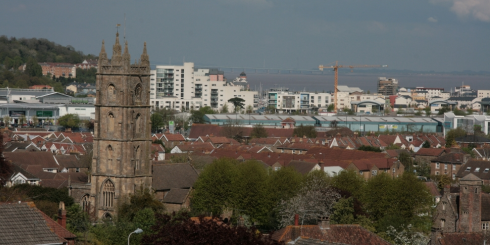
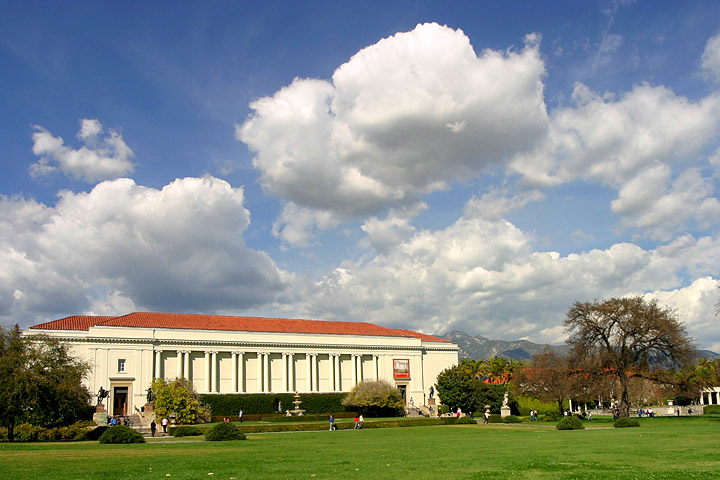
I suppose it is natural when you are on the other side of the world to turn your thoughts towards home. And so it is that on a trip to the Huntington Library in California (to attend this ace conference on ballads) I’ve felt inspired to write a post about my home town: Portishead in North Somerset.

The Huntington: A long way from home...

The Huntington: A long way from home…

One of the areas I focused on in researching alehouses for my forthcoming book was the county of Somerset, which has excellent quarter sessions records. Of course, as I scoured the archive looking for evidence of alehouse regulation and instances of good fellowship, I kept an eye out for references to my home town. I didn’t find much – it was no more than a small village before the Victorians adopted it as a seaside resort in the nineteenth century – but there were a few cases I came across which suggest something of the character of the place and its inhabitants. They don’t necessarily portray my ancestors in a positive light.

Home sweet home

Home sweet home

The first thing I discovered was the following order, made by the county magistrates, at a meeting of the Somerset quarter sessions in Wells, in 1656:

‘Whereas one Susan Gulston a poore cripple is lately come into the parish of Portishead in this County; and itt appearing that shee was last settled att Takeley in the County of Essex, this Court uppon complaint of the parishioners of Portishead doth order: That the said Susan bee retorned from parish to parish by the officers of each parish to Takeley aforesaid there to bee provided for according to lawe.’[1]

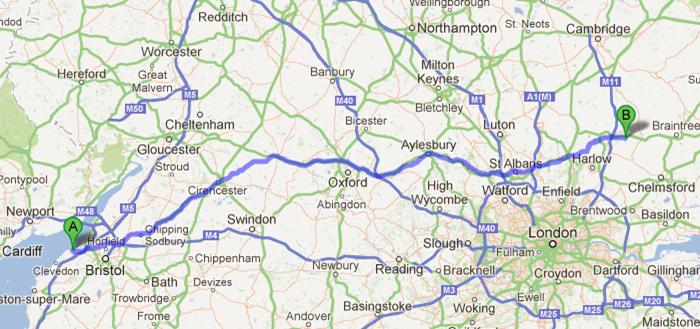
Basically, a poor crippled woman had turned up in the parish, and the locals did not want to be responsible for paying her poor relief. So they had asked that she be escorted from parish border to parish border all the way back to her home parish some 154 miles away to claim relief. That’s 51 hours of walking, according to google maps (assuming she stuck to the most direct A roads). That’s some walk, especially given that this poor woman was disabled:

The Long Walk Home

The Long Walk Home


The case doesn’t, I think, reflect particularly well on my Portishead forebears – but it is not by any means an untypical response to a poor stranger turning up in an early modern parish. As Brodie’s recent post on a 101-year old vagrant woman attests, the world’s first nation-wide welfare system was not necessarily a deeply compassionate one.

The next reference I found came from a meeting of the quarter sessions at Taunton in 1630. This time, the county magistrates were issuing an order that:

Fifty pounds be raised by a County rate and the money arising therefrom to be paid unto Rice Davies and Richard Cole, Esquires, to be by them imployed for and towards the transportinge of a greate number of Irish people from the parishe of Portishead.[2]

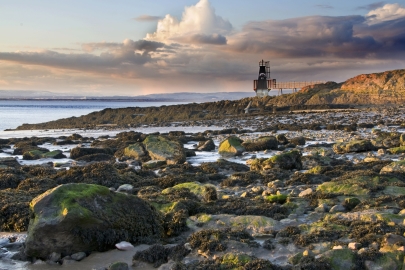
The precise details of what was going on here are not entirely clear, but it seems once again like a case of a cold Portishead welcome for outsiders – perhaps a group of Irish migrants had landed a ship at the beach in the parish, only to be apprehended by the locals who then asked for assistance to fund sending them straight back.

A stony welcome at Portishead beach?

A stony welcome at Portishead beach?

I was starting to fear that the only imprint left by my ancestral townsfellows on the historical records of the early modern period were a few cases of a pronounced, if not unusual for the period, lack of hospitality and compassion to outsiders – ‘local xenophobia’ if you will.[3]

Then I recently came across another reference rather more to my liking. In 1637, the churchwardens of Portishead – a local voluntary office whose duties included maintaining peace and good order in the community – were reported to their superiors for their tolerance of:

‘fives playeinge [an early racket sport like squash], dauncing, Cudgill playeinge [an early form of cricket perhaps?], and fightinge in the churchyard there’.[4]

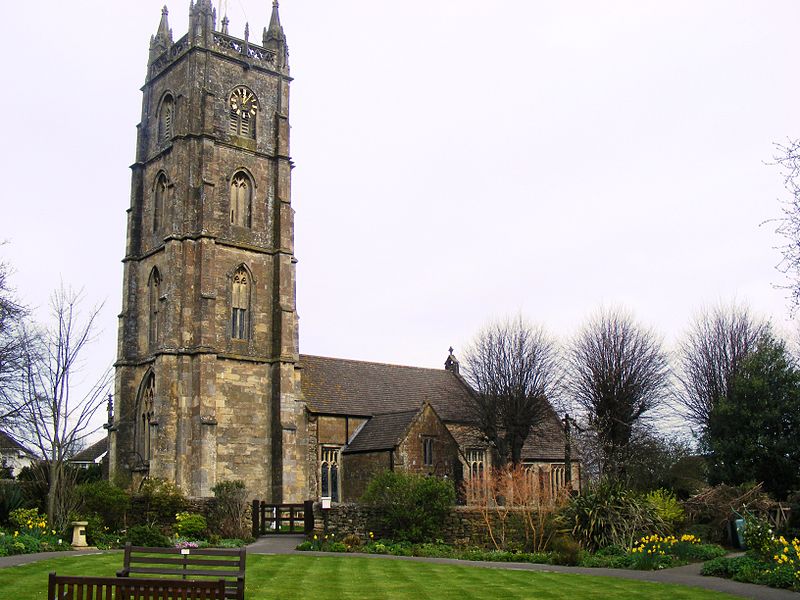
Since the Reformation, church authorities had worked hard to banish games and pastimes from taking place in the church grounds, as they sought to establish clear lines between the ‘sacred’ and the ‘profane’, and increase a sense of sober reverence in and around the church itself. But here were the parishioners of Portishead, having a merry old time in the churchyard, whilst local officials willingly turned a blind eye to this defiance of authority.

Fun and games at the parish church - now Grade I listed: http://en.wikipedia.org/wiki/Church_of_St_Peter,_Portishead

Fun and games at the parish church – now Grade I listed: http://en.wikipedia.org/wiki/Church_of_St_Peter,_Portishead

As Chris Marsh puts it, such ‘inveterate traditionalism’ was probably unusual by this date and these kind of activities had been largely suppressed. So here at last was something for me to hold on to: a sense of pride that Portishead had, albeit in a small way, played its part in the West Country’s long tradition of non-conformity and libertarianism. Even better, it sounds as though an afternoon of cricket, dancing and fighting was as popular in seventeenth-century Portishead as it is today.

* If anyone else happens to have come across a reference to seventeenth-century Portishead, please share it in the comments section.

[1] Bates Harbin, E.H. (ed.), Quarter Sessions Records for the County of Somerset, Vol. III, Commonwealth, 1646-1660 (London: Somerset Record Society, 1907-12)

[2] Bates Harbin, E.H. (ed.), Quarter Sessions Records for the County of Somerset, Vol. II, Charles I, 1625-1639 (London: Somerset Record Society, 1907-12)

[3] For more on the ‘culture of local xenophobia’ in early modern England see: Keith Snell, ‘The Culture of Local Xenophobia’, Social History, 2003, 28 (1), pp.1-30.

[4] The case is from REED (Somerset, p.207), though I encountered it through reading Chris Marsh, Music and Society in Early Modern England (Cambridge, 2010), p.375.

The many stages of writing: a personal take

Laura Sangha

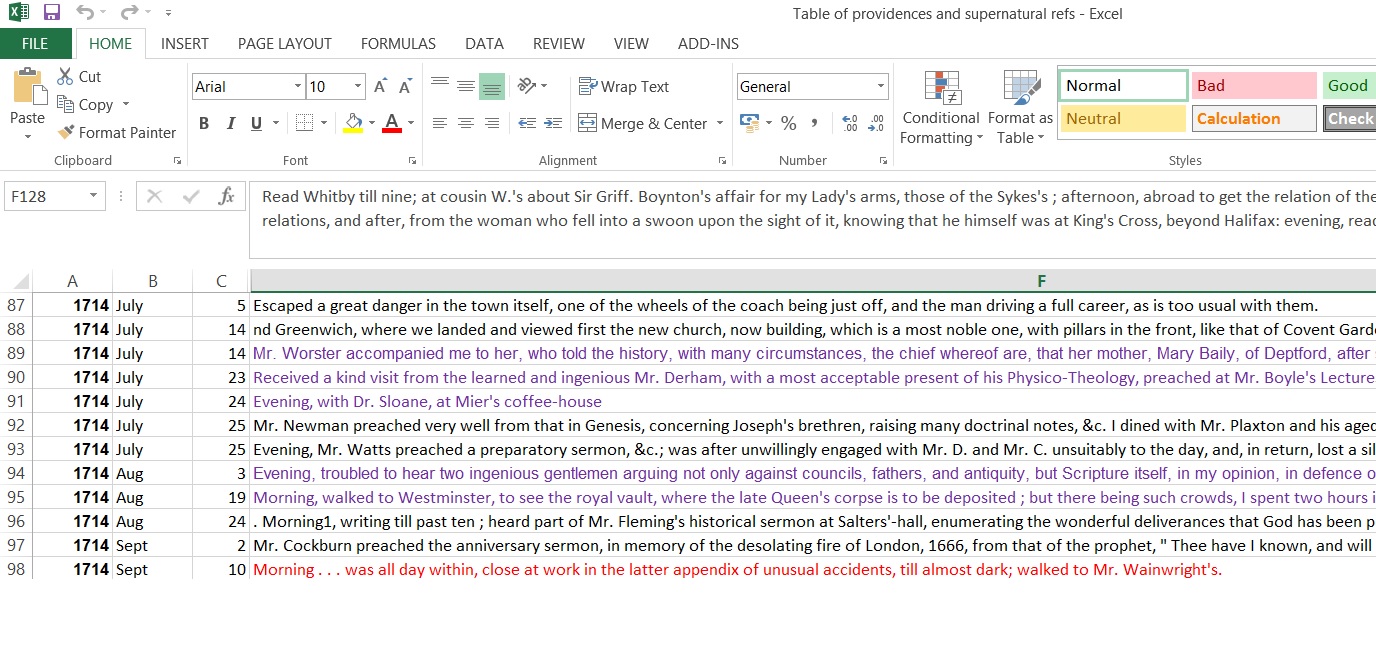
For the past few years, I have been asked to contribute to a postgraduate training session on ‘Preparing to write’ which I deliver jointly with a professor in the English department. It is something that I really enjoy doing, because it is a chance to compare my own experiences and practice with other researchers. And each year I am struck anew by the similarities in the way that we approach our research, as well the fact that there are always new techniques and ways of working out there that I haven’t considered. Whilst the English professor has a complicated system of index cards and quotations, I tend towards colour-coded excel spreadsheets, both of which methods have something in common with Keith Thomas’ labour (and envelop) intensive working practices. The informal and inclusive nature of the discussion of the training sessions are a great way to encourage reflection on our working practice, many of which seem to organically emerge and ossify throughout our training and early career.

Excel is currently my favourite note taking tool.

Excel is currently my favourite note taking tool.

Alongside thinking about preparing for writing, I have just bashed out my first paper on my new research into Ralph Thoresby, and found this blog post on what we might mean by ‘pace’ in writing incredibly useful for thinking about the processes involved. Recently Matt Houlbrook’s lyrical photo essay/ biography of a book chapter had also set me wondering just how similar our experiences are when it comes to writing. Does everyone feel the same deep unease [terror] when you open the new document and begin to formulate that first sentence? Or derive the same small comfort from putting the title at the top of the page, formatting it nicely, and saving the (as yet still blank) document to file? Why is it that I can only write 1,000 words a day, whether I have finished them by 11am, or 9pm, and does everyone have a ‘natural’ daily word limit? Is there an optimum number of jokey asides to include in a paper? And how do you turn off autocorrect in the latest version of Word?

With all that in mind, I thought I would be therapeutic to briefly summarise the main stages that I pass through when I am writing.

The dreaded introduction.

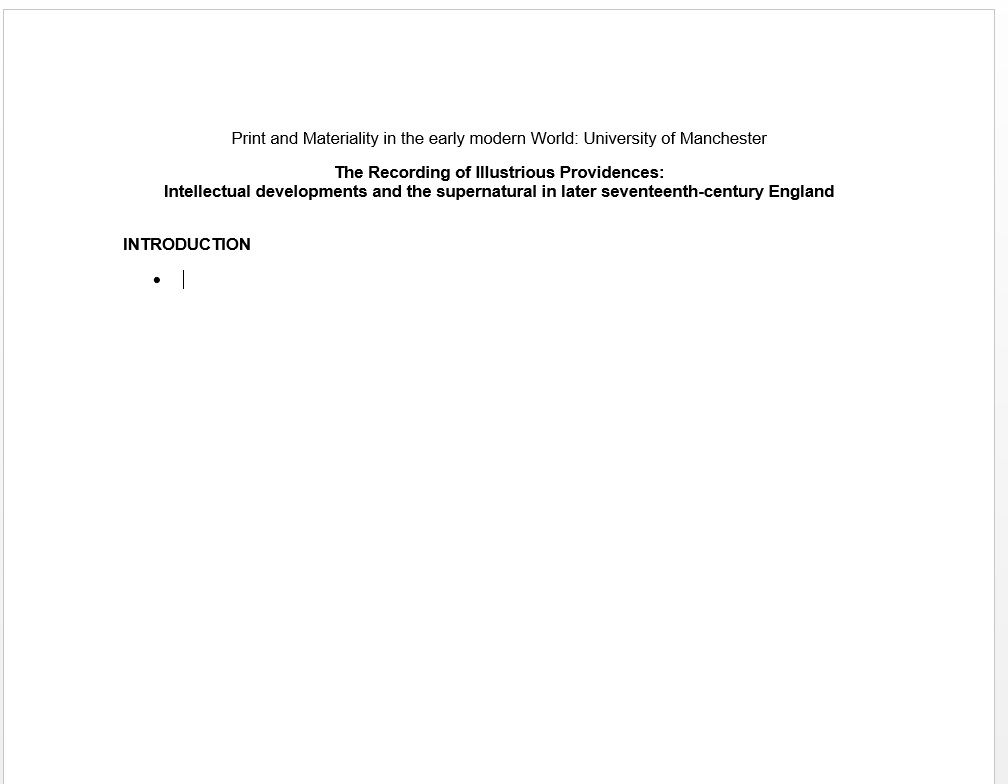
Undoubtedly my least blank docfavourite part of writing. The uncertainty, the weight of expectation, the fear that you have forgotten how to do it. The enormously intimidating existing scholarship and the huge pile of primary material. The plan that made sense when you wrote it but which is now an undecipherable mass of crossed out paragraphs, arrows pointing to nowhere, and an obscene number of question marks. NB. This entire post could have been written just about this point.

The false start.

Continuing the theme, the false start. You finally start getting something down, you pick your way through a particularly difficult bit of historiography, and you are feeling quite pleased with yourself. You stop for a cup of tea, and when you return, realise that you have 2,000 words of a 4,000 word paper, but you haven’t even mentioned the topic in the title yet. None of your 2,000 words are essential and most will need to be cut so you can actually address some of the important things. But the great news is: a false start is infinitely better than no start, and you can just deal with the editing later. NB. Save the original file because you might be able to use it somewhere else.

The comforting middle bit.

Before this post descends into paralysing misery, I usually find that once I get going, I tend to get into a groove and progress reasonably steadily. I generally target either a certain number of words each day (c. 1,000) or completion of a particular section from my plan. Attacking longer pieces of writing in bite sized chunks is essential and helps to make me feel accomplished every day, not just at the last. That said, there will inevitably be…

Possibly blasphemously, I also fondly think of the darkest day as the Slough of Despond [William Blake, Frick Collection New York].

Possibly blasphemously, I also fondly think of the darkest day as the Slough of Despond [William Blake, Frick Collection New York].

The darkest day.

There are lots of reasons for the darkest day, that day when your muse deserts you, and writing simply does not happen, or progress is so slow that an outsider wouldn’t notice it. For me it is usually when I am tackling a bit that is tricky conceptually, or if I am trying to synthesise and reduce something rather complicated into a manageable and not too distracting size. After hours of furrowing my brows, picking up and putting down books, groaning, re-reading articles, chewing my fingernails, cutting, pasting, and standing up to look out of the window, I usually have something useable. That’s the moment I save those precious 300 words, put my whip down, and leave that dead horse alone.

The race for the finish.

Finally, your steed has miraculously revived, the wind is in your hair, and you are heading into the final straight! Everything is great. You have crossed out the majority of your plan, you have discarded all the boring and inessential parts, you have mastered that horrible bit about predestination. You are so excited about finishing you write two sections in one day. Your conclusion is so close you can smell it. Your examples are fitter, your jokey asides are funnier, your analogies more similar, and your argument more persuad-ier. It turns out that dreaded introduction was worth it after all. Now – to the pub*!

*It is important to celebrate your accomplishments, but please drink responsibly.

Norwich Entertainments – Part VII: The science of music

Brodie Waddell

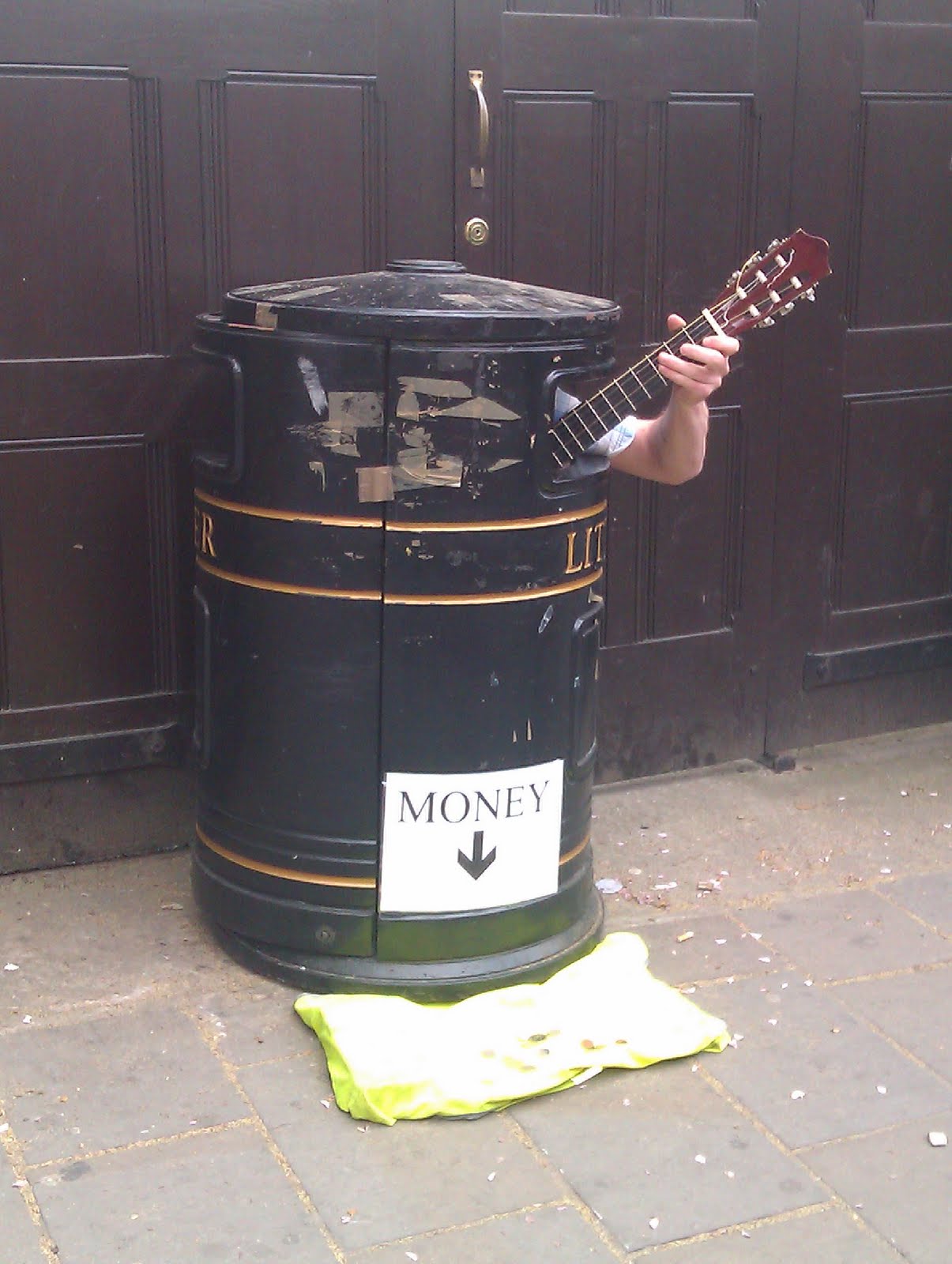
I live in Cambridge, a well-touristed little town, and when the sun is out the streets are Cambridge bin buskerawash with buskers. Some are quite good. For instance, there’s the chap who strums tunes on his guitar from inside a litter bin who always makes me chuckle even when his playing isn’t brilliant.

But there are also some that are decidedly displeasing to the ear. If only – I find myself muttering – these unmusical musicians had been sufficiently trained in the science of music. Continue reading

Elizabethan ‘madmen’ Part I: Not such a Virgin Queen; or, that’s one DNA test I’d like to see the results of!

Jonathan Willis

This post is the first in what may (or may not) become an occasional series about the ravings of assorted Elizabethan ‘madmen’.  This is a topic I’ve become quite interested in recently, after stumbling over some fascinating letters in the state papers.  This has nothing to do with a desire to procrastinate because I need to start writing up my monograph on the Ten Commandments.  Nothing at all…

Anyway, the letter I want to talk about today is one I came across quite accidentally because of its proximity to another letter which I have been using in my teaching and research.  The calendar entry for said letter reads as follows:

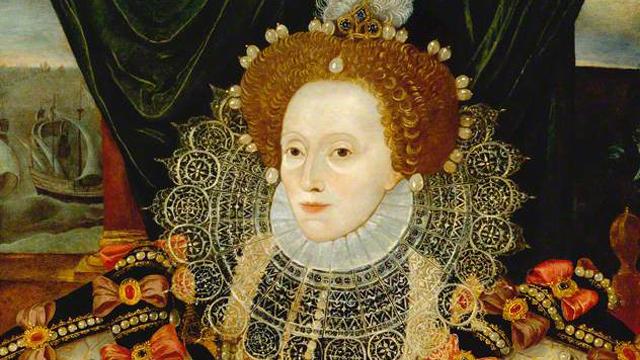
Miles Fry, a madman (who calls himself Emanuel Plantagenet), to Lord Burghley; saying he has an embassage from God to the Queen his (Fry’s) mother, he himself being the son of God and Queen Elizabeth, but was taken from her by the angel Gabriel and carried to one Mrs. Fry to be kept by her for a time, June 28, 1587.

A small amount of digging confirms that the letter is certainly not unknown to history or historians: other than its presence in the catalogue of the Lansdowne MSS, it also features in Henry Ellis’ nineteenth century edition of Original Letters, Illustrative of English History, and it merits a (very) brief mention in Christopher Haigh’s important biography of Elizabeth I.  Still, the letter was new to me, and I expect that the contents are unfamiliar to all but the geekiest Tudorphiles.

Miles Fry's mother?

Miles Fry’s mother?

The letter itself is relatively brief – just over half a single side – and, for a ‘madman’, Fry has a style which is lucid and concise, and a hand which is surprisingly legible to the modern reader (it beats most Tudor churchwardens’ accounts, that’s for sure!).  The concision and neat appearance of the letter, however, belie its extraordinary contents.  Addressed ‘To the right honourable the lord burley, lord tresorar of the queen of england’, it begins:

My lord I am sent an embassador from god the father unto the quenes highness to declare unto her that I am the sonne of the both…

Now that is an episode of Jerry Springer I would actually want to watch!  Fry explained to Burghley that, after his birth he was taken from Elizabeth to ‘one mistres ffry’ by the angel Gabriel ‘for to be kept’; but that ‘the time of this keeping is ended’, and that Fry had been sent by God to reveal himself to his mother.  His true name revealed both his royal and divine origins, for he signed his letter off, ‘your honors to use emanuel plantagenet’.  For Christopher Haigh, the significance of this event lay in the fact that ‘the official image of Elizabeth as virgin mother of her people … seems to have been effective – even if it was taken too literally by some’.[1]  That is certainly true.  Fry explains that he writes his letter because he is ‘in great extremity and redi to perish for lak of helpe’.

Definitely a case for Jerry Springer...

Definitely a case for Jerry Springer…

His divine ‘embasage’ and royal birth, however, mean that Fry also demanded a personal audience with the Queen.  He was nothing if not persistent.  In his letter to Burghley, he explained that he had made first made a similar plea to Sir Francis Walsingham some four years previously, and that Walsingham had ‘promised to helpe me unto the queen but did it not’.  In the intervening time, Fry wrote letters to the queen herself, assorted members of her counsel, and again to Walsingham, with whom he even claimed he had spoken ‘at divers times’.  Leaving aside the contents of his communications, this tale highlights the extraordinary ease which ordinary people could speak to the powers-that-were in Tudor England, even if they could not necessarily expect a response.

And not that his letters did Miles Fry much good.  As he lamented, ‘I am so far from helpe of my ladi that I have not the favour of a subiect in her relme thou I be her sonne: and during this sute I have bin hardli used’.  This, he explained to Burghley, was his last attempt to force the Queen ‘to accept me for her sonne’.  Thirty-five year old Miles was the (adopted?) son of John and Jone Fry, and he claimed that Burghley knew John Fry ‘wel’.  The Fry clan lived near Axminster in Devon, and Fry (writing from ‘the signe of the rose and crowne in Saint Johns street beyond smithfelde in london’) explained that it was not convenient (and it was too expensive) for him to remain in the capital for long.  The consequences of refusing to help him, Fry threatened, were not only that ‘immediatli upon my returne thither I shal end my life’ but that, as a consequence, god would ‘punish this land’.

Fry’s embassy was not only one of family reunion and material aid, however.  He explained:

My calling is not to redeme the worde but to shewe the end of generation and the love between christ and his church: which Salomon began to do and did it amisse…

History does not record the fate of Miles Fry, a.k.a. Emanuel Plantagenet.  Dismissed by the state papers as a ‘madman’ and ‘distempred in his wytts’, we can be fairly confident that his plea was also dismissed by Burghley, and it seems unlikely that a story with such a sad beginning can have had a very happy ending.  Fry was clearly a somewhat disturbed character, but it seems likely that the fiction he created was, in part at least, a response to an extremely difficult reality.  His misguided insistence that he was the queen’s son was juxtaposed several times with the desperate plea that he was not even being treated as favourably as ‘the quenes pore subiects’.  Perhaps because of the realisation that his life was of such little value that the threat of suicide was no threat at all, Fry attempted to gain greater leverage by appealing to a providential framework, in which a failure to treat him with charity would bring down the wrathful judgement of his divine progenitor.  In many respects Fry had a lot going for him: he was literate, educated, and possessed the wherewithal to make the one-hundred-and-fifty mile trip from his home to London (indeed, it seems likely that he had made the 300 mile round trip several times before).  He knew not only how to write, but also who to write to, even if his attempts to persuade were clumsy and heavy-handed.  Goodness only knows what his elderly parents made of their son’s delusions, but if we ever needed more evidence that ordinary people in Tudor England could be just as troubled, complex, thoughtful and pathetic (in the sense of arousing compassion) as in society today, then we have it in Miles Fry.


[1] Christopher Haigh, Elizabeth I (London: Pearson, 1998), p. 161.

The 100th Post

You are currently reading post number 100 on the many-headed monster. On realising this (statistically) significant event was approaching, we monster heads decided it would be worth marking in some way. The blog has been enormously rewarding as an arena to think through our ideas and to share our archival discoveries, but also as a way to connect with you, the reader. Since our first post in July 2012, we have had more than 40,000 views and 541 comments, and we are enormously grateful that so many people have read our musings and engaged with us on the blog. Thus, this is a round-up of some pearls from the blog archive: our most popular posts, collectively and individually,  alongside a nominated personal favourite from each contributor. Enjoy, and we look forward to continuing to work with you in the future!

Our heaviest traffic on the ‘monster comes from the ‘The Future of History From Below Online Symposium’, a collection of multi-authored papers based on two conferences on the topic. For the heads, this has become an important resource for research and teaching, and was also responsible for our busiest day in July 2013 when we received a spectacular 481 views.

Mark Hailwood

Most popular post: The Immersive Turn: Or, what did a seventeenth-century drinking song sound like? (Nov. 2013)

Nominated post: “many of my favourite ‘monster posts are those that have generated a lot of debate about aspects of ‘the craft’ – digital v archival sources; the use of jargon etc – but the post I would like to nominate here does something rather different: it’s one of Brodie’s ‘Norwich Entertainments’ series, ‘Ballad-singers and dangerous news, with coffee‘ (Nov. 2012). Historians of early modern England now make a lot of use of printed materials like ballads and pamphlets, but we know less than we would like about their dissemination and consumption. This fascinating little post provides us with some valuable insight into the social history of print in an early modern city.”

Laura Sangha

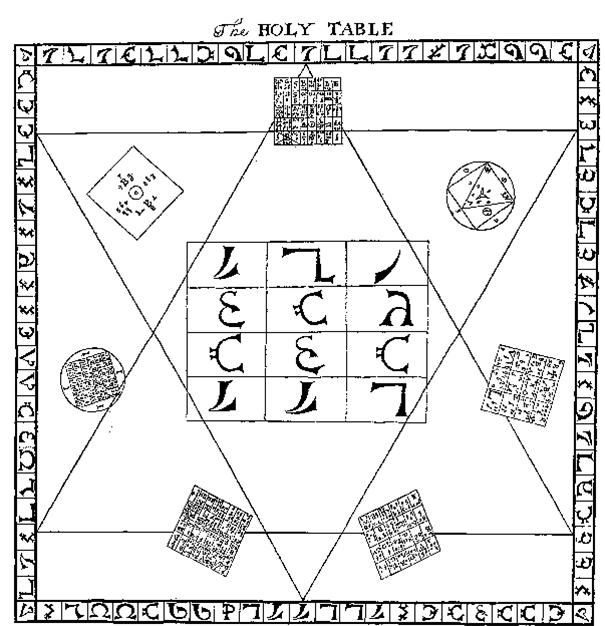
Holy TableMost popular post: John Dee’s conversations with Angels (Nov. 2012)

Nominated post: “Jonathan’s Idols of the mind, or What does God look like? (June 2013) tackles a ticklish question: how did people in the past visualise God? The delightful post explores this central and controversial aspect of the early modern mentality, taking in some wonderful illustrations along the way.”

Brodie WaddellDante_Gabriel_Rossetti_-_Fair_Rosamund

Most popular post: Norwich Entertainments – Part III: A medieval royal mistress in the 17th century and beyond (Aug. 2012)

Nominated post: “Laura’s two History and Analogy posts (Sept. 2013). A light-hearted look at one of the least-discussed but most-important aspects of historical writing and teaching. Some of the examples, including some offered in the comments, got me chuckling.”

Jonathan Willis

david-starkey_2622826bMost popular post: Tudor history on TV, and a partial review of David Starkey’s ‘Music and Monarchy’ (Aug. 2013)

Nominated post: “Mark’s three-part ‘Workers Representation’ series. As someone who’s worked on ballads primarily as musical and textual artefacts (and for the evidence they provide about religious identity), the use of ballad images for information about occupational identity had never really occurred to me and these are a fascinating series of discussions. If I had to pick just one of the three, I think I’d go for ‘spinning a yarn’ (Sept. 2012): one of my favourite quotes has to be ‘a woman of lower or middling status didn’t need to wear the highest quality clothing to win a man’s heart – she needed to be able to make it’.”

Measuring misery?

Brodie Waddell

In the late sixteenth century, the famed Elizabethan poor laws commanded every parish in the kingdom to relieve their poor residents though local taxation rather than private charity. By around 1800, England’s parishes were spending more than £4 million per year on poor relief.

One of my current research projects is an attempt to examine the nature of this massive expansion in formal, institutional support for the most vulnerable members of the community – that is to say, the rise of the so-called ‘parish welfare state’. I’ve been doing this by looking at the amounts spent by local officers – the overseers of the poor – in a set of sample parishes from across the country. Jonathan Healey at Oxford has been doing much the same, and we have recently decided to work together, combine our data and attempt to come up with a new analysis of this oft-noted development.

I will be discussing some of the early findings from this project at a talk on Friday, February 28th, at the Institute for Historical Research in London, so please do come along if you are interested. However, I thought I might offer one image from the talk here as I think it raises some potentially interesting questions.

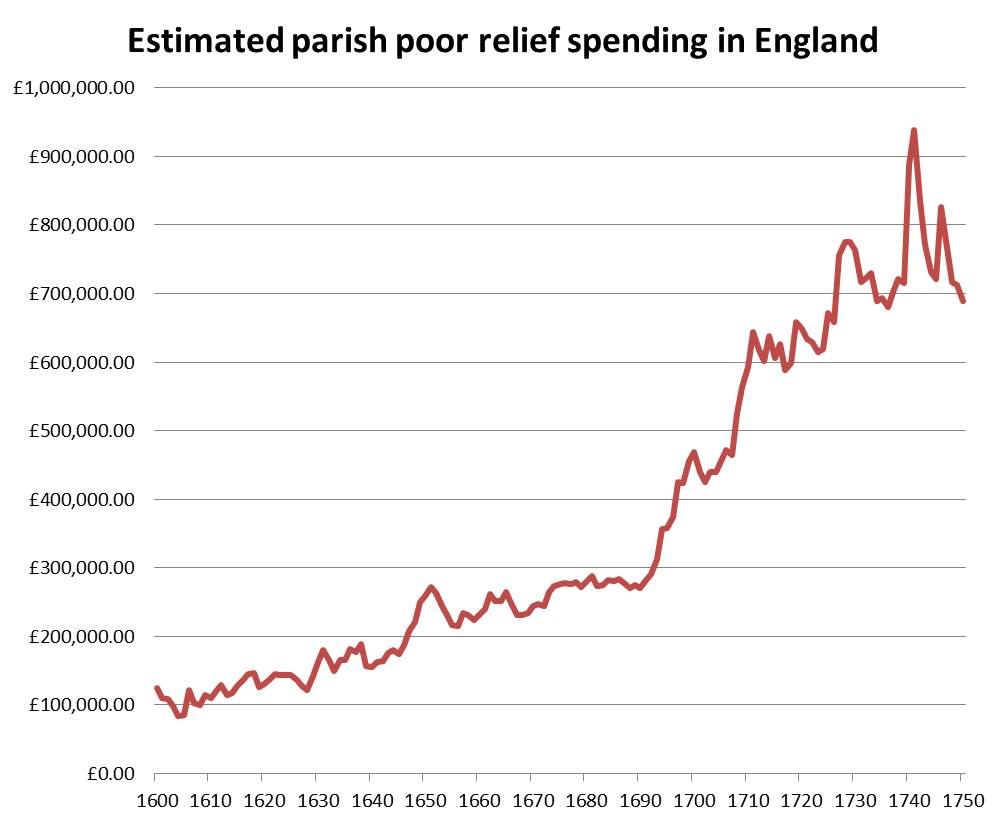
Poor relief spending, 1600-1750 (81 parishes, 24-02-14)What you see above is an estimate for national annual spending on poor relief based on my sample of 81 parishes. There are some significant methodological problems with these estimates – especially for the first few decades – that I will discuss in my talk. But, for the sake of argument, if we assume that this is actually an accurate measure of relief spending in England, the question then becomes: What does this tell us?

It seems to tell us that there was not simply steady growth in relief in the 17th and 18th centuries. Instead, we see periods of extraordinary expansion, of stability and of retrenchment. We also seem to see a shift in the trajectory of the rise sometime in the decades around 1700, when growth seems to have accelerated markedly.

Yet, this graph is also extremely opaque. There is much that it does not tell us.

For example, what about non-parochial poor relief, such as formal charitable bequests or informal personal giving? Did this follow a similar pattern? Or was it working in the opposite direction?

What, too, about regional differences? Was there similar growth in sleepy country villages as in booming industrial towns?

Even more significantly, this graph tells us little about why parish welfare was expanding in this period. Although we can speculate based what we know about the periods of greatest expansion, the raw numbers in themselves cannot reveal short-term economic pressures or changing legal contexts.

Finally, and perhaps most importantly, this bare line may obscure the nature of relief, which was after all a relationship between human beings who normally knew each other – not simply an anonymous financial transaction.

Did those who received relief actively demand it or passively accept it? Did those who distributed it do so gladly, grudgingly or fearfully – as an act of Christian charity, or out of mere legal obligation, or to stave of the threat of disorder? Was such relief considered the poor’s rightful entitlement? Or was it conditional upon their obedience and reputation for morality?

In other words, whilst this chart may offer a useful bird’s eye view of the emergence of perhaps the world’s first nation-wide welfare system, its lack of a human dimension may also actively mislead us about the nature of this system. For that, we must look to records in which real individuals – such as Mary Stevens, the 101-year-old vagrant – step out of the page to meet us.

Acknowledgements

The 81 sample parishes upon which the chart is based include 24 whose totals were generously provided by other historians. I am therefore very grateful to the late Joan Kent via Steve King (for 9 parishes), Henry French (7 parishes), Jeremy Boulton (3 parishes), Tim Hitchcock & Bob Shoemaker (2 parishes), John Broad (2 parishes) and Steve Hindle (1 parish). If you or any of your colleagues have data on parish poor relief before 1834 that you are willing to share, please get in touch!

Fantastic Thoresby – Part III: historic storms, floods and corpses washed out of graves

Laura Sangha

This post is part of an occasional series on antiquarian, topographer and dissenter Ralph Thoresby (1658-1725).

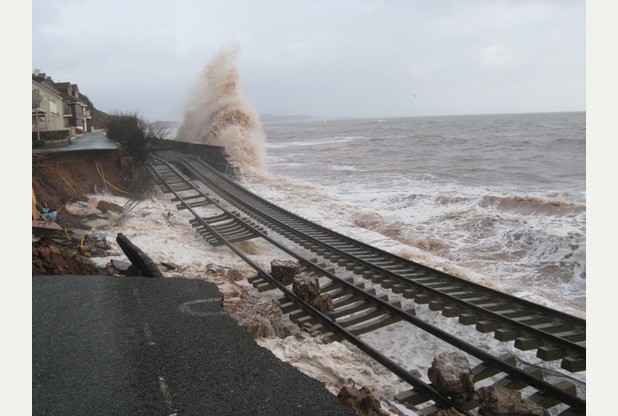
dawlish railwayIt’s been a little wet in the south of England this winter, as some of you may have noticed. Storm has followed storm, houses have been flooded, villages cut off, and here in the south west the railway at Dawlish washed away. This has precipitated a deluge of news stories dragging out all sorts of beloved clichés as the media bandwagon has careered on its merry way. Predictably a political row about the causes of flooding has erupted where Conservatives have blamed Labour for previous policy mistakes and Labour have accused the government of ignoring climate change. But the storms have proven to be a delightfully flexible concept, allowing for commentary on all sorts of social issues, including: the storm blitz spirit, the storms and austerity, the storms and the royal family, the storms and the proposed high speed rail link, the storms and the under-equipped army, and my personal favourite, the storms and the mysterious case of the python that was battered to death in the night-time.

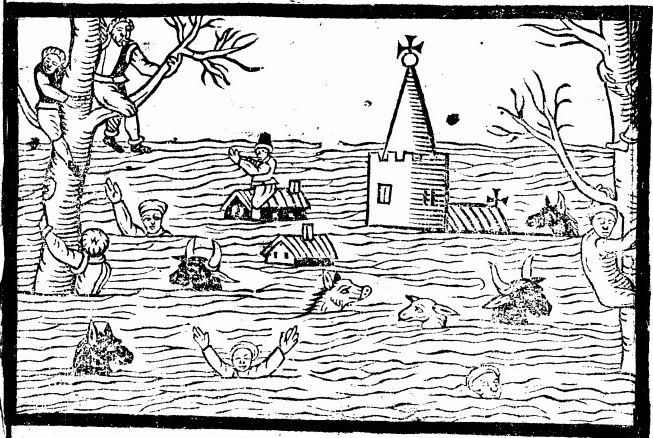
1607 FloodPerhaps more interestingly, the storms have also prompted some writing on historic bad weather and its consequences – I am sure I am not the only early modern historian who was delighted to see a seventeenth century woodcut on the front page of the Guardian’s website on February 12. We were also offered some timely musings on Daniel Defoe’s The Storm, his memorial to the hurricane that pummelled northern Europe in 1703, and this blog on eighteenth-century ‘climate change advocates’ provided some interesting historical context. Continue reading

Mary Stevens, vagrant, age 101

Brodie Waddell

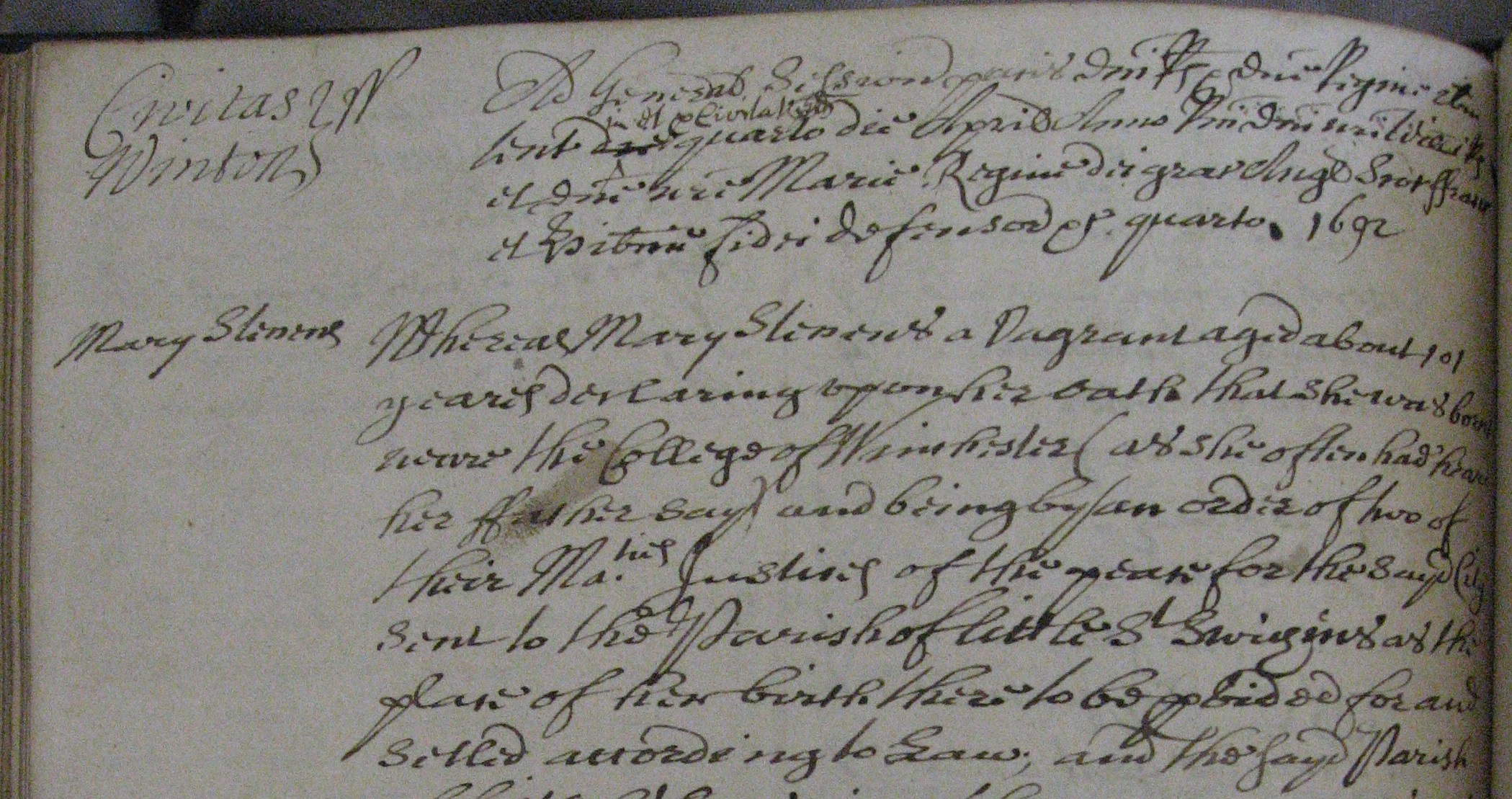
On the fourth of April 1692, the city fathers of Winchester assembled at one of their splendid quarterly courts to judge criminals, hear disputes and resolve pressing civic concerns. As was often the case, one of the poor souls who found herself standing before them was an alleged vagrant. The magistrates probably examined dozens of vagrants in a typical year, but this one was a bit different – she was over 100 years old.

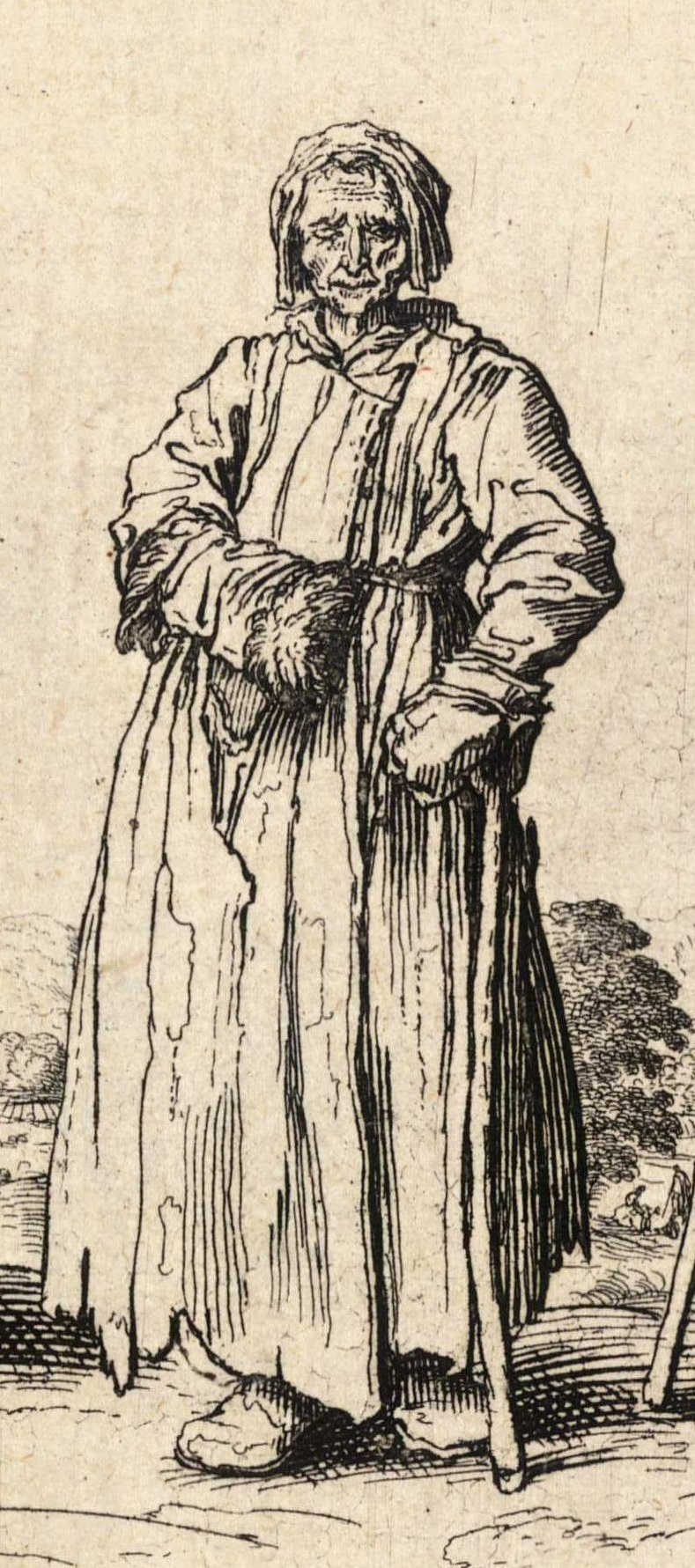
From Wenceslaus Hollar, ‘Men and Women Beggars’ (1625-77)

From Wenceslaus Hollar, ‘Men and Women Beggars’ (1625-77)

The clerk described her as ‘Mary Stevens a Vagrant aged about 101 yeares’ and noted that she swore ‘upon her oath that she was born neare the College of Winchester (as she often had heard her Father say)’.

In other words, this was a woman had apparently been born sometime around 1591, in the final decade of the reign of Elizabeth I, only a few streets away from the court where she now stood. She had outlived four monarchs and Oliver Cromwell. She had survived a decade of civil wars, another decade of republican rule, the country’s last great visitation of the plague, and then yet another revolution only three years earlier. And, given her description as a ‘vagrant’, she had probably spent many months or years on the road and seen the effects of these upheavals with her own eyes. Yet here she was, back in Winchester.

So why had she come back? The examination does not tell us. Perhaps she had come on her own accord. Or perhaps had been sent back from somewhere further afield, whether a neighbouring village or halfway across the country.

This wouldn’t have been unusual. Beggars and paupers were regularly seized by the constables and brought before the local Justices of the Peace. If they were accused of ‘vagrancy’ – a criminal offence usually defined as ‘wandering and begging’ – they could be punished by whipping or imprisonment in the local house of correction, before being expelled to their place of birth. In other cases, they might be defined as one of the ‘deserving poor’ and escape punishment, but still be sent to a ‘home’ they had long-since abandoned.

What we do know is that once Mary Stevens had arrived back in the area, she was then sent back and forth between the city of Winchester and the parish of ‘little St Swigins’ (St Swithuns) next to Winchester College, presumably just outside the city’s jurisdiction. Neither the city nor St Swithuns wanted to pay the cost of supporting her.

We can only hope that the new order issued by the Winchester authorities – sending her to St Swithuns ‘to be provided for and setled according to Law’ – was the conclusion of this petty jurisdictional argument. There she may have finally become a ‘lawfull & settled Inhabitant’.

With luck, Mary Stevens’ days of ‘wandering and begging’ were over. At age 101, she deserved a rest.

Mary Stevens, vagrant, age 101 IMG_3977Source
Hampshire Record Office, W/D3/1, fol. 79: examination of Mary Stevens, 4 April 1692

Some Further Reading
A.L. Beier, Masterless Men: The Vagrancy Problem in England 1560-1640 (1985)
Steve Hindle, On the Parish? The Micro-Politics of Poor Relief in Rural England, c. 1550-1750 (2004)
David Hitchcock (ed.), ‘Poverty and Mobility in England, 1600-1850’, Rural History, 24:1 (April 2013), special issue.
Tim Hitchcock, Down and Out in Eighteenth-Century London (2004)

The Tudor South West at Exeter’s Royal Albert Memorial Museum: Part 5 – Parting thoughts

Laura Sangha

This is the fifth post in a week long series about an exhibition at Exeter’s museum.

In this final post I offer some brief parting thoughts on the success of the exhibition as an exploration of a complicated and dynamic society.

A skilled society

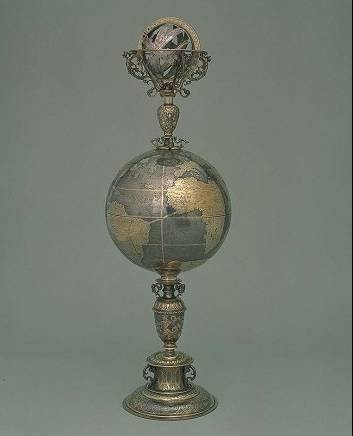
It was clear that this was a highly creative drakes cup editsociety, with many accomplished practitioners of the arts and crafts. Perhaps this is overemphasised by the very nature of museum exhibitions that are likely to contain a preponderance of manufactured objects and paintings, but that does not detract from the quality of the items on display. There are more prestigious objects such as the Drake Cup (c. 1595). By tradition it was given to Drake by Elizabeth I after he circumnavigated the globe, its silver gilt engraved with a map of the world, complete with names of continents, islands and seas in Latin, plus sailing ships, whales and dolphins. Its hard to imagine anyone actually drinking out of this (it’s enormous and unwieldy for a start), but the same is certainly not true of more everyday objects such as the glazed stoneware drinking vessels and delicate silver spoons also in the collection – whilst important indicators of status and often treasured family possessions, these items were made to be used, not rest on a shelf.

An intellectual society

As ever, I am left to marvel at the intellectual sophistication of people in the distant past, in an era that most people now would think of as the technological dark ages. In terms of intellectual activity the pre-modern period was not backwards or uncivilised, this was a society that exhibited civic pride (for more see day 1: a map of Exeter), where renaissance style and learning was spreading, and where important topographers (such as mapmaker John Norden) and antiquarians (such as Richard Carew) were beginning to make their mark. Another nugget that I learned at the exhibition – Sir Thomas Bodley, the founder of Oxford’s Bodleian library, was born in Exeter.

A Protestant society

As a religious historian I am particularly sensitive to the Protestantism that underpins late Tudor society, but I think few historians would disagree that the Reformation’s repercussions were also to be cathedralfelt in every sphere of daily life. From the goldsmiths who prospered when reshaping church plate for a new liturgy (for more see day 3: a Devon communion cup), to the soldiers engaged in an epic struggle against the antichrist and international Catholicism (for more see day 4: the Spanish Armadas), to those for whom scripture became deeply embedded in their ways of expressing themselves and in guiding their everyday activities (for more see day 2: domestic decoration), Protestantism was key. We can’t even begin to understand this society without considering it.

An ambitious society

On his talking tour, exhibition curator and Exeter Professor Sam Smiles described Francis Drake as the Neil Armstrong of his age, and the analogy struck a chord with me that kept reverberating. Partly because it immediately suggested the celebrity of the man – how many contemporaries knew Drake’s name? Current scholarship has a tendency to be picture-astronaut-walking-legsceptical about the importance of exploration for sixteenth century societies, with claims that few people were aware of new discoveries which made little impact on ordinary people’s lives. But the Armstrong analogy is intriguing because of what it suggests about the mentality of the Elizabethans. Clearly some were ambitious, self-confident, cocky even, heading into the unknown on the uncertain hope of economic rewards and a boost for their honour and all important reputation. This was a society where political success and innovation or entrepreneurship were occasionally linked. And it is undoubtedly true that whilst precedent, custom and tradition were revered this was not to the exclusion of novelty.

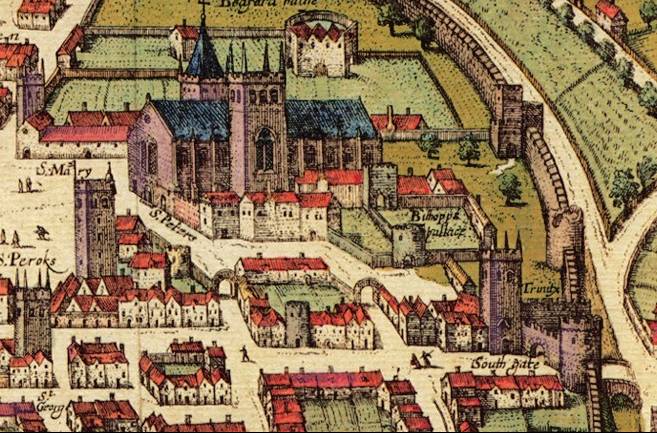
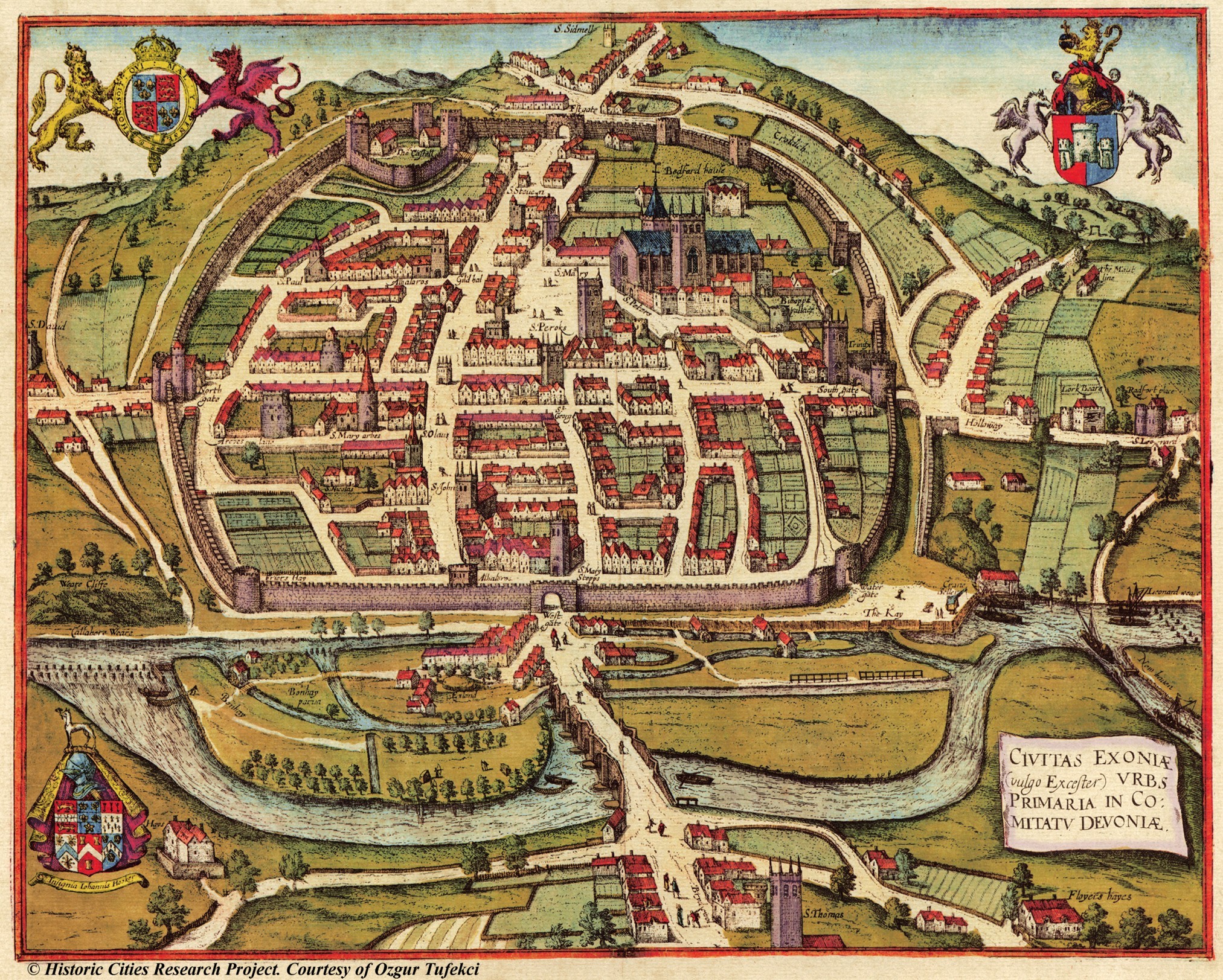
Two maps in the exhibition really capture this duality. The first is the map of Exeter that I discussed in my first post.

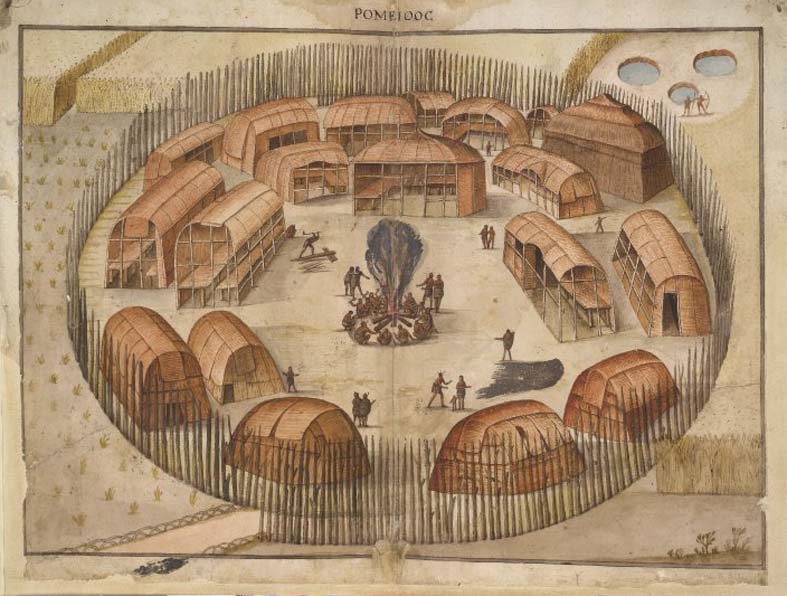
braun_hogenberg_VIThe second is a map of the North America village of Pomeiooc, on Roanoke Island (1585-93).

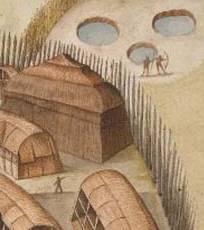
the-village-of-pomeiooc1Placed next to each other, the similarities between early modern Exeter and Pomeiooc are striking. Pomeiooc is presented as a well ordered settlement, encased in a wooden palisade for defence, it’s inhabitants are hunters, fishers and farmers. Sophisticated visual techniques are again on display – some of the houses are ‘cut away’ to reveal their inner organisation, and there is even a chap practising his archery by the fishing pools in the top right corner, just like in the map of Exeter. As before, this might tell us just as much about the European who painted the map as it does the native Americans that it depicts. It might reveal the tendency of archerEuropeans to impose their own understandings and framework on the new cultures and societies that they encountered in far away places. It might be propaganda, designed to support overseas settlement by enticing potential settlers to the New World – like Exeter, Pomeiooc looks like a productive and fertile community (though I do wonder, what is that wooden fence keeping out…?). It certainly suggests that not all Europeans dismissed these people as barbaric savages, and that they could identify similarities between their own society and non-European counterparts.

An impressive society, an excellent exhibition

All in all, I was deeply impressed by both the achievements and complexity of the Tudor south west, as well as the exhibition’s capacity to capture and explore it. The Golden Age is here in all it’s glory – crafts, art, architecture, entrepreneurs, discovery, military triumph, intellectual development.

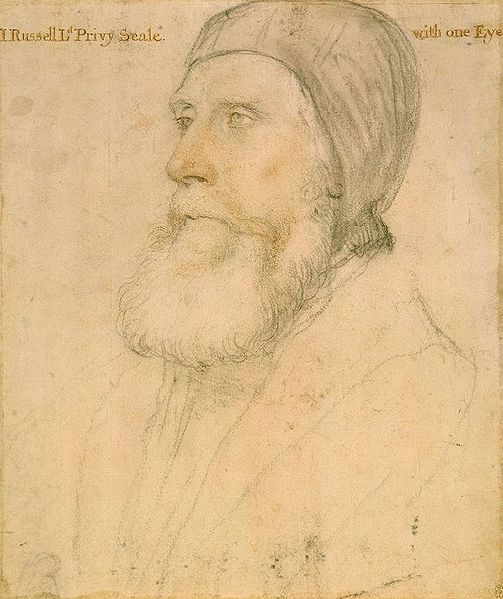
My only remaining niggle is that the difficulties, the struggles and the violence of the age are largely absent. Here we see the middling and upper sections of Elizabethan society, but these objects are largely silent about the lower sorts, the people suffering in the hardships of the 1590s, the people resisting religious change and suffering due to economic trends. We do come face to face with Lord John Russell, 1st earl of Bedford,John_Russell_Earl_of_Bedford_Hans_Holbein_the_Younger in a sketch by Holbein the younger. Russell was in charge of the forces that brutally suppressed the West Country or Prayer Book Rebellion in 1549, slaughtering hundreds in a number of bloody encounters around Exeter. But here his image must serve as the only reference to the scars left on the south west by that tragic rebellion. Of course, it would be strange to linger on these more troubling aspects of the period in an exhibition that is intended as a pointer to the south west’s ‘manifold contribution to the Tudor age’, and these comments are not intended as a (horribly unfair) criticism of the exhibition. They are included here as representative of my worry that perhaps there is too little space for the lower sorts in our museums and a reminder that we should fight hard to make sure they can find a place.

In summary, this is undoubtedly an excellent exhibition that certainly fulfils its remit of revealing the intellectual, artistic and economic importance of south west in the Tudor Age. The sophistication of this society is perhaps the most striking impression that one is left with: despite being a geographically-peripheral region, this was by no means a provincial backwater. Head to the RAMM to see for yourself.

‘West Country to World’s End: the South West in the Tudor Age’ runs until 2 March 2014 at Exeter’s Royal Albert Memorial Museum. You can find all the details about the museum, it’s opening times, it’s wonderful café and more here