The Tudor South West at Exeter’s Royal Albert Memorial Museum: Part 5 – Parting thoughts

Laura Sangha

This is the fifth post in a week long series about an exhibition at Exeter’s museum.

In this final post I offer some brief parting thoughts on the success of the exhibition as an exploration of a complicated and dynamic society.

A skilled society

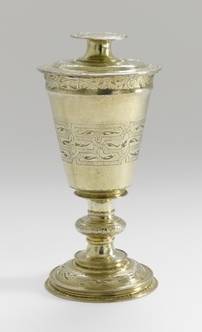
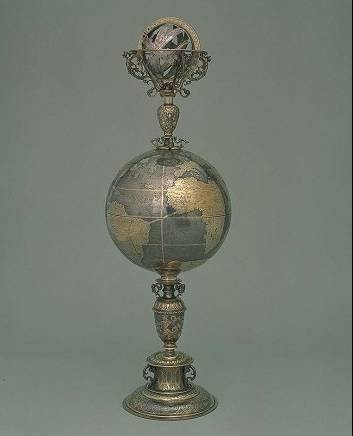
It was clear that this was a highly creative drakes cup editsociety, with many accomplished practitioners of the arts and crafts. Perhaps this is overemphasised by the very nature of museum exhibitions that are likely to contain a preponderance of manufactured objects and paintings, but that does not detract from the quality of the items on display. There are more prestigious objects such as the Drake Cup (c. 1595). By tradition it was given to Drake by Elizabeth I after he circumnavigated the globe, its silver gilt engraved with a map of the world, complete with names of continents, islands and seas in Latin, plus sailing ships, whales and dolphins. Its hard to imagine anyone actually drinking out of this (it’s enormous and unwieldy for a start), but the same is certainly not true of more everyday objects such as the glazed stoneware drinking vessels and delicate silver spoons also in the collection – whilst important indicators of status and often treasured family possessions, these items were made to be used, not rest on a shelf.
An intellectual society

As ever, I am left to marvel at the intellectual sophistication of people in the distant past, in an era that most people now would think of as the technological dark ages. In terms of intellectual activity the pre-modern period was not backwards or uncivilised, this was a society that exhibited civic pride (for more see day 1: a map of Exeter), where renaissance style and learning was spreading, and where important topographers (such as mapmaker John Norden) and antiquarians (such as Richard Carew) were beginning to make their mark. Another nugget that I learned at the exhibition – Sir Thomas Bodley, the founder of Oxford’s Bodleian library, was born in Exeter.

A Protestant society

As a religious historian I am particularly sensitive to the Protestantism that underpins late Tudor society, but I think few historians would disagree that the Reformation’s repercussions were also to be cathedralfelt in every sphere of daily life. From the goldsmiths who prospered when reshaping church plate for a new liturgy (for more see day 3: a Devon communion cup), to the soldiers engaged in an epic struggle against the antichrist and international Catholicism (for more see day 4: the Spanish Armadas), to those for whom scripture became deeply embedded in their ways of expressing themselves and in guiding their everyday activities (for more see day 2: domestic decoration), Protestantism was key. We can’t even begin to understand this society without considering it.
An ambitious society

On his talking tour, exhibition curator and Exeter Professor Sam Smiles described Francis Drake as the Neil Armstrong of his age, and the analogy struck a chord with me that kept reverberating. Partly because it immediately suggested the celebrity of the man – how many contemporaries knew Drake’s name? Current scholarship has a tendency to be picture-astronaut-walking-legsceptical about the importance of exploration for sixteenth century societies, with claims that few people were aware of new discoveries which made little impact on ordinary people’s lives. But the Armstrong analogy is intriguing because of what it suggests about the mentality of the Elizabethans. Clearly some were ambitious, self-confident, cocky even, heading into the unknown on the uncertain hope of economic rewards and a boost for their honour and all important reputation. This was a society where political success and innovation or entrepreneurship were occasionally linked. And it is undoubtedly true that whilst precedent, custom and tradition were revered this was not to the exclusion of novelty.

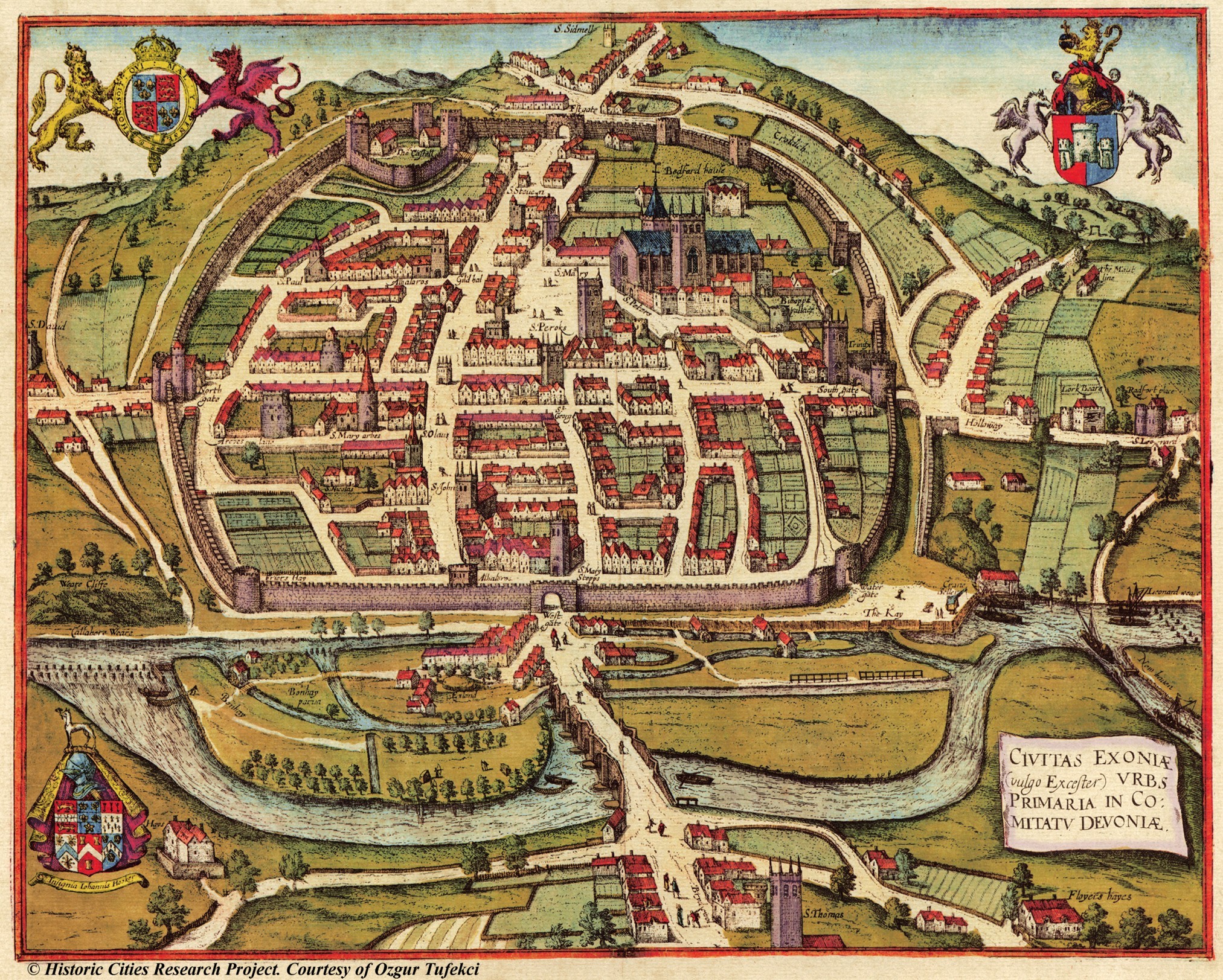
Two maps in the exhibition really capture this duality. The first is the map of Exeter that I discussed in my first post.
braun_hogenberg_VIThe second is a map of the North America village of Pomeiooc, on Roanoke Island (1585-93).
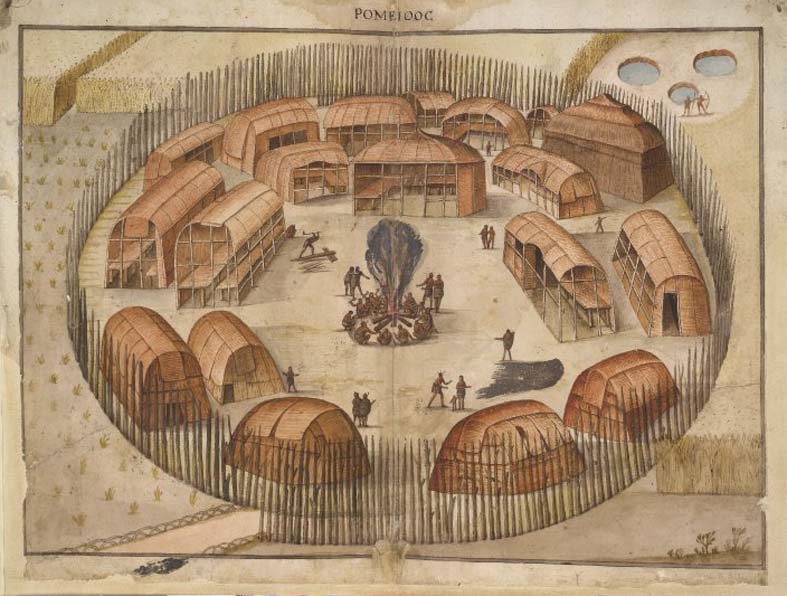
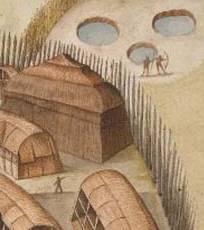
the-village-of-pomeiooc1Placed next to each other, the similarities between early modern Exeter and Pomeiooc are striking. Pomeiooc is presented as a well ordered settlement, encased in a wooden palisade for defence, it’s inhabitants are hunters, fishers and farmers. Sophisticated visual techniques are again on display – some of the houses are ‘cut away’ to reveal their inner organisation, and there is even a chap practising his archery by the fishing pools in the top right corner, just like in the map of Exeter. As before, this might tell us just as much about the European who painted the map as it does the native Americans that it depicts. It might reveal the tendency of archerEuropeans to impose their own understandings and framework on the new cultures and societies that they encountered in far away places. It might be propaganda, designed to support overseas settlement by enticing potential settlers to the New World – like Exeter, Pomeiooc looks like a productive and fertile community (though I do wonder, what is that wooden fence keeping out…?). It certainly suggests that not all Europeans dismissed these people as barbaric savages, and that they could identify similarities between their own society and non-European counterparts.
An impressive society, an excellent exhibition

All in all, I was deeply impressed by both the achievements and complexity of the Tudor south west, as well as the exhibition’s capacity to capture and explore it. The Golden Age is here in all it’s glory – crafts, art, architecture, entrepreneurs, discovery, military triumph, intellectual development.

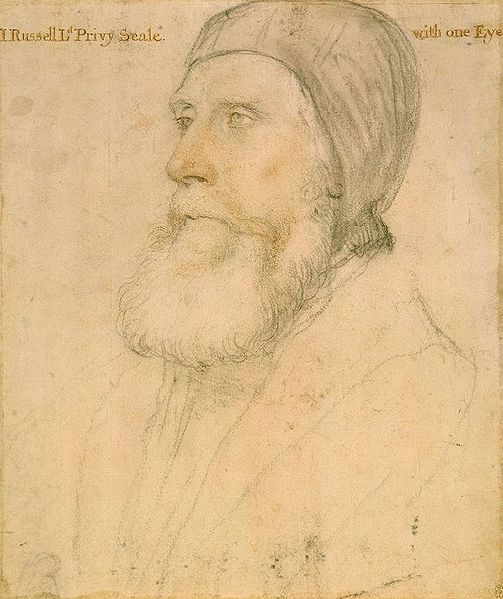
My only remaining niggle is that the difficulties, the struggles and the violence of the age are largely absent. Here we see the middling and upper sections of Elizabethan society, but these objects are largely silent about the lower sorts, the people suffering in the hardships of the 1590s, the people resisting religious change and suffering due to economic trends. We do come face to face with Lord John Russell, 1st earl of Bedford,John_Russell_Earl_of_Bedford_Hans_Holbein_the_Younger in a sketch by Holbein the younger. Russell was in charge of the forces that brutally suppressed the West Country or Prayer Book Rebellion in 1549, slaughtering hundreds in a number of bloody encounters around Exeter. But here his image must serve as the only reference to the scars left on the south west by that tragic rebellion. Of course, it would be strange to linger on these more troubling aspects of the period in an exhibition that is intended as a pointer to the south west’s ‘manifold contribution to the Tudor age’, and these comments are not intended as a (horribly unfair) criticism of the exhibition. They are included here as representative of my worry that perhaps there is too little space for the lower sorts in our museums and a reminder that we should fight hard to make sure they can find a place.
In summary, this is undoubtedly an excellent exhibition that certainly fulfils its remit of revealing the intellectual, artistic and economic importance of south west in the Tudor Age. The sophistication of this society is perhaps the most striking impression that one is left with: despite being a geographically-peripheral region, this was by no means a provincial backwater. Head to the RAMM to see for yourself.

‘West Country to World’s End: the South West in the Tudor Age’ runs until 2 March 2014 at Exeter’s Royal Albert Memorial Museum. You can find all the details about the museum, it’s opening times, it’s wonderful café and more here

The Tudor South West at Exeter’s Royal Albert Memorial Museum: Part 4 – The Spanish Armadas

Laura Sangha

This is the fourth post in a week long series about an exhibition at Exeter’s museum. Click on pictures for enlargements.

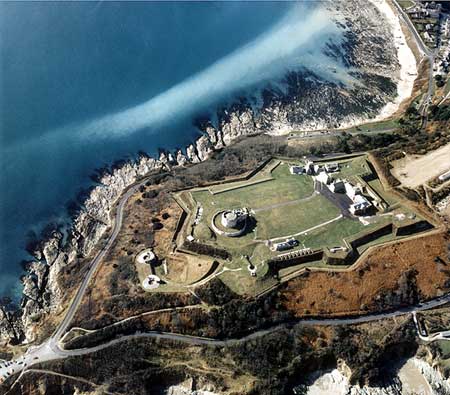
Pendennis Castle, Cornwall.

Pendennis Castle, Cornwall.

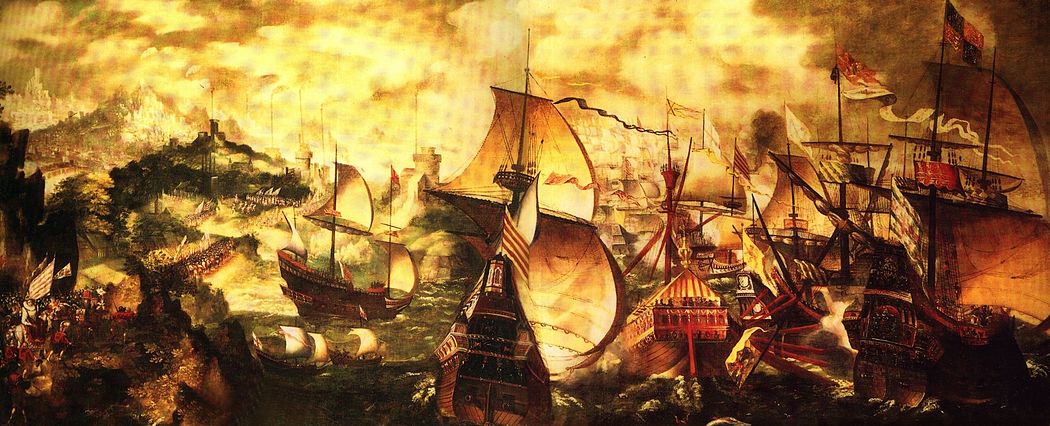
Politically, the south west was of crucial importance during Elizabeth’s reign when hostilities with Spain put Devon and Cornwall in the front line. This drew the region into events of national importance, but these events were also experienced on a local level and were of particular significance for the region. The 1588 Spanish Armada is probably the best known event of Elizabeth’s realm, and is certainly the most iconic, but for the south west things didn’t end there: two more invasion fleets sailed for Britain in 1596 and 1597. From the exhibition catalogue I learned that the region had in fact had been repeatedly strengthened militarily during the Tudor era – forts were constructed at western harbours in the reign of Henry VIIII, including the impressive examples at St Mawes (1543) and Pendennis (1546). In Elizabeth’s reign, Plymouth’s St Nicholas Island was heavily fortified in 1583-85 and Sir Richard Grenville was given command of the defence of Devon and Cornwall in March 1587, when he readied the equipment and defences of the peninsula. Anxieties remained high throughout the 1590s, Plymouth received more fortifications, and a small force landed at Mousehole, Newlyn and Penryn in 1595, doing extensive damage when they set them afire.

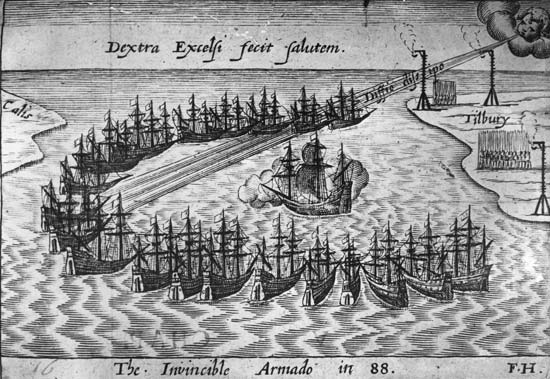
But it was the 1588 Spanish Armada that really became embedded in national consciousness and whose memory has endured. This is surely because the failed invasion was accorded with such importance at the time. Special forms of prayer were issued by the government giving thanks for the nation’s deliverance, and celebrations wind-blowing-on-armadamarking the defeat became a regular fixture in a rapidly developing new national ‘Protestant’ calendar, as David Cressy has documented. In the epic struggle between Catholicism and Protestantism, God appeared to have revealed his hand, assisting the numerically inferior and poorer Protestant forces to miraculously defeat the mighty fleet of a Catholic superpower. This was not a mere fluke convergence of bad weather and inspired naval leadership, this was a providential deliverance. The ‘Protestant wind’ that sent the Spanish ships into disarray was proof of God’s special care and protection of his chosen people, those Protestants who professed the ‘true’ faith.

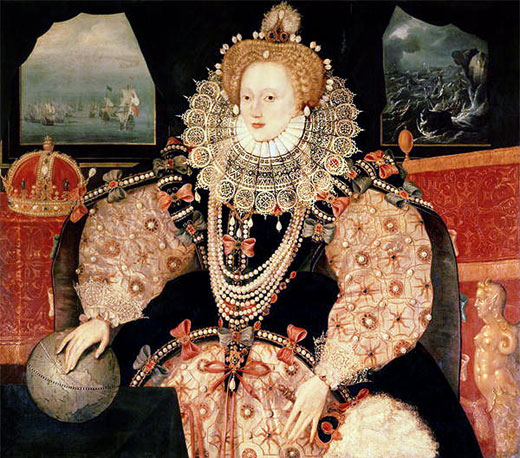
ELIZ portraitEven at the time the iconography of the Armada was well developed (again giving lie to the ‘iconophobia’ discussed in a previous post). If you see a crescent of tall masted ships you are probably looking at a representation of the Armada of 1588, and there a few examples of these crescents in the RAMM’s exhibition. Most obviously, there is the ‘Armada Portrait’ of Elizabeth I, so called because the queen is framed by two images of the naval action. Above the queen’s left shoulder the English ships are shown bravely sailing towards a confrontation with the Spanish fleet in its distinctive crescent formation; over her right shoulder a wreckage strewn seascape represents the remains of the once proud Spanish fleet.

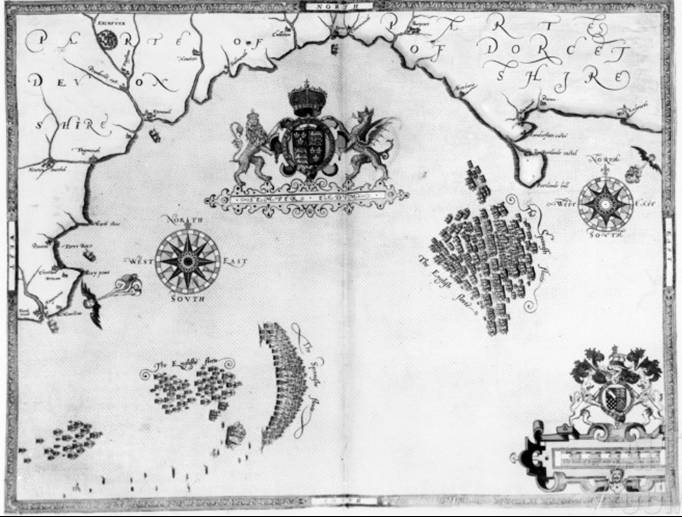
Augustine Ryther engraving, note Exeter top right.

Augustine Ryther engraving, note Exeter top left.

The exhibition also houses a wonderful series of exquisite hand coloured engravings, telling the story of the engagements off the Devon and Cornish coasts. The engravings were produced by Augustine Ryther from charts which recorded the route of the Armada around the coast. They really do provide the story of the events – this black and white copy shows the recognisable crescent shape of the fleet, and collapses the timing of the events so that two parts of the action are shown simultaneously, creating an easily understood narrative. This is a technique that I often encounter when examining early printed material with my students, particularly those ballads and broadsheets that seem to be aimed at the least literate members of society.

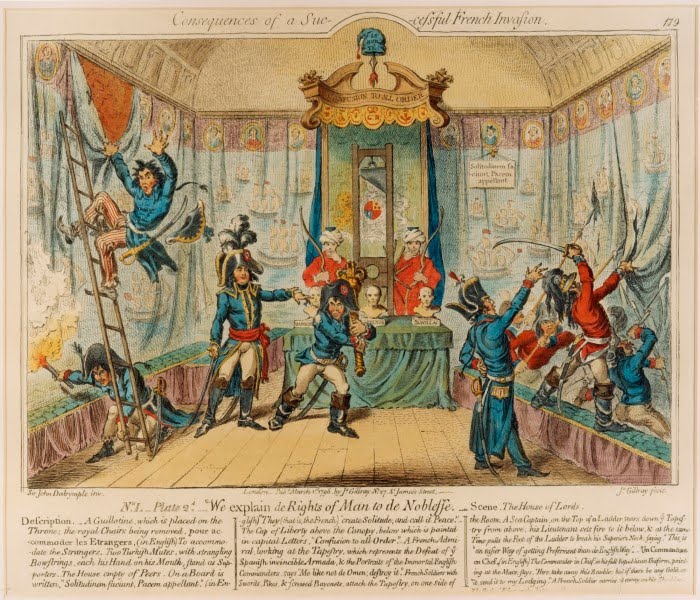
cartoon with tapestriesThe prints are similar to the tapestries that were hung in Parliament in 1650. Commissioned in 1592, the ten tapestries were enormously expensive, costing £1,582 (the equivalent of 87 years wages for a labourer in 1590); and enormous in size: we think they measured 14 feet in height and between 17 and 28 feet in width. In 1650 they found their way into the Houses of Parliament, where they were mentioned in debate on several occasions. As if further evidence were needed of the longevity and significance of the Spanish Armada, in 1798 when there were concerns about a possible French invasion, the artist James Gillray was commissioned to produce images that would rouse patriotic fervour in the English people – the series of satirical prints he produced included one (above) depicting a French Admiral ordering his men to destroy the Armada tapestries.

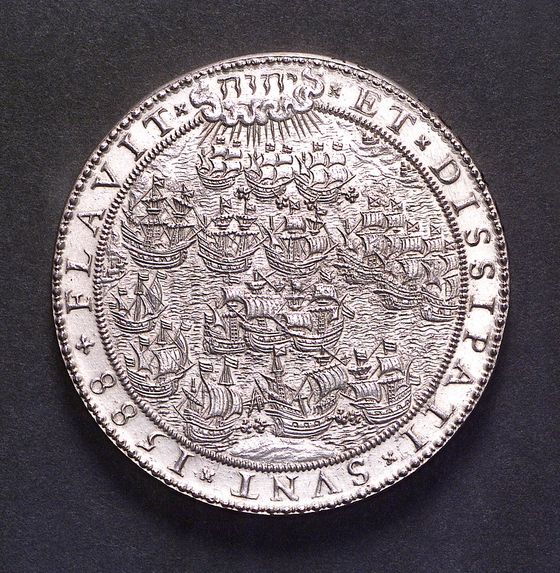
medalFinally, amongst other Armada memorabilia in the collection there is also a commemorative medal similar to the one in the picture. These were not only produced in England but also in other Protestant nations, indicating the way that the defeat of Catholic Spain reverberated throughout Europe, an important symbolic victory for international Protestantism. The medal in the RAMM collection is from the Netherlands. In the 1580s the Dutch United Provinces were in revolt against Catholic Spain, and Spanish hostilities against the English were in part an attempt to stop the English aiding their European Protestant allies.

The museum medal depicts the Armada in its familiar crescent shape. It bears the famous inscription ‘Flavit Jehovah et Dissipati Sunt’ (with ‘Jehovah’ in Hebrew letters, the Tetragrammaton יהוה): ‘Jehovah blew with His wind and they were scattered’. It is a reference to Job 4: 8-11:

Even as I have seen, they that plow iniquity, and sow wickedness, reap the same.

By the blast of God they perish, and by the breath of his nostrils are they consumed.

 The roaring of the lion, and the voice of the fierce lion, and the teeth of the young lions, are broken.

The old lion perisheth for lack of prey, and the stout lion’s whelps are scattered abroad. [King James Version]

Spanish Armada - so famous it made it into the Simpsons.

Spanish Armada – so famous it made it into the Simpsons.

References like this are deeply suggestive of one of the ways that Protestantism was changing English society. Scriptural allusions were commonplace, and from the way that they are used (casually, briefly) it strongly suggests that people were expected to recognise them and the deeper religious truths that they stood for. Job has of course already cropped up in this series of posts (see day two, domestic decoration), here the brief quotation serves a similar purpose as an image: a reminder, a prompt to reflection, a stepping stone to a more profound appreciation of one’s own faith.

In the final post tomorrow: a round up of the prominent themes.

‘West Country to World’s End: the South West in the Tudor Age’ runs until 2 March 2014 at Exeter’s Royal Albert Memorial Museum. You can find all the details about the museum, it’s opening times, it’s wonderful café and more here

Further reading:

Sam Smiles (ed.), West Country to World’s End: The South West in the Tudor Age [essays to accompany the RAMM exhibition].

David Cressy, ‘The Spanish Armada: Celebration, Myth and Memory’, in J. Doyle and B. Moore (eds), England and the Spanish Armada (Canberra, 1990) or Bonfires and Bells: National Memory and the Protestant Calendar in Elizabethan and Stuart England (London, 1989).

The Tudor South West at Exeter’s Royal Albert Memorial Museum: Part 3 – Goldsmiths and urban redevelopment

Laura Sangha

This is the third post in a week long series about an exhibition at Exeter’s museum.

Today I want to talk filthy lucre. One of the things I learnt at the RAMM was that Exeter was an important centre for the goldsmith trade from as early as the thirteenth century, and this set off a train of thought that ended up in the surprisingly short-term world of town planning. I’ll try to recreate the train here.
The goldsmiths golden age

cup editMany of Exeter’s early modern artisans had their workshops in Goldsmith Street, an impressive thoroughfare that had a church at either end, almshouses, and a handsome hall used by the Company of Tailors. The exhibition houses a variety of related items, but the one that took my eye was a communion cup made by John Jones, one of the wealthiest goldsmiths in early modern Exeter. It is indicative of the fact that in this society, ‘fine art’ did not necessarily mean paintings (though there are some wonderful Holbeins in the exhibition, if that’s your thing). This cup, manufactured from silver with delicate engraving around the gilt-edged rim and foot, is extremely accomplished, in fact I was rather surprised by quite how fancy it was, given that this was over ten years into the Calvinist-inspired Elizabethan reign. The cup is still a thing of beauty, it could easily be a lot plainer and less ostentatious.

The uniqueness of the Church of England

My first thought was that perhaps this is proof that the Elizabethan Settlement acted as a ‘broad umbrella’, incorporating a number of different types of Protestants and a range of churchmanship? Christopher Haigh has argued that the adjustments made to the Prayer Book at the start of Elizabeth’s reign, particularly additions to the words used during the administration of the Lord’ Supper, deliberately introduced ambiguity into the ceremony, encouraging a range of opinion about what actually happened during the sacrament to survive or evolve. Diarmaid MacCulloch has argued along similar lines, suggesting that these changes were to bring the English Reformation in line with what was happening in the rest of Europe, particularly in Germany and Geneva. It is entirely plausible that the fancy cup could be a part of these processes – the use of a silver work of art, rather than a plain wooden cup, would have been deeply suggestive to a congregation versed in the ritual and symbolic importance of the liturgy.

The impact of the Reformation

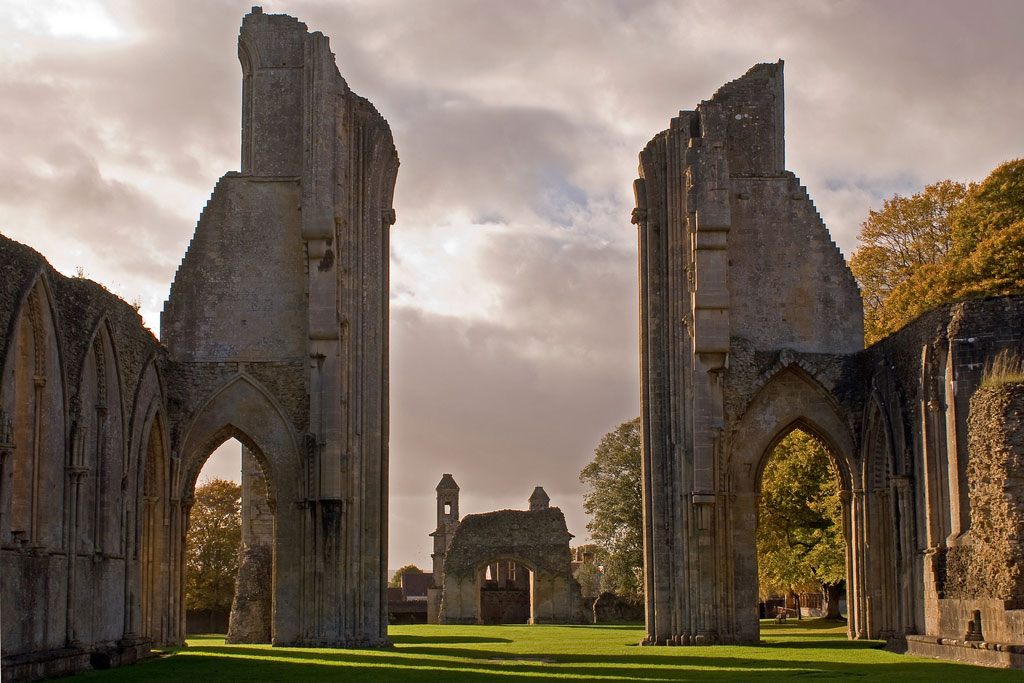
Beyond the sometimes obscure and Glastonbury2always complicated world of Reformation theology, the goldsmiths can also tell us much about the way in which changes in belief left a deep and enduring imprint on early modern society. For part of the reason for the continued success and prestige of the goldsmith community in Exeter was the dissolution of the City’s priory and friaries in 1538 and ongoing changes in religious policy that sent a lot of work their way. Historians have discovered that far from being isolated and cut off from their local communities, monasteries were in many ways integral to the social and economic functions of their local region, providing charity and education, and as producers and consumers. Following their abrupt closure, the shock waves were swift, reshaping the landscapes of local communities physically as well as spiritually. Large, imposing buildings were torn down or their functions changed, and Henry VIII quickly appropriated the vast riches of these institutions. This not only meant that the crown took control of church lands, they also seized their more moveable treasures. For the large group of goldsmiths in Exeter, this would have meant a very welcome steady source of work and income, as church plate was confiscated, some of which had to be melted down and reworked in a more acceptable shape, suitable to the new reformed liturgy. This was a lucrative business, as at each stage of the process the participants could take their cut, not to mention that the parishes had to buy new plate from the goldsmiths to replace the old throughout the Tudor era. Similar processes happened in parish churches – the RAMM’s information card tells us that the churchwarden accounts of St Petrock’s church in Exeter show that Jones was paid £1 15s 5d in 1572 for ‘converting’ this communion cup to make it suitable for Protestant worship. Thus the redistribution of wealth that the dissolution triggered is not restricted to the property market but bought benefits and profits to other groups that can easily be overlooked.

Heritage and Urban Planning

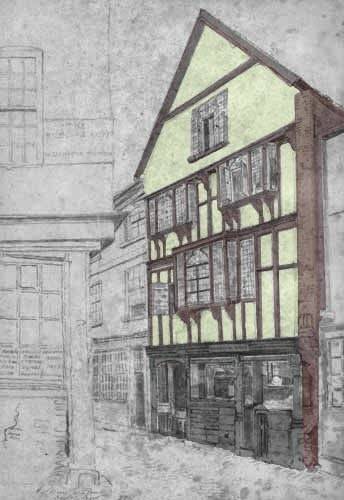
Exeter's Goldsmith's Street as it once was.

Exeter’s Goldsmith’s Street as it once was.

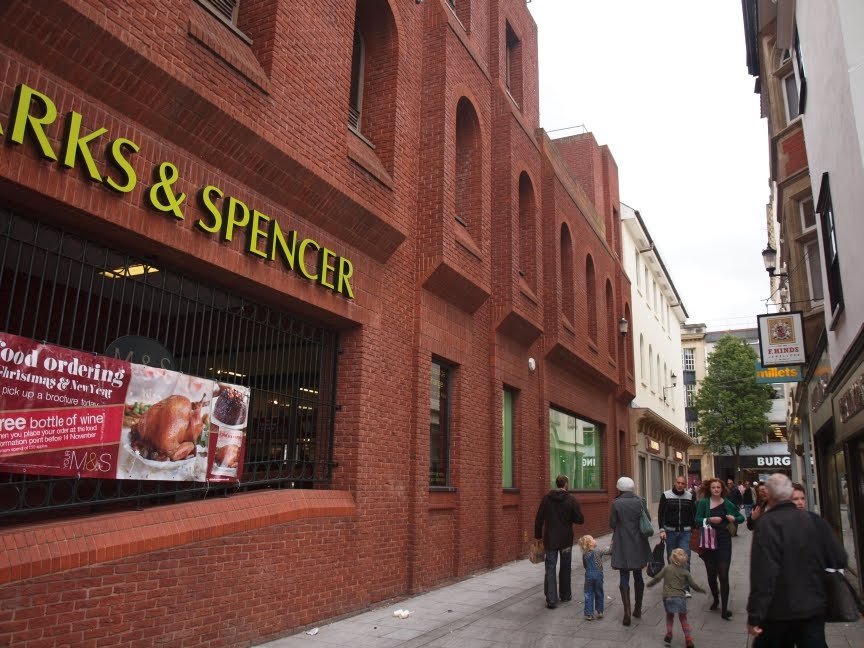
Finally, I was also interested to discover the fate of Goldsmith Street – the majority of the historic buildings there were demolished by the City Council in the 1970s to make way for redevelopment – today you will find Marks and Spencer and Millets where the goldsmiths used to ply their trade. Although one of our enduring national myths is that bombing raids in World War II were responsible for the destruction of much of our pre-modern urban architecture, more recently historians have begun to question this narrative. They have drawn attention to the fact that many cities were already undergoing a programme of redevelopment that included sweeping away inconveniently narrow medieval streets that were seen as obstacles to modern infrastructure and progress. Though the blitz did account for damage in many historic centres, our society’s own decision to prioritise the needs of economic and industrial advancement over our historic past may be the real explanation of urban change. A recent article on the BBC website revealed that this is even true of Coventry, which suffered devastating destruction in a terrible air raid in 1940, but where demolition had actually started before the war and continued after it. Exeter too suffered, in a severe raid in 1942 1,500 houses were destroyed, 2,700 were seriously damaged, and the Cathedral itself was hit, narrowly escaping the destruction of the nave. But much of value was left, though not all of it was subsequently retained – wiped away just as Goldsmiths was to make way for shopping centres and fast food joints.

The shock of the new

Exeter's Goldsmith Street now.

Exeter’s Goldsmith Street now.

In many ways modern redevelopment of our urban landscapes is now just as shocking and significant as the deliberate destruction of the monasteries and the properties of the parish churches in the 1500s, and increasingly we are now beginning to see it that way. Each was an iconoclastic act, signalling a rejection of and moving away from the past. They were both inspired by a shift in the prevailing ideology and the emergence of something new: Protestantism, capitalism, modernity. Each are shocking to us now because these acts display a complete lack of respect for the past and for beautiful treasures which can now never be recreated. Each seems to have been driven by ‘the authorities’ in the face of limited public resistance, and in many cases the public seem unable to prevent the change even where they disagree with it. Perhaps this can helps us to understand the ‘compliance conundrum’ – the question of why there was a relative lack of any widespread resistance to the dissolution, despite the commitment that most English women and men had previously shown to the institutions. Perhaps they felt as helpless as we do in the face of development, perhaps they also felt a sense in which they were swimming against the tide in trying to preserve the past or stand in the way of state sponsored change. Or perhaps they came to terms with and even embraced the changes, regretting the passing of the old ways and the destruction of beautiful things, but eager to make the most of the opportunities that the new future offered them, and keen to create new and more beautiful – but different – things to replace those that had been lost.

In tomorrow’s post: the Spanish Armada arrives off the south west coast.

‘West Country to World’s End: the South West in the Tudor Age’ runs until 2 March 2014 at Exeter’s Royal Albert Memorial Museum. You can find all the details about the museum, it’s opening times, it’s wonderful café and more here

The Tudor South West at Exeter’s Royal Albert Memorial Museum: Part 2 – Domestic Decoration

Laura Sangha

This is the second post in a week long series about an exhibition at Exeter’s museum. View the first post on a map of Exeter here.
In early modern England the population was expanding incredibly rapidly and massive inflation led to the deterioration of living standards for many of the lower sorts. In contrast, changes in income tended to increase the number of middling groups in society, those merchants, artisans and gentry who benefited from rising property prices. In the west country, the prosperous cloth trade and various mercantile enterprises meant that the middling sorts had money to invest in the arts. You are perhaps already aware of the National Portrait Gallery’s current exhibition on Elizabeth I and her People, and if that is your sort of thing, there are lots of paintings at the RAMM too, including ‘The Armada Portrait’ of Elizabeth I; several from the school of Holbein; numerous works by Exeter’s most significant artist to date, the miniature-painter Nicholas Hilliard; and a huge piece that tells the story of the arrival of Armada in the South West in 1588. Click on images for enlargements.

attributed hilliard armardaAll are deeply impressive, but the artistic accomplishment of the south west is also to be found in the crafts – in the production of jewellery, elaborate drinking vessels, church plate (more on that in tomorrow’s post), household utensils, decorative plasterwork, moveable furniture, architectural stone and woodwork, and fine needlework. Some of these were functional, but all displayed the taste, wealth and status of their owners in this society.

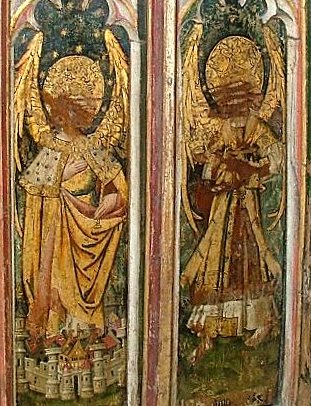
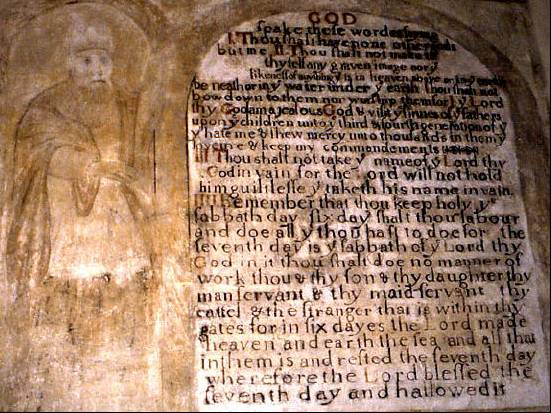
Two of my favourite objects in the exhibition seem to be less about status, but certainly fall within the category of the decorative arts. They are a set of boards with an image painted on each them. Both are reasonably small – perhaps the size of an A3 sheet of paper – and one depicts Moses, the other Job. Each has a scriptural extract painted above the image. On loan from the V&A, they are part of a series of Old Testament figures. The drawings are plain but relatively accomplished: Job wears a long red tunic, cinched at the waist with a belt with a tasseled pouch hanging from it. He has a long brown pointed beard and wears a small turban and long boots, an interesting suggestion of ethnic stereotyping. He looks as if he is walking somewhere, and his hands are together and raised in supplication. The figure stands on some scraggly grass, and it is against a black background, in contrast to the scriptural text in black letter against a white background that forms a strip across the top of the board. It reads: ‘I ame sure that my redemer liveth and that I shall rise [oute?] of the earth at the latter day. Job [19?].’

Moses wears a white tunic and his extra long, brownish belt flaps around his legs as if in a breeze. He has tights tucked into his high brown boots, and wears a warm looking hat. He has a brown beard, much shorter than Job’s, and he also looks like he is walking. In his arms is a large tablet divided in two, dashed lines across it representing the Commandments. There is a skull between his feet, and I was intrigued to see that Moses is blindfolded – I am assuming this represents the Lord’s impartial justice but would be delighted to hear of other examples of this. His inscription reads ‘The Lord will stirr up amonge the brethren a Profet, like unto me. Deutrinomy 18’.

The RAMM’s information card informs us that the boards might have been displayed in a church or private house near Plymouth, but immediately my little grey cells started humming. I doubted that it was the former in Elizabethan England, where the work of iconoclasm in parish churches was relatively complete. To me, these images were a surprise – what were images of scriptural figures doing here, in an era when images had been rejected by the reformers as leading to wrong belief and wrong practice?

When iconoclasts attack.

When iconoclasts attack.

The scholarship on visual culture in early modern England can help to answer this question, as it has been rapidly developing in recent years. Earlier historians had to an extent been won over by Patrick Collinson’s argument that throughout Elizabeth’s reign, English Protestantism became less, not more popular in character. Crudely summarised, Collinson asserted that the first generation of Protestant publicists and propagandists made polemical use of cultural vehicles (songs, drama, cheap print, the visual arts), using these forms to transmit the evangelical message with the aim of converting the English people to Protestantism. Protestant plays were written and produced, godly ballads were published and sung, images were used to attack Catholicism and to commend their own religious beliefs and values. But around 1580 Collinson thought that a new generation of evangelicals began to reject visual and performative culture, judging it to be unsuitable for their religious message. This later generation of Protestants thought that plays, songs and images were distracting the audience and confusing the religious message. Worse, the arts mixed sacred ideas with filthy ‘popular’ forms, doing violence to religious truth by associating it with base, bawdy and inappropriate behaviour and language. In this new world, Collinson argued that Protestants came to completely refuse any appeal to the senses in religious matters. All images were ‘Popish’, most Elizabethan and Jacobean bibles therefore had no illustrations, the only decoration in the parish church was to be the Royal Arms and perhaps a table of the ten commandments. England had moved from iconoclasm in the first stages of reform (rejection of abused, dangerous and false images), to complete iconophobia (rejection of all images).

And yet…, whilst Collinson’s argument is enormously useful in thinking about the continuing repercussions of religious change, it is perhaps more useful for thinking about reforming clergymen than it is English society more broadly. Objections have been raised, and work is afoot to provide a corrective to the ‘iconophobia’ argument. It is easy to point to the continued existence of images in England – British Printed Images to 1700 is a website that hosts a database of several thousand printed images produced in Protestant Britain, and much decorated medieval furniture can be found in parish churches across the country to this day (though of course some of this may have been restored during a later era). Our Moses and Job boards are of course another example of later imagery.

Images persisted despite reforming disapproval. So how can we explain Moses and Job? Are these a rare surviving example of something from the bottom of the Tessa Watt’s ‘ladder of sanctity’ – inoffensive Old Testament figures that Protestants were comfortable displaying in a secular context? Watt has taught us that those scriptural figures who were the least sacred in the Catholic tradition, those that did not have cults associated with them and who were therefore unlikely to be the focus of devotion, were often still depicted in post-Reformation England. Moses and Job fit the bill – they are Old Testament figures, and both are strongly associated with moral teaching and practices. You are not meant to worship them but to learn from their stories and they were probably a new element of visual language in the post-Reformation church – there are no wall paintings of Job in Anne Marshall’s excellent catalogue of medieval wall paintings, and only one of Moses – which was painted after the Reformation.

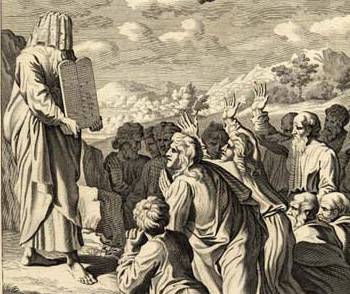
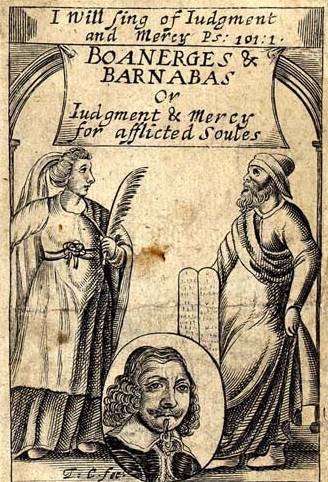
Watt’s theory therefore helps us to explain images that survived in the face of fierce criticism of the Catholic use of imagery in worship. It seems that the purposes of post-Reformation images were usually didactic, images were used symbolically to recall to mind important beliefs or Christian principles. Here the scriptural texts above the images suggest that these figures were intended as an aid to memory, representative of bigger theological and moral truths. Job stood for the trials, temptations and suffering that an ordinary family man might face in everyday life, the text the hope of release from them. Moses would call to mind the Ten Commandments (perhaps displayed for all to see in the parish church) and their Picture1importance as the basis of Christian morality and behaviour. Both are eminently suitable for display in a secular sphere such as the household, reminders of everyday Christian beliefs that could comfort and guide people as they went about their lives. Incidentally the British Printed Images database throws up eight images of Moses and two of Job, all from the seventeenth century, suggesting that these images might be less suitable for publication than for display in the household. Often these images are found in the frontispiece: Drexel’s School of Patience (1640) has an image of Job with the caption ‘Patience’; in Francis Quarles 1646 collection of miscellaneous reflections Boanerges and Barnabas Moses represents justice (in opposition to mercy) and wears a similar outfit to that depicted on our boards (see below); whilst a 1695 edition of Richard Allestree’s Works shows the prophet wearing a veil. Does the latter represent squeamishness over showing Moses’ face, or is it just because the book contains a section on the topic of veiling?

quarles mosesIt appears then that Moses and Job need not have been out of place in the Elizabethan south west after all. Tara Hamling’s recent work on domestic decoration supports such an interpretation, and these boards indeed suggest that Elizabethan England ‘still contained many images to help its inhabitants in converting the words of the Protestant religion into a visualised experience’, as Tessa Watt has argued. These images were complementing and supporting preaching and reading, those activities more traditionally seen as the heart of Protestant practice. The physical environments that people inhabited had also been changed as a result of reform, reconfigured to encourage the development of the Godly society that the evangelicals strove to create.

In tomorrow’s post: musings on the impact of the Reformation, goldsmiths and contemporary urban redevelopment.

‘West Country to World’s End: the South West in the Tudor Age’ runs until 2 March 2014 at Exeter’s Royal Albert Memorial Museum. You can find all the details about the museum, it’s opening times, it’s wonderful café and more here

Further reading:

Patrick Collinson, ‘From Iconoclasm to Iconophobia: the Cultural Impact of the Second English Reformation’, The Stenton Lecture 1985 (University of Reading:1986). Reprinted in Peter Marshall (ed.), The Impact of the English Reformation (London, 1997).

Tessa Watt, Cheap Print and Popular Piety (Cambridge, 1991), chapter 4, ‘Idols in the frontispiece’.

Tara Hamling, Decorating the ‘Godly’ Household: Religious Art in Post-Reformation Britain (London, 2010).

The Tudor South West at Exeter’s Royal Albert Memorial Museum: Part 1 – City Map

Laura Sangha

This is the first in a week long series of posts about a new exhibition at Exeter’s museum.

Exeter's Royal Albert Memorial Museum

Exeter’s Royal Albert Memorial Museum

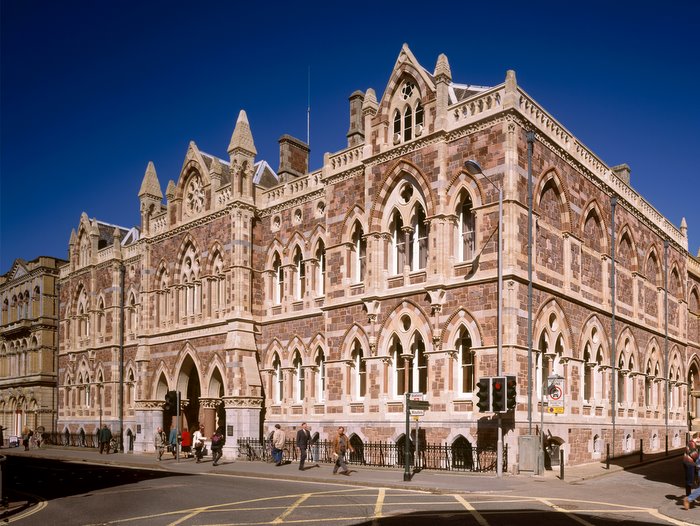
I few weeks ago I had the pleasure of visiting a wonderful new exhibition at Exeter’s recently refurbished Royal Albert Memorial Museum. Titled ‘West Country to World’s End: the South West in the Tudor Age’, the publicity describes it as ‘celebrating the spirit of adventure and enterprise of south west people’ during the Elizabethan ‘Golden Age’. Along with some of my first and second year undergraduates, I was also lucky enough to attend a talking tour of the exhibition by one of its curators: Sam Smiles, Professor of Art History and Visual Culture at the University of Exeter. It was an intriguing insight into the thought and planning that goes into such a project, and I was struck by how carefully constructed museum exhibitions are in order to allow viewers to assemble a history from the objects themselves. It led me to reflect on the way that the selection, juxtaposition and display of the objects prompts the viewer to make associations and identify themes, leading to their greater understanding of the period and the subject. The exhibition runs until 2 March 2014, and each day this week I will be offering some thoughts on objects from the exhibition, explaining what the items said to me and following up on the questions that they raised. Click on pictures for enlargements.

Mapping Exeter

Engraving of Exeter by Hogenberg, 1587.

Engraving of Exeter by Hogenberg, 1587.

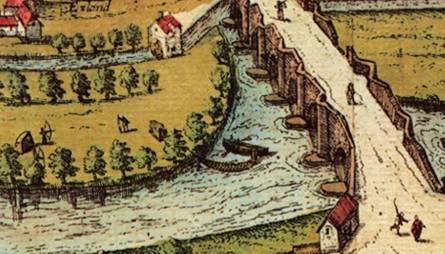
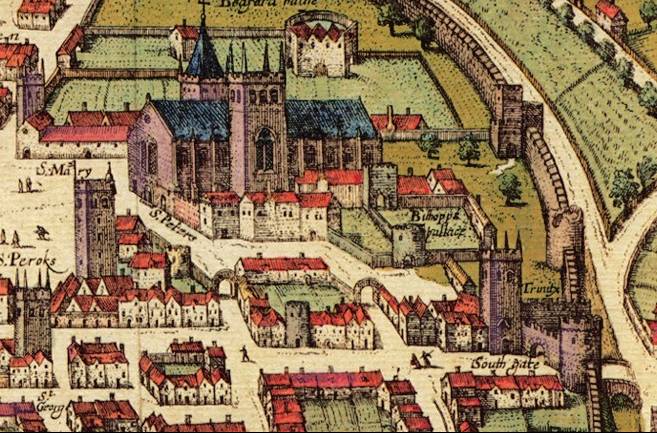
As a naturalised Exonian, I was very taken by the large scale reproduction of a map of Exeter as it was in 1587. Placed at the start of the exhibition it immediately orientates you within the early modern city, and it is fascinating for any number of reasons. The Exeter on the map has some familiar landmarks, yet the contours are not what are not what you expect: the river has been redirected in the centuries since, the castle and city walls have largely disappeared, and of course modern Exeter is far larger, incorporating parishes that were entirely separate in the early modern period and archers riversprawling suburbs where once there was only farmland. The map is incredibly detailed – there are figures promenading in the streets and a couple of archers practise their skills by the Exe bridge, whilst the tenterhooks used in Exeter’s successful cloth trade are plain to see on the banks of the river. There are at least seven churches within the walls in addition to the huge cathedral, and everywhere there are wide green open spaces: a reminder that the Tudor urban environment was vastly different to our own. The map is hard to navigate for a modern too – the perspective allows the viewer to see the city in it’s entirety, but in doing so fails to indicate the very steep incline between the river and the city centre, so buildings that appear to be next to each other on the map are not experienced like that in reality.

Of course maps are never realistic in the way that they present their subject, they are designed to convey specific information to the map ‘reader’, thus the map designer chooses which aspects to emphasise and which to elide. The resulting distortion might The Cathedral was surrounded by churches, and someone's fancy house.therefore tell us more about the producers’ perceptions and intent than the place they are depicting. Thus we do not see the city ‘as it actually was’, but rather we see what the producer (or patron) wants us to. This map was made for the great city atlas edited by Georg Braun and largely engraved by Franz Hogenberg, published in Cologne in six volumes 1572-1617. Many of the images in this post can be seen at ‘Historic Cities‘ which has excellent digital reproductions of city maps of the past, present and future.

Meanwhile, just outside Oxford

Meanwhile, just outside Oxford…

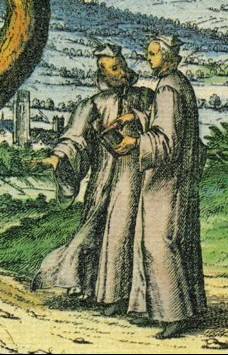
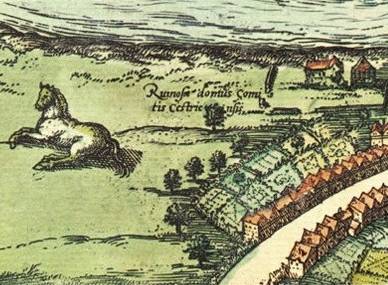
Braun and Hogenberg’s atlas contained 546 maps of cities, mainly European but there was also room for Mexico city and Casablanca. Other English cities included were London and the second city Norwich, Oxford and Cambridge, York, Canterbury, Chester and Bristol: the fact that Exeter was deemed worthy of inclusion alongside these indicates its important national status at the time. Hogenberg’s other city plans share features with Exeter’s –York is surrounded by a profusion of windmills, and in Norwich archers are also practicing their skills on the outskirts of town. There are differences too: Bristol, Cambridge and Norwich have sheep grazing in their hinterlands whilst in Exeter is surrounded by arable land, some of the maps have larger figures in contemporary dress in the foreground, indeed Oxford has what appear to be two scholars having an argument under a tree.

Either Chester was menaced by giant horses, or this map is not to scale.

Either Chester was menaced by giant horses, or this map is not to scale.

The Exeter map thus tells me that Hogenberg saw the city as a Godly, thriving, well defended and well connected metropolis, relatively compact though already outgrowing the limits of it’s walls. The river was clearly a central part of it’s extensive trading and manufacturing activities, the water cluttered with boats and mills. A steady stream of people cross over the bridge towards the city gates, and within the walls there were some impressive houses suggesting wealthy citizens – this was a bustling regional centre, then as now. Surprisingly there are no cows to be seen (Cambridge, Bristol, Chester and other cities have sheep and horses grazing around about them), but there are some chaps fishing near a weir at Bonhay. The wide streets and green spaces within the city and the rolling Devon countryside which form the hinterland suggest this would be a good place to live and work, it is presented as a civilised, spacious and clean environment. As such, my suspicion is that it only tells part of the story of life in urban Elizabethan England.

In tomorrow’s post: what are images of Moses and Job doing in the Protestant south west?

‘West Country to World’s End: the South West in the Tudor Age’ runs until 2 March 2014 at Exeter’s Royal Albert Memorial Museum. You can find all the details about the museum, it’s opening times, it’s wonderful café and more on their website.

Credits:

Historic Cities, a joint project of the Historic Cities Center of the Department of Geography, the Hebrew University of Jerusalem and the Jewish National and University Library.

Georg Braun and Frans Hogenberg, ‘Civitas Exoniae (vulgo Excester) urbs primaria in comitatu Devoniae’, in Civitates Orbis Terrarum, Cologne. Vol. VI 1617.

The Immersive Turn: Or, what did a seventeenth-century drinking song sound like?

Mark Hailwood

I know what you are thinking: isn’t it about time for yet another historical ‘turn’? Well, you’re in luck! I think there is a really interesting one already underway in early modern studies, quietly coming together from a number of different approaches and without, as yet, a clear sense of itself. I want to give it an identity, and I’m going to start by giving it a name: the ‘immersive turn’. But I’m open to suggestions.

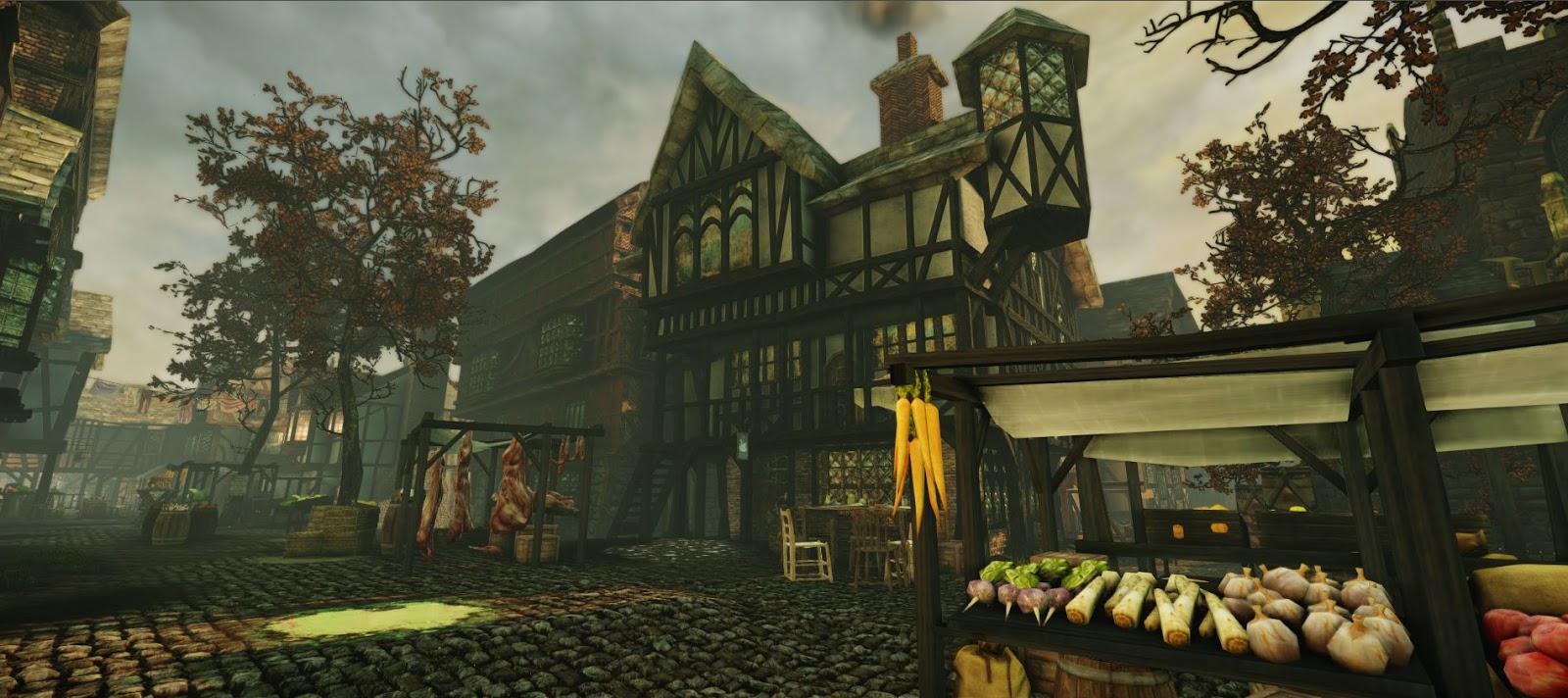
What I mean by this is a growing desire on the part of early modern historians to try to recover a more multi-dimensional, multi-sensory feel for the period than we conventionally derive from an analytical reading of written sources: a search for the texture of the past, not just its texts. What prompted me to pull together this line of thought into a blog post was the recent attempt by students at De Montford to create a virtual version of seventeenth-century London before the Great Fire of 1666. It is worth a look, if you haven’t seen it already.

Pudding Lane Productions (http://puddinglanedmuga.blogspot.co.uk/century) have created a virtual 17th century London.

It seems to me that the interest generated by this project is a symptom of the fact that early modern historians are increasingly attracted to the idea of ‘immersing’ ourselves more fully in the physical and sensory aspects of the world that we study: the emergence of the study of material culture, increased attention to visual sources, to ‘space’, and to the history of the senses, might all be seen as part of this same process.

Pre-Reformation worship recreated (http://reformation.modhist.ox.ac.uk/index.html)

Pre-Reformation recreated

There have been recent attempts to recreate pre-and post-Reformation church interiors, and experiences of worship, for instance, and popular history books and TV shows taking the form of ‘Time Travellers’ Guides’ invite their readers and viewers to imagine the sights and smells one would encounter on entering a medieval or early modern city. All of these approaches invite us to imaginatively transport ourselves into the shoes of our early modern ancestors, and to concentrate on the immediate experience of sights, sounds and material surroundings.

These ‘immersive’ approaches have influenced my own work, especially in relation to the seventeenth-century drinking songs that I use to examine alehouse culture in the period. I don’t just mean that I get drunk and try singing them in the pub—although, we’ll come back to that—but rather that to understand the meanings of such songs it is important to think about the ways in which they were performed. It might be easy for a historian, sat alone at their desk quietly reading such a song, to misjudge the tone of its meaning, a tone that was informed by its tune, and also the manner and context in which it was actually sung, aloud, communally.

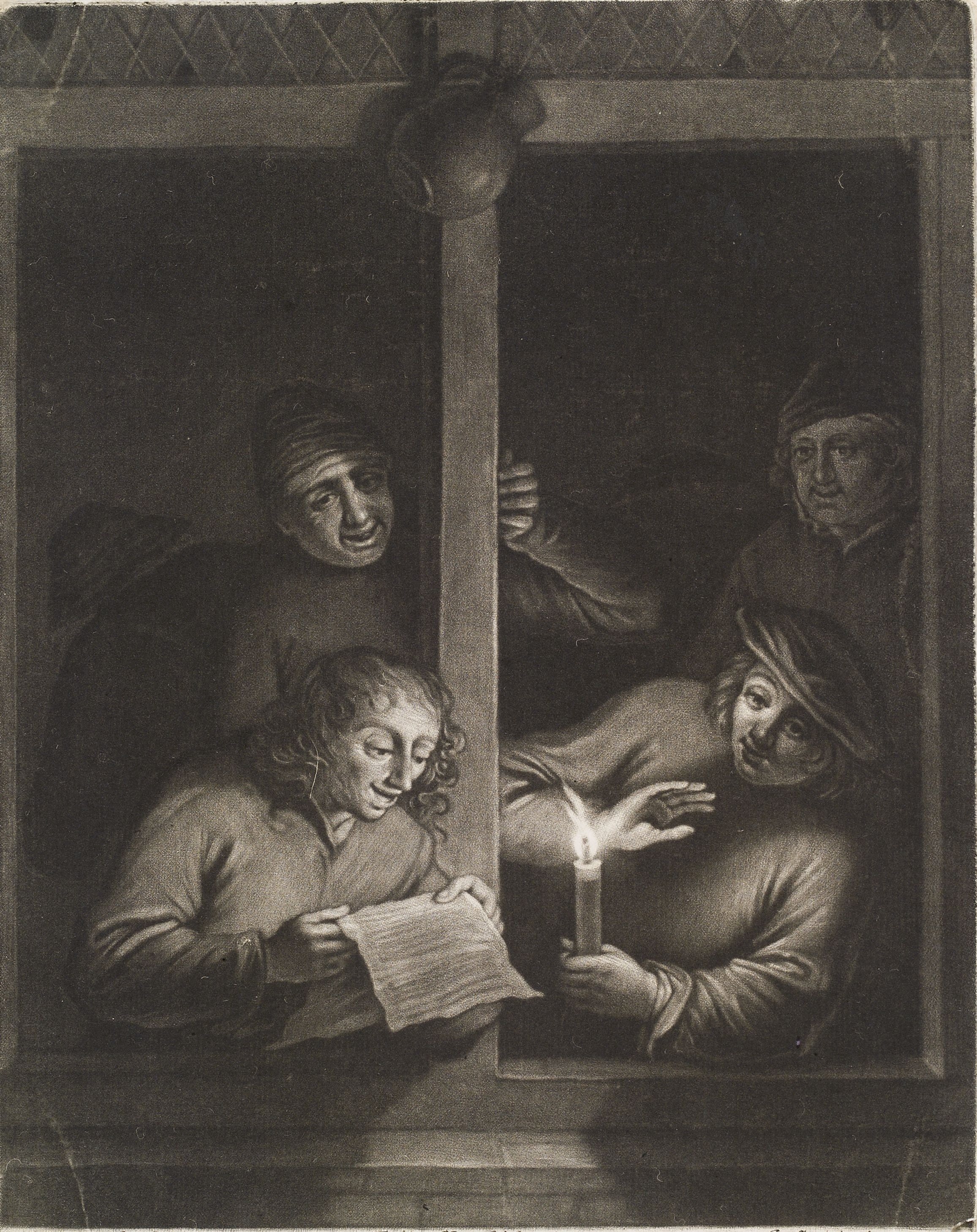
Singers in an alehouse window - hardly the same environment as sitting at my desk.

Singers in an alehouse window – hardly the same environment as sitting at my desk.

I developed a few thoughts on this in a short article for The Appendix, a new journal that embraces these new types of immersive and experimental history. You can read it for free here, and it would make sense to do so before reading on…. but, if you don’t have the time or inclination, here is the nub of it: I argue that it is important to think about how performance might influence the meaning of a seventeenth-century drinking ballad, and I applaud some recent attempts to recreate ballad performances. But I think they can misrepresent the tone in which such songs would have been sung.

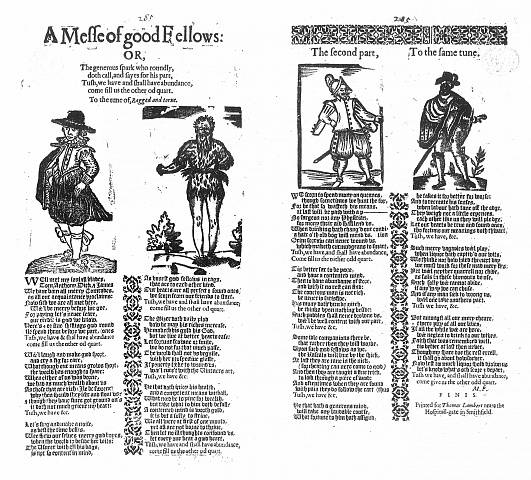
For instance, take a moment to listen to EBBA’s recording of the drinking ballad, A Messe of Good Fellows, by clicking here.
A Messe of Good Fellows (© British Library)

A Messe of Good Fellows (© British Library)

It’s helpful to hear it put to a tune, but surely the tone would be a little more raucous if performed by a company of intoxicated good fellows bellowing it out from the alebench?

A bit more raucous - a bit more like it...

A bit more raucous. A bit more like it?

Indeed, I suggest in the article that a modern-day football song – with a well-known tune, repetitive chorus, and an inebriated collective of (mostly) men – might actually come closer to capturing how such drinking songs would have been experienced in the alehouse. In case you haven’t had the pleasure of experiencing terrace tunefulness first hand, click here. I’ve tried to pick a relatively inoffensive one, but apologies to residents of Cardiff.
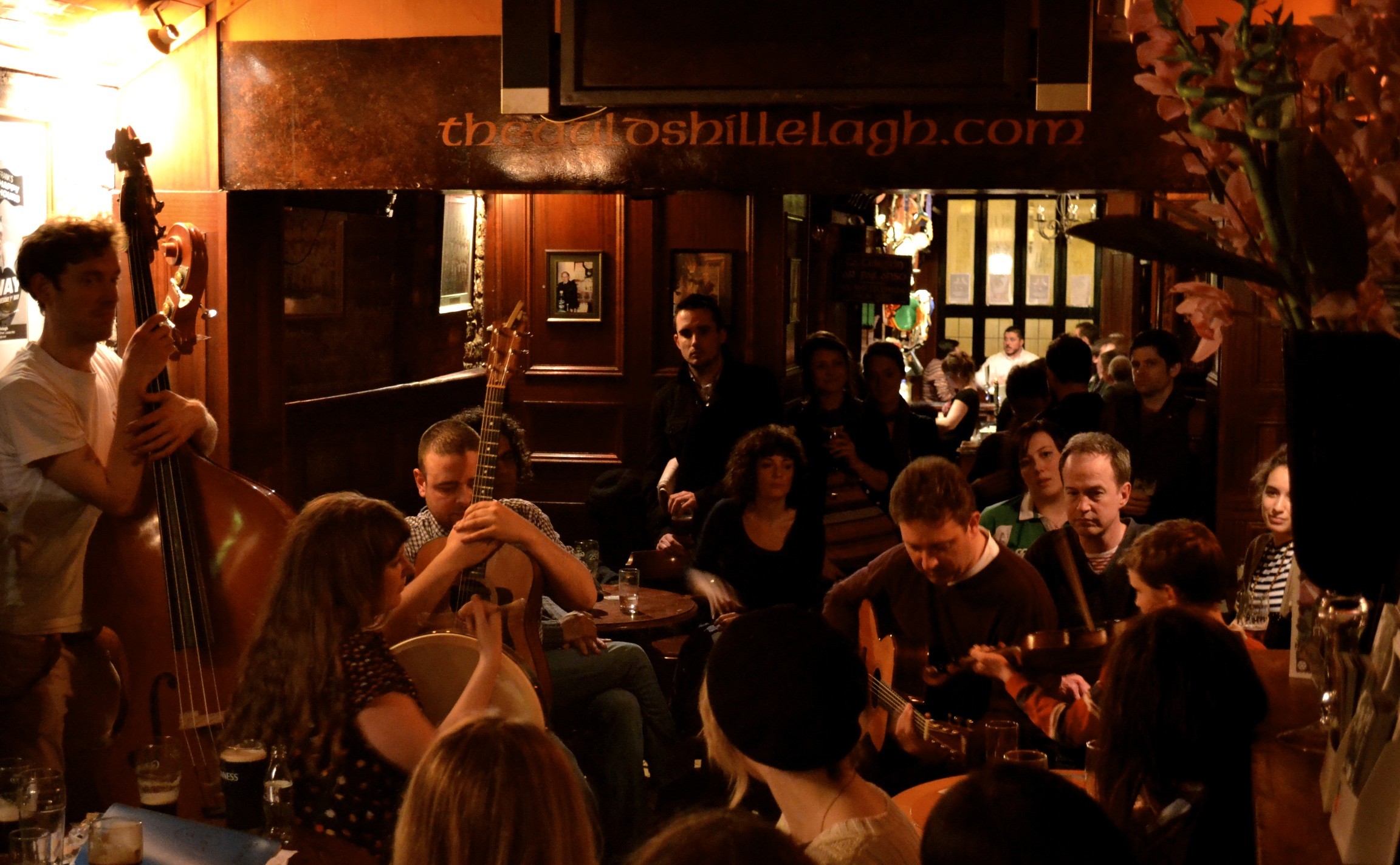
In response to the article I also received a suggestion from Phil Edwards, a Lecturer in Criminology at Manchester Met and an enthusiastic folk musician, that present day folk singing – often pub-based and communal – might be a closer descendent of the seventeenth-century alehouse song. I expect many historians would probably agree, but it is still a bit too sanitised and orderly for what I imagine performance would have actually sounded like. See what you think by listening to this ballad singaround recorded by Phil.

Are folk singarounds the key?

Are folk singarounds the key?

I’d be interested to hear your thoughts on which style of performance you think is most effective at ‘transporting’ us into the experiential world of our early modern forebears, but more importantly, I suppose, I’d like to know whether you think this little experiment in ‘immersion’ is a worthwhile exercise at all. Is attempting to recreate the sounds, or the smells, or the sights/sites, of the early modern past allowing just a little too much imagination into the historical process? It is undoubtedly an imprecise science, and we will never be able to capture with any certainty the tone of ballad performances – which no doubt varied immensely anyway. Is it therefore likely to be as often misleading as illuminating? A bit of fun perhaps – a harmless thought experiment to fill a coffee break – but not to be taken as a serious part of the historian’s craft? Or is the ‘immersive turn’ the next big thing, a way of bringing history to life that can enhance the understanding of both academic historians and non-academics alike?

Norwich Entertainments – Part VI: Rope dancing and nine-pins

Brodie Waddell

On 1 December 1677, the Norwich Mayor’s Court granted permission for a new performer to ply her trade in the city:

Mrs Saboul Rymers hath Lycence to make shew of Dauncing upon the Rope at the Redd Lion in St Stephens for a weeke from this day.1

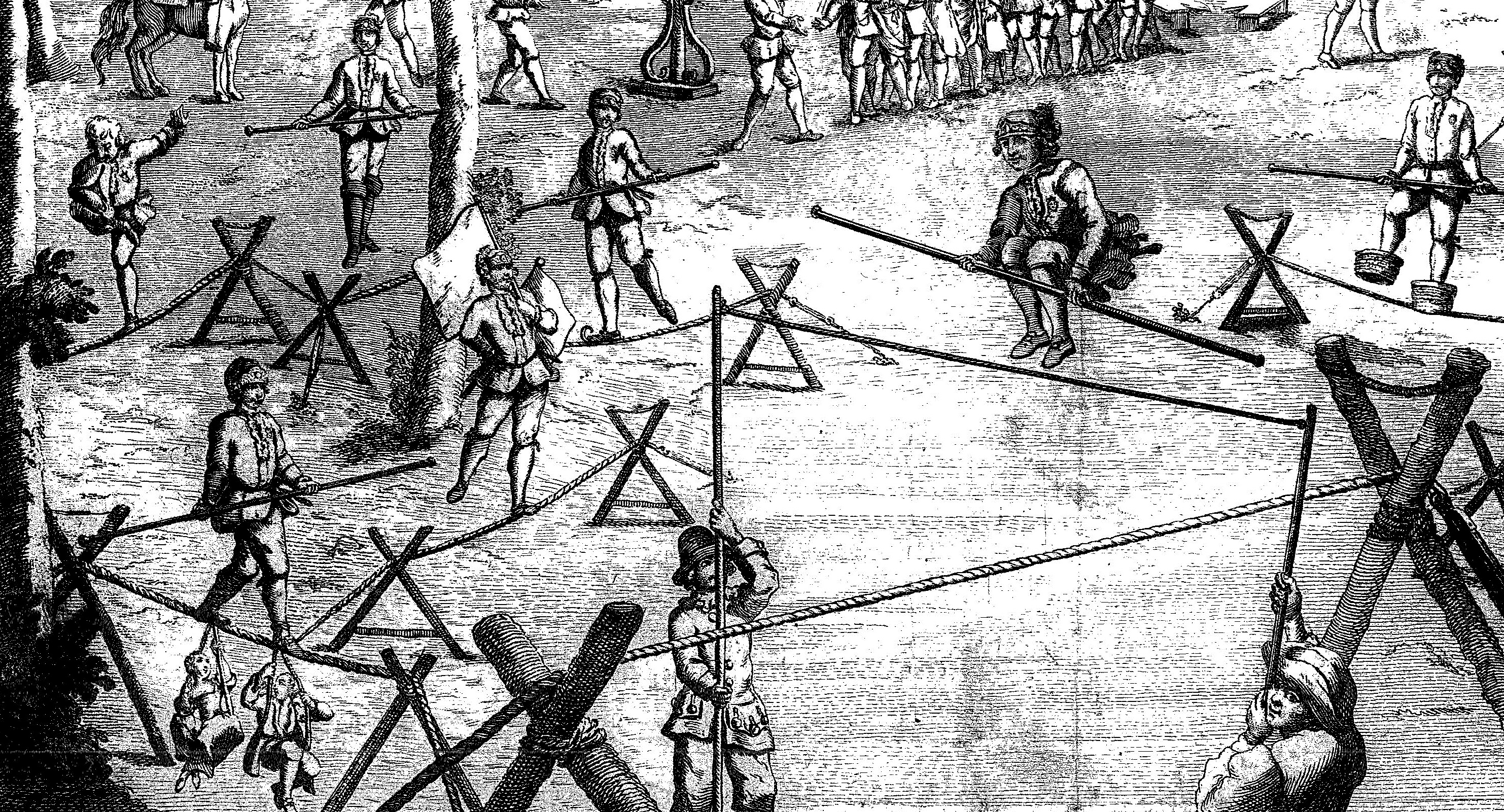
Rope dancing, now usually known as ‘tight-rope walking’, had already been a popular entertainment for thousands of years by the time Mrs Rymers arrived in Norwich. It was a common amusement in the seventeenth century, apparently beloved by rich and poor alike. The Duchess of Cleveland, King Charles II’s famous mistress, ‘greatly admired’ one these acrobats, and Samuel Pepys reported that he ‘saw the best dancing on the ropes that I think I ever saw in my life’ at Bartholomew’s Fair in 1664.

Rope dancers Continue reading

The Past is a Foreign Country: History and Analogy, Part II

Laura Sangha

sword

A visual analogy of analogy.

In my previous post on History and Analogy I explored why we use the technique and the ways in analogy can be a two-edged sword (if you will). Here I want to give some examples that I have come across recently when preparing for my module on Tudor England. I didn’t have to look far for these, evidence of the ubiquity of these types of comparison. Many are taken from G.W. Bernard’s The Late Medieval English Church, the book that inspired the original post. If you have any examples of your own, please do add them in the comments below.

The short and pithy:

G.W. Bernard is unable to resist analogies, whether historical or not. How about:

Did people collect indulgences in the spirit that we collect tokens or Air Miles?[1]

Or a W.G. Hoskins comparison passed on by Brodie that is short, pithy, and controversial to say the least:

Henry VIII was ‘England’s Stalin’.[2]

The elaborate and multi-layered:

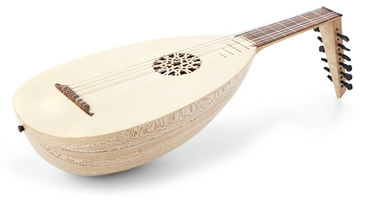
Grappling with the problem of how to perceive of early modern culture in Music and Society in Early Modern England, Christopher Marsh invites us to envisage culture as a lute, with each of it’s six strings representing:

Early modern culture made flesh.

Early modern culture made flesh.

…one of the basic socio-cultural polarities that helped individuals to understand their world and to locate themselves with it: gentle/ common, male/ female, old/ young, clerical/ lay, urban/ rural, native/ foreign. The extremes are permanently connected, and in tension, the strings form a musical staircase that allows for traffic in both directions, the sounds produced can be in harmony or might result in ugly clashes, anyone can pluck and strum as they see fit…[3]

The familiar:

If an analogy is a comparison between the familiar and unfamiliar, there is also a tendency for writers to use a concept that they know particularly well and which they would assume might therefore particularly resonate with their audience. Bernard’s comparisons of modern academic and late medieval religious institutions are a case in point, the author connects with his reader by drawing on what they have in common. In some instances, this can allow him to load his prose with a double meaning, as here:

How far were religious vocations – like those of modern academics – stultified by the piling up of administrative tasks, by the burdens of detailed administration of buildings and estates? Was there a loss, or a lack, of spiritual impetus and creative energy?[4]

The peculiarly appropriate:

In other instances, the analogy is pleasing because it is fitting, as with Alexandra Walsham’s allusion in her book on landscape:

Before we can begin to investigate the Reformation of the landscape, it is necessary to evacuate the sedimentary layers of religious association that had been deposited upon it over the course of the preceding two millennia.[5]

Religious cultures are actually slightly more complicated than these sediments.

Religious cultures are actually slightly more complicated and layered than these sediments.

The unintended:

Technically this is not an analogy, but given Bernard’s love of comparison it was hard not to read the following as a metaphor for the life of an early career academic:

…there was no necessary connection between ordination – a relatively straightforward matter – and the security of a benefice – a relatively difficult matter, since all turned on finding a suitable post. A priest might wait years before obtaining a benefice. Meanwhile he would seek employment as an assistant, as a deputy, as a chantry priest or as a chaplain in a domestic household… for which there were many opportunities… In practice they did play a considerable part in the religious life of a parish, despite lacking any formal pastoral responsibilities.[6]

Even if Bernard had not encouraged his reader to draw such parallels, current debate about the rectitude and extent of zero-hour contracts in academia reverberates through the passage.

The mundane:

Sometimes the comparison is straightforward and passes without much notice:

Of course, monasteries were organic entities, all that grows decays, and, just as in a garden, weeding and pruning deadwood were perennial tasks.[7]

The humorous:

At other times humour provides some light relief:

The tone of many Elizabethan congregations seems to have been that of a tiresome class of schoolboys.[8]

Any modern British university historian who has lived through countless administrative reorganisations, and seen the consequences of, say, the restructuring of local governments, will hesitate before pronouncing too confidently on the shortcomings of the monasteries in late medieval England.[9]

As with historical analogy, nitroglycerine should be handled with care.

As with historical analogy, nitroglycerine should be handled with care.

[On the real presence of Christ in the Eucharist:] the strength of conservative feeling at home, and the sensitivity of Protestant divisions abroad, made the issue the theological equivalent of nitro-glycerine: it had to be handled with care.[10]

And Patrick Collinson…

Patrick Collinson was renowned for his epigrammatic, witty and entertaining writing style, and the well-turned comparison was an important component of this. Jonathan reminded me of his special talent by passing on this wonderful bit of analysis:

When Picasso came to Sheffield to attend a peace rally, he sat on the platform making sketches and dropping them on the floor. Nobody picked them up. These preliminary sketches – Swallowfield and Terrington – can lie where they have fallen. Our subject is neither local government nor village republics, but the political culture of England at its centre and summit, in the age of Elizabeth I.

Here is a further selection, all drawn from the same chapter on the culture of Puritanism:

Traditionally, puritanism and culture have been seen as polar opposites, so that an essay on puritan culture might seem to merit no more space than the topic of snakes in that book on Iceland, which, according to Samuel Johnson, contained a chapter consisting of a single sentence: ‘There are no snakes to be found anywhere in the island’.

Shortly followed by:

But if man shall not live by bread alone, he must have bread, and perhaps some butter and even jam to spread on it; and it is not likely that puritans found all their needs supplied by ‘every word that proceedeth out of the mouth of God’.

Furthermore:

‘it was those local teacup storms which gave substance, a cultural or counter-cultural substance, to the very concept of ‘Puritanism’.

Now, whenever you see an okapi, you will immediately think 'Puritanism'.

Now, whenever you see an okapi, you will immediately think ‘Puritanism’.

And my favourite:

That is not to say that the thing identified as ‘puritanism’ had no real or prior existence, any more than the large quadraped which Sir Harry Johnston ‘discovered’ in the Ituri rainforests in 1900 had no existence until Johnston gave it a name, ‘okapi’.[11]

And we are still only on the third page of the chapter. It seems very fitting therefore that in his obituary, John Morrill used an analogy to sum up Collinson’s lifelong interest in Puritanism:

The obsession at its heart is the role of principled disobedience within powerful institutions, a study of those committed to reform from within. And that is how Pat saw himself… He became an establishment figure who struggled to square his radical conscience with membership of establishments.


[1] G. W. Bernard, The Late Medieval English Church: Vitality and Vulnerability before the Break with Rome (London, 2012), p. 143.

[2] W.G. Hoskins, The Age of Plunder (1976), p. 232.

[3] C. Marsh, Music and Society in Early Modern England (Cambridge, 2010), pp. 15-22.

[4] Bernard, The Late Medieval English Church, p. 197.

[5] A. Walsham, The Reformation of the Landscape: Religion, Identity and Memory in Early Modern Britain and Ireland (Oxford, 2011), p. 18.

[6] Bernard, The Late Medieval English Church, p. 79.

[7] Bernard, The Late Medieval English Church, p. 190-1.

[8] K. Thomas, Religion and the Decline of Magic: Studies in Popular Beliefs in sixteenth- and seventeenth-century England  (London, 1971), pp. 191-2.

[9] Bernard, The Late Medieval English Church, p. 196.

[10] P. Marshall, Reformation England 1480-1642 (London, 2003), p. 65.

[11] P. Collinson, ‘Elizabethan and Jacobean Puritanism as Forms of Popular Religious Culture’ in C. Durston & J. Eales (eds), The Culture of English Puritanism 1560-1700 (Basingstoke, 1996), pp. 32-4.

The Past is a Foreign Country: History and Analogy, Part I

Laura Sangha

I’ve just finished G.W. Bernard’s The Late Medieval English Church, which is an excellent and well informed survey, in case you are wondering. One of the things that made it a particularly enjoyable read were the analogies that peppered the text, which were thought-provoking and on occasions mischievous. For example:

The attitude of medieval townsmen to their local cathedral was, it has been suggested, rather like that of their successors to modern universities: an ambiguous mixture of slight suspicion and considerable incomprehension was alleviated by a natural pleasure that this corporate giant might contribute to their own prestige and economic welfare.

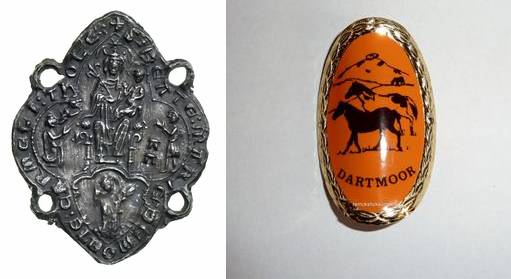
Should pilgrim badges… be seen as sacred objects, almost ‘secondary relics’, for those who acquired them, or more like the souvenirs that day trippers buy today? … Medieval pilgrimage has been compared to modern museums, full of half-comprehending tourists, of young people having a day out, yet with serious and scholarly purposes at their core. Are the experiences of those who go church-crawling, or visit the blockbuster exhibitions in art galleries, or go to concerts at all comparable? Does the ritual of pilgrimage meet a perennial human need?… How many pilgrims took part in pilgrimages in much the same part-materialistic, part-sentimental way that many nowadays treat Christmas? [1]

The early modern pilgrim badge and its modern walking stick equivalent?

The early modern pilgrim badge and its modern walking stick equivalent?

Along with Brodie Waddell’s recent post on jargon and Mark Hailwood’s comparison of early modern alehouse ballad singing with modern football chants, it got me thinking about language, and more specifically about the way that we use analogy in writing and teaching. For historians, the carefully picked parallel is a potent weapon, it provides an inference or argument from one (familiar) particular to another, in the process attaching meaning to the unfamiliar particular. Analogy enables us to grasp the new and to process the different. For the early modernist, this is especially useful, because a parallel can help us to negotiate the strangeness of our subject and to close the gap between the mysterious and murky past and the bright shiny present. This is exceptionally useful when it comes to teaching: when I challenge my students to try to understand the early modern mentality I often begin by inviting them to self-reflect on their own experience, before exploring the early modern equivalent. So you might ask students to list what they think are the main elements of ‘identity’ in the present day, before discussing how early modern people thought about the same, the comparison drawing attention to those areas of similarity and difference which then invite explanation.

Similarity as well as difference is of course key here. Historical analogies are neat, effective and pleasing, but also fraught with peril because it is unlikely that the two particulars in the analogy are exactly the same. Bernard acknowledges as much:

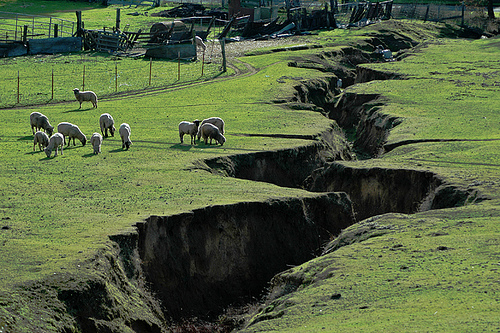
Another scholar has offered the metaphor of ‘faultlines in the landscape’ but, while that is suggestive, it nonetheless rests upon the underlying inevitability of the coming earthquake.[2]

faultline

Just imagine the Late Medieval Church criss-crossed with lots of these.

In similar vein, Versailles might have ‘sowed the seeds of the second world war’, but this suggests a dangerous teleology that might distort our understanding of the interwar years. Thus a facile or lazy comparison can obscure rather than illuminate. Politicians and journalists in particular play a dangerous game  when they use analogy in association with events that are still unfolding, or to justify actions or simplify complexity. Recently, the labeling of the wave of demonstrations and regime changes in North Africa and the Middle East as the ‘Arab Spring’ (an allusion to the Revolutions of 1848 and the Prague Spring) has fitted rather awkwardly with subsequent developments that bear no relation to the promise of rebirth, liberation and growth usually associated with the pre-summer season and the historical precedents. One commentator notes that:

It appears that the right analogy is a different central European event — the Thirty Years’ War in the 17th century — an awful mix of religious and political conflict, which eventually produced a new state order.

Analogies surely work best only when the dissimilarities of the two things are considered alongside the parallels – the analogy can in fact help you to identify both. Ruling out unsuitable analogies is also a useful strategy, as Peter Marshall does when describing the processes of the English Reformation:

The modern analogy is less with the overthrow of ancien regimes in 1789 and 1917 than with the ‘cultural revolution’ of 1960s China, in which central government worked in alliance with cadres of true believers to undermine reliable elements in positions of authority, and radically reconstruct the outlook of people as a whole.[3]

More in common than you might think?

More in common than you might think?

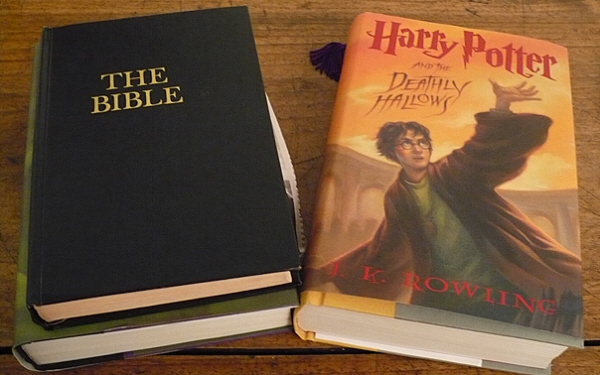
It is always a delight when students come up with their own analogies, because it reveals their learning: their coming to terms with information and expressing their own understanding of it. When discussing oral culture, and the astonishing feats of memorisation that early moderns were capable of, one student declared that it wasn’t that surprising that people knew the Bible off-by-heart, as she felt sure that if someone named a chapter from any Harry Potter novel she would be able to recall the important events from memory. Other memorable comparisons were Henry VIII’s visitation officers as ‘Ofsted Inspectors’, Elizabeth I’s beauty ‘trending’ at court, and Charles I’s relationship with the Duke of Buckingham as a classic ‘bromance’. These are not simply throwaway comments, they reveal students grasping and reframing the past in a way that resonates with their own existing knowledge.

**I followed this up with another post with examples of different types of analogies, incorporating those suggested to me by readers.**


[1] G. W. Bernard, The Late Medieval English Church: Vitality and Vulnerability before the Break with Rome (London, 2012), pp. 159-60; 143.

[2] Bernard, The Late Medieval English Church, p. 236.

[3] P. Marshall, Reformation England 1480-1642 (London, 2003), p. 58.

Tudor history on TV, and a partial review of David Starkey’s ‘Music and Monarchy’…

Jonathan Willis

Early modern history has done pretty well out of the BBC lately. Earlier this year, in late May and early June, there was a season of programmes (apparently 5 documentaries constitute a ‘season’) based around the Tudor Court. We had an interesting and quite adventurous treatment of The Last Days of Anne Boleyn, which made the brave decision not to give top billing to a single authoritative historical narrator, or wrap up its argument with neat historical conclusions, but instead featured a real diversity of opinions from half a dozen historians and historical novelists. Diarmaid McCulloch presented a view of Thomas Cromwell which, while at first glance appearing to owe much to GR Elton, also contained a few tantalising hints of the major new biography he is working on (and which I for one am very much looking forward to reading). Thomas Penn told the story of Henry VII, Winter King, and Ian Mortimer presented a Time-Traveller’s Guide to Elizabethan England. And finally, Melvyn Bragg made the case for William Tyndale as The Most Dangerous Man in Tudor England in appropriately evangelical mode, in a strange piece of film which was shot like an episode of the late-lamented popular BBC spy drama, Spooks.
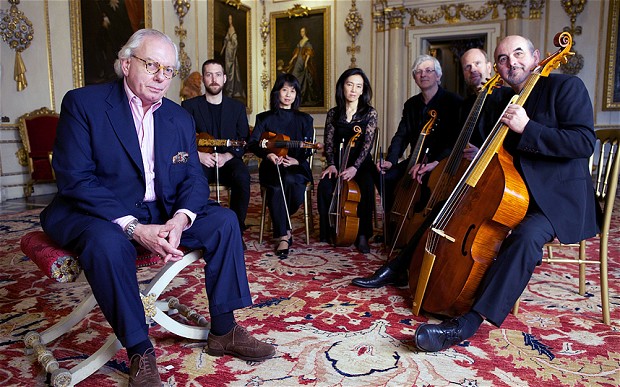
spooks002These documentaries were accompanied by re-runs of the Showtime series, The Tudors (which I don’t intend to dissect here!), and all in all I think that this sort of documentary interest in the period is, in the immortal words of Sellar and Yeatman, A Good Thing. Another recent onscreen foray into Tudor England has been conducted by David Starkey, in his four-part series Music and Monarchy, which began airing on 20 July and finished on Saturday 10 August: UK residents can still catch it on iplayer. Entitled ‘Crown and Choir’, the first episode looked at ‘royal music’ in England from Henry V to the death of Elizabeth I. I have to say, that as a historian who has written a fair amount about sixteenth century music, I had somewhat mixed feelings about watching this documentary. I like the fact that the history of music is something that people (and documentary-makers) seem to be increasingly interested in: in recent years the BBC has also given us Sacred Music and Howard Goodall’s Story of Music, both of which were interesting pieces of television. But music and monarchy? Starkey is of course primarily an historian of elites, and of court culture. But (and I hope that, given the recent online symposium on history from below, I am preaching largely to the converted) the story of music in the sixteenth century is so much more interesting than that, in terms of the broader role it played in popular culture and religion. david-starkey_2622826b

On balance, watching this first episode of Music and Monarchy I was pleasantly surprised. Starkey, for all his controversy and confrontational style as a commenter on current affairs, is a compelling and captivating storyteller, and it’s pretty clear that he is passionately interested in his subject. The tone strikes about the right balance: it isn’t overly simplified or patronising, and neither is it loaded with too much technical jargon. Occasionally Starkey allows his effusiveness about the music to cloud what could be a more rigorous analysis, but this is popular TV, not an academic lecture. He talks to a small number of musicians and academics, including the multi-talented David Skinner, and includes lots of long, sumptuous performances of pieces of early music in the venues in which they were (or at least in which they could possibly have been) performed. All in all then, this documentary too, to my surprise, is probably A Good Thing. Except… For 50 minutes of ‘Crown and Choir’ I broadly enjoyed what I was watching. But for the last 10, I pulled out my hair, and if my train carriage had had opening windows I might have thrown the iPad I was watching out of one of them. This is for two main reasons.
ipadrepairspreston

Bad Thing #1. In large part, the interplay between music and monarchy (and religion) was dealt with well, but in the final ten minutes what had functioned quite successfully as a lens turned suddenly into a pair of blinkers. Elizabeth I saved church music, we were told (partly right), but not only that, she did it singlehandedly, solely by maintaining a chapel royal of equivalent musical magnificence to her father, Henry VIII. Inside it, Elizabeth composed for herself a warm and dazzling sacred oratorio; beyond her chapel was merely a cold and frosty Protestant wasteland. Now that is just plain wrong. Even if we leave aside the complex musical picture in the Elizabethan parish church, which may well have still contained an organ, a choir, or at least a couple of paid singers, what about the musical livings she preserved elsewhere, and the university college and cathedral choirs up and down the country? True the chapel royal was probably the best resourced choir in Elizabethan England, but its musical reputation was maintained in part by poaching singers and composers from other musical establishments, such as the composer and organist William Byrd from Lincoln Minster.

Bad Thing #2. Where the parish church was briefly mentioned, it was as a cold, austere, whitewashed box, devoid of all visual and oral ornament. Cue a group of aged parishioners slowly and tunelessly droning out the ‘Old Hundredth’, a musical oxymoron; ‘all people than on earth do dwell, sing to the lord with cheerful voice’! That, Starkey observed, was as good as it got: the best that the man in the street (or at least the parish church) could aspire to. Again, leaving aside the complexity of the parish situation, which I would characterise as a vibrant and amorphous fusion of traditional and innovatory musical forms, the problem with this sort of approach is that it harks back to an outdated musicological approach that equated musical ‘quality’ with historical significance. Congregational metrical psalmody might not be the sort of music that features on the glossy CDs produced by modern choirs like the Sixteen or the Tallis Scholars, but that does not mean that it lacked value or importance (interestingly, the bibliography of the book that accompanies the series references rather dated literature on this topic, such as Temperley’s 1979 Music of the English Parish Church). For the first time, ordinary men and women were invited to play an active and participatory role in parish church worship, by joining in and singing praises together in one resounding voice. Starkey even misses a trick here in terms of his focus on music and monarchy. Such was the popularity and success of congregational song, that in the 1570s the government produced a series of metrical anthems, to be sung to familiar tunes to the glory of both God and the Queen. These works were most obviously to be sung on the ‘Crownation Day’ celebrations of 17 November, and far more people sang them than ever even heard Byrd’s beautiful motet, O Lord, let thy servant, Elizabeth. The reason that the vernacular sacred oratorios of Handel proved so popular in the eighteenth century, one might surmise, is at least in part because by that point the English had been singing themselves Protestant for the best part of two centuries. The reformation had effectively turned every parish church into a choir, albeit often a not very good one.

I don’t feel professionally qualified to comment on the rest of the series, and anyway this is supposed to be a blog, not a monograph. I’m now three-quarters of the way through, and broadly I think that his perspective is an interesting one, and that the documentary is a Good Thing – it might even inspire some people to find out more. But just as the story of popular religious music cannot be told without paying some attention to the interventions of kings and queens, so the musical legacy of kings and queens cannot be properly told without paying some attention to popular reception. And ‘reception’ in this context should not be envisaged as a passive process, but as a means by which people helped to shape the Protestant nation of which they themselves were part.