Norwich Entertainments – Part V: Ballad-singers and dangerous news, with coffee

Brodie Waddell

The people of late seventeenth-century Norwich did not get their entertainment solely from hairy children and pieces of plays. They also amused themselves with the ever-growing numbers of printed works that were pouring from the presses at that time.

In June 1680, for example, the Norwich Mayor’s court ordered that ‘Twoe Ballad singers haveing Lycence to Sell ballads, pamphlets small bookes & other bookes Lycensed from the Office of the Revells have leave to doe soe until Monday senight [?seven-night]’.1

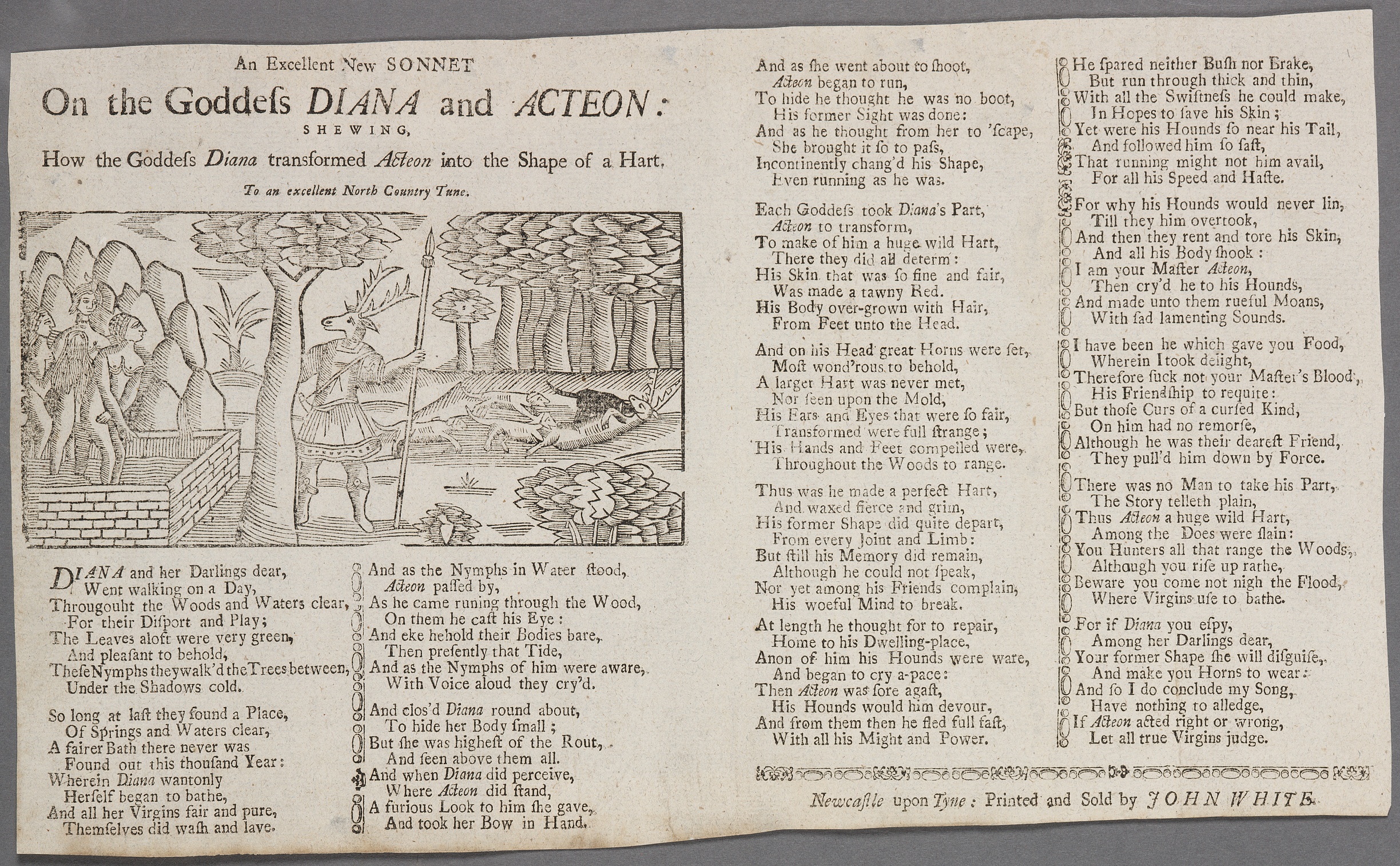
Ballad entitled ‘An Excellent New Sonnet On the Goddess Diana and Acteon’ (c.1725-69). EBBA.

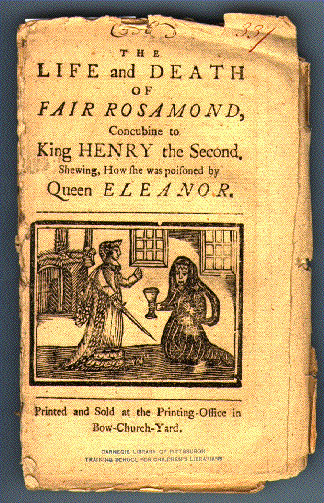
Title-page of a chapbook titled ‘The Life and Death of Fayr Rosamond’ (1755). SF.

These balladeers were just two of the hundreds that traipsed through the city streets and country lanes of early modern England, singing to advertise their wares. The exact contents of a peddler’s sack could be very diverse. In addition to all sorts of petty trinkets, they sold tales of drunken sailors, royal mistresses, industrious spinsters, and much else besides. Often these were in the form of broadside song sheets, but they might also be ‘pamphlets’ and ‘small books’, sometimes called chapbooks, written in prose to provide merriment or salvation for the price of penny or two. Margaret Spufford and Tessa Watt, among many others,  have discussed this ‘cheap print’ in much more detail, noting that ballad-sellers were often condemned by the authorities as vagrants. But in late seventeenth-century Norwich at least they seem to have been welcomed by both the townspeople and city officials.

Rather more unusual, however, was the license issued to a man a year earlier. In November 1679, the court declared that ‘Lawrence White is allowed to reade & sell Pamphlets on Horsebacke untill Wednesday next’.2 Continue reading

John Dee’s conversations with Angels

Laura Sangha

Question: Why would you want to have a conversation with angels? More specifically, why would you want to have a conversation with angels if you were a sixteenth-century mathematician, philosopher, court astrologer and magus? And how would you go about doing it?
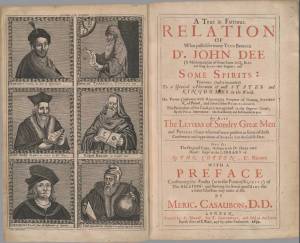
Sections of Dee’s record of his conversations with angels were published by Protestant minister Meric Casaubon in 1659.

Elizabethan John Dee had some very clear answers to these questions, as is evident from the records he left us of hundreds of conversations conducted with angels between 1583 and 1587. The earliest record of his angelic conferences is prefaced by a prayer in which he outlined his motivation. He confessed how he had prayed since his youth for ‘pure and sound wisdom and understanding of your [God’s] truths natural and artificial’, truths which were to be used for the honour of god and the benefit of humankind. However, although he had studied long and hard, in many books and places, and conferred with many men, he had become disillusioned with conventional routes to knowledge and what he called ‘vulgar scholar’. His lifelong struggle to acquire a universal wisdom from dogged researches in mathematics, astrology, optics, geography, navigation, history and other disciplines had not yielded the results that he was hoping for – true wisdom remained elusive. All was not lost though, as Dee came to the conclusion that there was another way to attain the better understanding that he sought, and that was through direct consultation with angels.
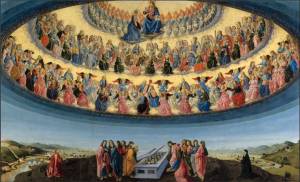
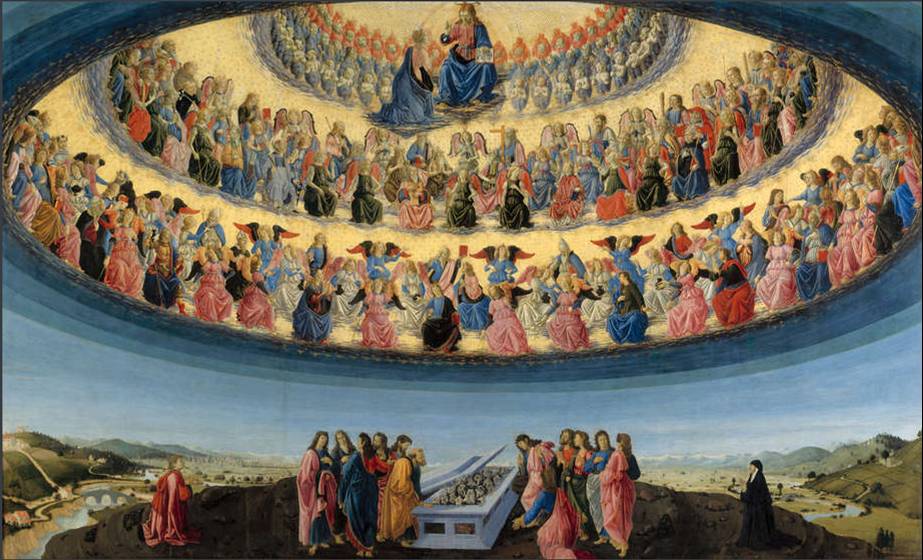
Botticini’s ‘Assumption of the Virign’ (1475) depicts the 3 orders of the angelic hierarchy in all their glory.

Early modern folk understood that angels were the next step down from God in the universal hierarchy, and this nearness meant that they were endued with a special knowledge, much superior to the cloudy understanding of mankind. Dee knew that in the past God had sent his angels to men like Enoch and Moses, to ‘satisfy their desires, dowtes and questions of thy secrets’, giving them access to this true wisdom that had originally come directly from God. Conversations with angels therefore had a firm scriptural precedent, and could give man access to an ancient esoteric wisdom that had originally been communicated to Adam, but which had been lost and forgotten over the course of human history. The arts of divination and magic were fragments of this original, pristine knowledge, and the angels had the potential to fill in the missing gaps. Dee’s reasons for conversing with angels were therefore, in his mind, spiritually and intellectually sound. They were the culmination of his lifelong efforts to decipher the book of nature and to discover a universal science that could bridge the gap between heavenly wisdom and faulty human perception. His dialogues were designed to build a Jacob’s ladder to the other world. Importantly, as well as seeking this recondite knowledge, Dee was also looking for signs of his own salvation, as every good Protestant should, and he thought that his conversations were proof that he and his assistant (or scryer) were, like Enoch and Moses, the specially chosen recipients of divine knowledge. For Dee, his actions were thus a type of religious experience sanctioned by scriptural precedence.

The practicalities of Dee’s conversations reinforce this idea. The ceremonies began in the simple religious atmosphere of an oratory, a chamber in Dee’s house that had been set aside for the purpose of conducting the conversations. He and his scryer, Edward Kelly, began with a period of silent prayer. Most often Dee would humbly petition God to send his angels, addressing God and Jesus as the embodiment of wisdom, and asking that Dee and Kelly be worthy of divine aid in understanding. Dee was acutely aware of this need to be worthy, he placed great emphasis on approaching the conversations in a proper spirit of piety, and the angels themselves delivered frequent homilies on Dee and Kelly’s sins, the nature of salvation, and the necessity of complete obedience to God as a prerequisite of receiving the whole revelation. But unlike with medieval magic, initially there were no elaborate ritual preparations or ceremonies, no incantations, hymns, purifying fumigations, candles or talismans to attract the influences of the planetary angels. The one piece of magical apparatus that Dee and Kelly did have was a ‘shew-stone’ through which the scryer saw the visions of angels.
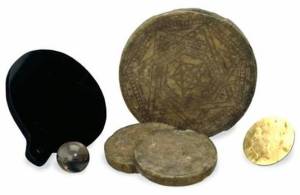
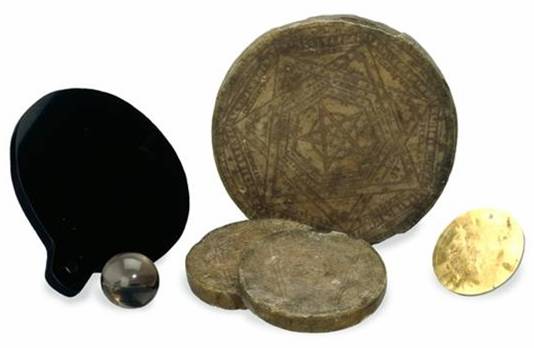
You can see the shew-stones and wax discs Dee used in his conversations at the British Museum.

Dee never saw or spoke to the angels himself, they appeared to Kelly, who related the information back to him – an angel told them that Kelly saw the angels ‘in sight’, whereas Dee could only see them ‘in faith’. The original shew-stone was probably a circular flat black mirror of polished obsidian, but there were several others, including one which was delivered by the angels themselves, as described by Dee:

I cam within 2 feet of it, I saw nowthing, then I saw like a shadow… on the ground.. hard by my books under the west window. The shadow was roundish, and less than the palm of my hand. I put my hand down upon it, and I felt a thing cold and hard, which taking up, I perceived to be the stone before mentioned.

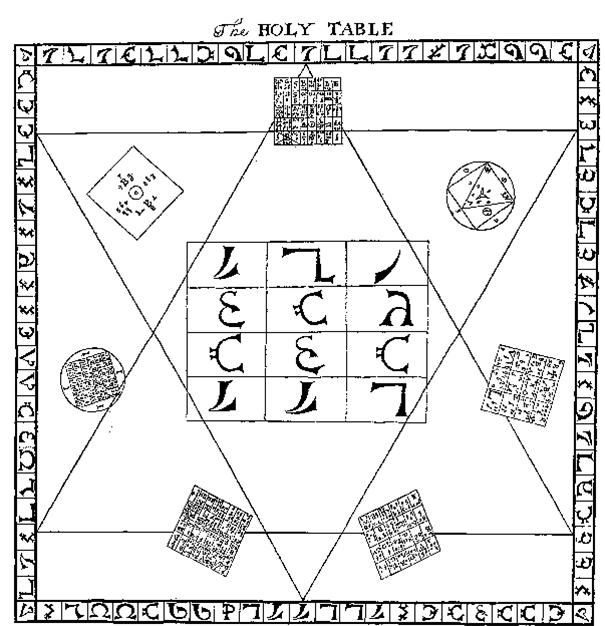
The scrying stone was the bridge between the divine and earthly worlds. Over time, other new ritual elements began to creep into the conversations, bringing a greater ‘magical’ aura to proceedings. The angels gave direction for a table of practice decorated with various mystical symbols, and for a seal of God to be inscribed on wax discs which were then placed under the legs of the table and beneath the shew-stone on the table.
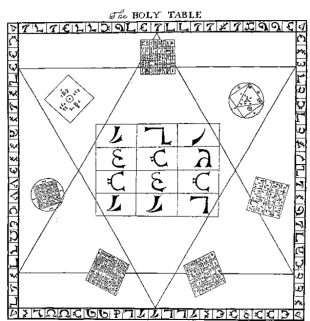
The holy table used in the conversations. The angels instructed Dee in its design.

So did it work? Did Dee achieve his aims? It certainly wasn’t a complete failure – numerous spirits appeared to Kelly and extensive conversations were conducted. Most often the visitors were the archangels Michael, Gabriel, Raphael and Urial, although another, Madimi was also a regular visitor. The apparitions appeared in a variety of guises: they might look like a young girl, or a husbandman in red apparel, a yellow haired women who was like an old maid, or on one occasion just like ‘a big tall creature’. During the conversations with these celestials, two main forms of knowledge were conveyed to Dee. Firstly, the angels provided many grid like tables purporting to be an angelic alphabet.
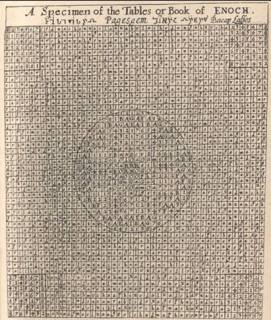
One of the grids relating to the angelic alphabet. The angels selected letters from the grids to make words and sentences.

This represented a divine language, which if mastered would allow Dee to know the true nature of all things. Secondly, the angels provided information about the names and responsibilities of the angels – the sections of the air that they ruled, the angelic tribes that they belonged to, and the number of subordinates that they controlled.

In the first Air: the ninth, eleventh, and seventh Angel of the Tribes, bear rule and govern. Unto the ninth, 7000. and 200. and 9 ministering Angels are subject…. The whole sum of this Government amounteth to 14931

This information about the angelic hierarchy would eventually give Dee command over the angels and would allow him to participate in the society of angels. Unfortunately for Dee, his attempt to use religious magic as a means to ascend up the universal hierarchy was ultimately a failure. The angelic language and spiritual hierarchies that he learned from the angels were not the pristine knowledge that he sought, they were just the means to access that knowledge, and the language and hierarchy were only partially complete in any case. Dee went to his grave without having unlocked the secrets of nature, though fortunately for us he recorded his endeavours in great detail, giving us an insight into the pious, rational, yet strange and alien world of the Elizabethan intellectual elite.

Want to know more? [*endorsement alert*] I discuss many of the other beliefs associated with angels in my recent book. If you want to know more about John Dee try these:

  • M. Casaubon, A True and Faithful Relation of what passed for many yeers between Dr. John Dee … and some spirits (London, 1659).
  • N. Clulee, John Dee’s Natural Philosophy: Between Science and Religion (London, 1988)
  • D. Harkness, John Dee’s Conversations with Angels: Cabala, Alchemy, and the End of Nature (Cambridge, 1999)
  • W.H. Sherman, John Dee: The Politics of Reading and Writing in the Renaissance (Amherst and Boston, MA, 1995)
  • G. Szonyi, John Dee’s Occultism: Magical Exaltation through Powerful Signs (Albany, NY, 2004)

Workers’ Representation Part Two: Making Hay

Mark Hailwood

Herein lies the second installment of my blog series on woodcut images of workers

As I sit here in fenland fog, my mind drifts back to sun-baked Californian afternoons at the Huntington Library. Often I would avail myself of a short break from such wonders as the Ashby-de-la-Zouch manor court records, and pop upstairs to the office of the Director of Research, Steve Hindle (who also happens to have been my PhD supervisor) to either pick his brains or raid his bookshelves.

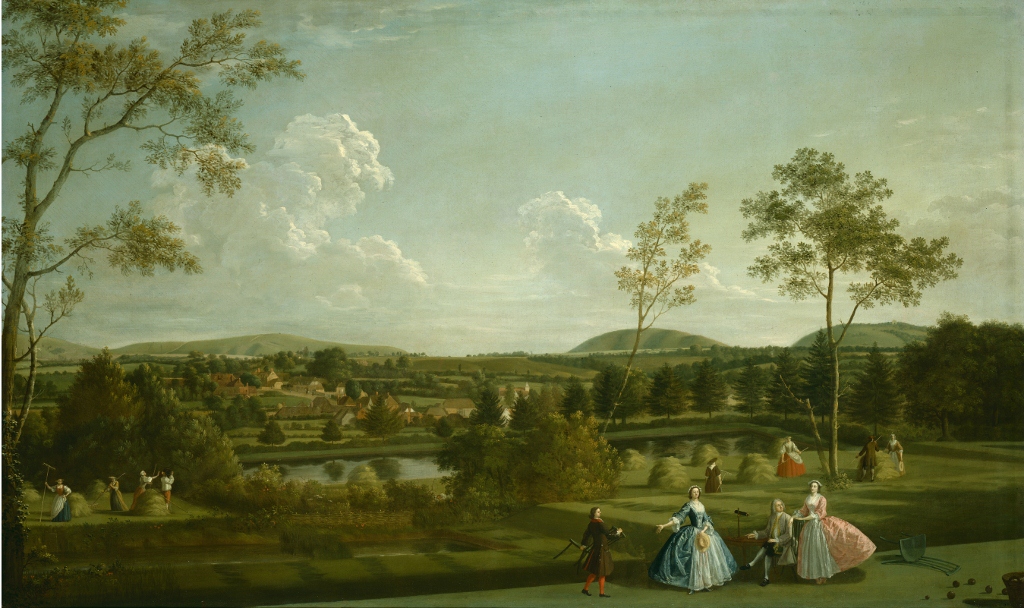
On one such afternoon we fell to discussing the following painting that hangs upon his office wall, a depiction of the Montagu family at their Sandleford Priory estate in Berkshire, by Edward Haytley, commissioned in 1743:

The Montagus at Sandleford Priory
Source: hayinart

At first I was a bit worried – what was this flag bearer of ‘history from below’ doing with an aggrandising portrait of the rural gentry in pride of place on his wall? Continue reading

REED all about it – Part II: Angelic sheep-stealers, iconophobia, and the unaccountable longevity of ‘Merry England’?

Jonathan Willis

Last month I wrote a REED-related post about a minor scuffle at a church ale in Bere Regis in 1590, but this time I would like to highlight a more significant and well-known case, to my mind one of the real gems of the REED material: the controversy surrounding the performance of the Whitsun plays in Chester during the early 1570s.[1]  There was a rich history of sacred drama in Chester going back at least as far as the late fourteenth century, including plays to celebrate Easter, midsummer, and Corpus Christi.  By the sixteenth century, it was held that the ‘old and Antient Whitson playes’ held annually in the city were ‘first made Englished and published by one Randall Higden a monk of Chester Abbey, and sett forth and played at, and by the Citizens of chester charge In the time of Sir Iohn Arneway Knight, and Major of Chester Anno 1268’.[2]  In 1571-2 the plays were still going strong, and detailed guild accounts give a fascinating insight into both the performances themselves, and the degree of time, effort and resource which went into their preparation.  The Smiths, Cutlers and Plumbers’ Records for that year recorded 3d for equipment (a ‘touyle’), 1s 4d for casting costs (‘seekinge our players’), and 7s 8d worth of beef to sustain them ‘for our genrall rehearse’, along with two whole cheeses and spices for the meat.[3]   An amateur dramatics group, like an army, evidently marched on its stomach, as payments for bread over three separate rehearsal days totalled 4s 10d, and to quench the assembled thirst there was 10s worth of ale and 9d of small ‘beare’.  Alongside the players, payments were also made to musicians and minstrels, as well as 4s 2d ‘to the clergy for the songes’, implying a close relationship between the professional religious institutions of the city (quite possibly the choir of Chester Cathedral) and the amateur efforts of the trade guilds. Continue reading

Fantastic Thoresby – Part I: Dangerous Diaries

Laura Sangha

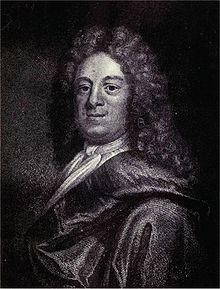
Ralph Thoresby, 1658-1724.

The time has come to introduce many-headed monster readers to my current historical obsession: Ralph Thoresby (1658-1725). Thoresby, the son of a wool merchant, was a well respected antiquarian and topographer, a dissenter who conformed to the Church of England later in life, a husband, a father, a historian, a fellow of the Royal Society, the owner of a museum, a prolific correspondent, and a diarist. Over the summer, I had the pleasure of delving into Thoresby’s diary, which was transcribed and published by the Reverend Joseph Hunter in 1830. Future posts will deal with the content of the diary, which reveal a likeable, pious, and reflective man, but reading it also got me thinking about the ‘diary’ as a historical document, and it is this that I will deal with in this initial post. Continue reading

Eric Hobsbawm: some personal reflections

Brodie Waddell

Busy though I may be, I can’t help but note the death of Eric Hobsbawm and offer a few thoughts.

No doubt our readers will already be familiar with Hobsbawm and his work. If not, the lengthy obituary in the Guardian or this article by the historian Mark Mulholland will make clear his perhaps unmatched contributions to historical knowledge, both popular and academic.¹

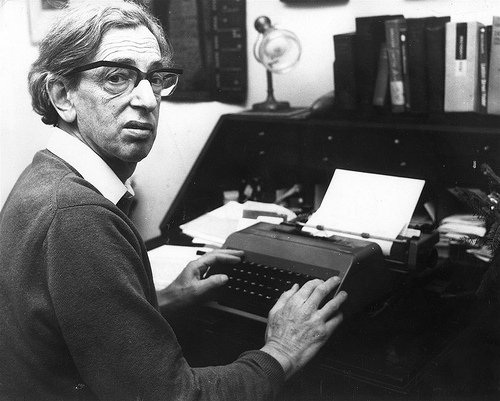
Eric Hobsbawm at his typewriter. Source: John Brown via Jacobin.

Rather than recount his fascinating life or delve into his most famous works, I’d like mention how he (unknowingly) touched my life at a couple of important moments.

The first took the form of his book Uncommon People: Resistance, Rebellion and Jazz (1998) which I received as a gift for, I believe, my seventeenth or eighteenth birthday from my infinitely thoughtful uncles. At the time, I was vaguely interested in history but my contact with truly artful historical writing was negligible. Then I opened this book and found an essay entitled ‘Political Shoemakers’:

The political radicalism of nineteenth-century shoemakers is proverbial. Social historians of a variety of persuasions have described the phenomenon and assumed it needed no explanation. A historian of the German revolution of 1848, for example, concluded that it was “not accidental” that shoemakers “played a dominant role in the activities of the people”. Historians of the “Swing” riots in England referred to the shoemakers’ “notorious radicalism” and Jacques Rougerie accounted for the shoemakers’ prominence in the Paris Commune by referring to their “traditional militancy”. Even so heterodox a writer as Theodore Zeldin accepts the common view on this point. The present paper attempts to account for the remarkable reputation of shoemakers as political radicals.²

The essay goes on to provide plenty of colourful examples drawn from across the globe, but by the time I’d read the first sentence I was already hooked. The image of the militant shoemaker, writing radical manifestos and taking to the barricades, was simply too wonderful for a nerdy teenager to forget.³

Not long after receiving Uncommon People, perhaps in my first or second year as an undergraduate, I came across his Primitive Rebels (1959) in a used book store. I think this may have been the first time I found a work of history that was not only interesting and politically appealing, but also made an important argument about the nature of past societies. Indeed, the book almost single-handedly created a whole new analytical category: ‘social crime’.⁴ I’m not going to claim it was the light on the road to Damascus that turned me into a budding historian, but in retrospect I think it helped to push me in that direction. It’s no accident that the undergrad module I put together for this year includes a week focusing on the debate that this concept spawned.

Hobsbawm’s writing room, reassuringly messy. Source: Eamon McCabe via the Gaurdian.

And then, many years later, whilst looking around for something to do at the expiration of my fellowship at Cambridge, imagine my delight at being invited for an interview for a post at Birkbeck. Founded in a tavern as the London Mechanics’ Institute back in 1823, this was the place that Hobsbawm made his academic home when become a lecturer there in 1947. He was still its nominal President when I applied there last year and, despite being in his nineties, my colleagues recount vivid memories of him still occasionally strolling into the department to chat and of course frequently showing up at conferences to engage in conversation (and disputation) with historians less than half his age. I am saddened to have never met him myself, but I hope that in some very small way I can help carry on his legacy at this wonderfully unusual institution.

I would be very curious to hear how some of the monster’s other heads or perhaps some of our readers encountered Hobsbawm’s work. Does anyone have any stories to share?

Footnotes

¹ See also this nice little collection of quotations from the great man himself. The final one ‘On his writing room’s bookshelves’ is particularly pleasing.

² ‘Political Shoemakers’ was co-authored with Joan Wallach Scott and originally published in Past & Present, no. 89 (1980), pp. 86-114

³ Note that this also means, strangely, that I read Hobsbawm before reading E.P. Thompson or Christopher Hill, two other members of the Communist Party Historians Working Group, whose work I cite infinitely more often.

⁴ The Wikipedia article on ‘social bandits’ isn’t bad, but for a more detailed recent discussion, see John Lea, ‘Social Crime Revisited’, Theoretical Criminality, 3:3 (1999) [ungated]. For early modernists, the work on this by Douglas Hay, Peter Linebaugh and E.P. Thompson, especially but not exclusively Albion’s Fatal Tree (1975) and the responses it provoked, is essential reading.

What shall we do with a drunken sailor?

Brodie Waddell

Surely this was an age-old question. Although the traditional sea shanty was only recorded in the early 19th century, there were more than a few early modern seamen who over-indulged in drink.

Indeed, when ‘a crew of Jovial Blades’ met in an alehouse in one late 17th-century ballad, it was the sailor who took the lead over his landlocked companions:

A bonny Seaman was the first,
but newly come to Town,
And swore that he his Guts could burst
with Ale that was so brown.

In another song from this period, a group of cunning ‘Maidens’ from the London suburb of Poplar tricked ‘several young Seamen’ into eating a cat baked in a pasty. Once they realised their mistake, the feline feast ‘did force them to spew’, but they still ‘laughed and quaffed’ and ‘drank off the Liquor before they went out’. It seems the solution to eating ‘A Cat-Pasty’ is to get thoroughly drunk.

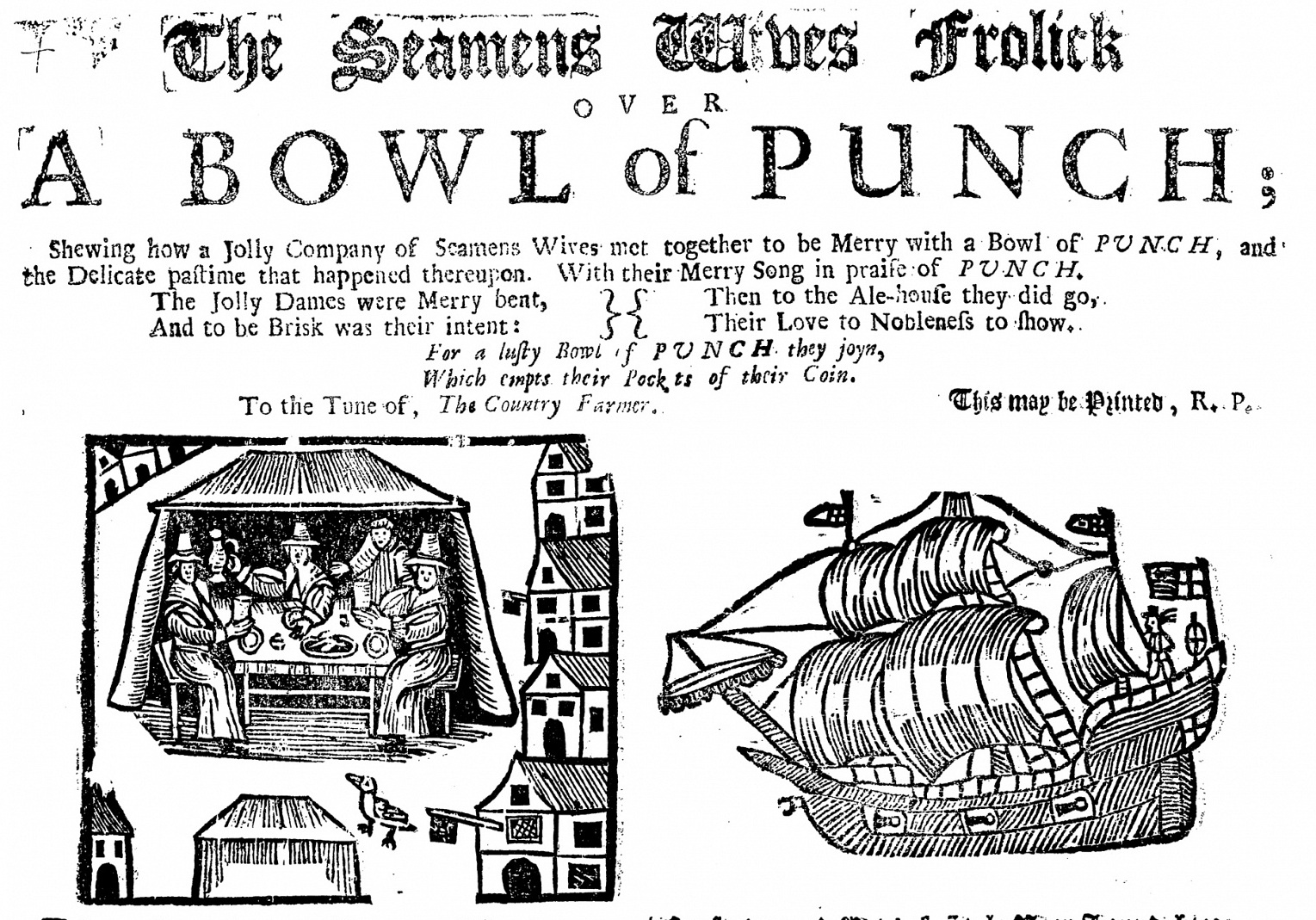
Even sailors’ wives were not averse to downing ‘a lusty Bowl of Punch’. According to another ballad, the ‘Jolly Company’ raced to the alehouse as soon as their ‘Seamen had newly left the Land’ and set on their task with gusto:

We Seamens brisk Wives are bonny and glad,
While our Men on the Ocean are sorry and sad;
We love our Liquor to drink it all up,
None of us but love a full Glass or a Cup

They went so far as to claim that the punch would ‘make our Noddles the quicker’, a suggestion that was not as far-fetched to their contemporaries as it might be to us. As unlikely as it sounds, Mark has shown that the idea of alcohol enhancing ‘wit’ and ‘reason’ was not unknown in early modern England.¹ A little of ‘haire of the old Dogge’ might also cure the resulting hang-over.

Detail from ‘The Seamens Wives Frolick Over A Bowl of Punch’ (1685-88), in Pepys Ballads, IV, p. 184, via EBBA.

One might be inclined to dismiss these as stereotypes played up by the balladeers trying to make a few extra pence, but there are also examples from the archives. The records of the High Court of Admiralty, for example, include depositions describing sailors such as Robert Oyle who habitually ‘debauch[ed] himselfe with drinke’, Frisby and Archer who spent ‘five dayes and nights together drinking and frequenting houses of lewd repute’, and Thomas Grove who returned aboard ‘much distempered with drink and began to curse and sweare’.

Are these cases typical? It’s hard to say at this point. All of the Admiralty examples come from the MarineLives project, a new group which is currently transcribing and publishing online a whole swathe of rich material from court records held at Kew. Perhaps once we have a complete set of cases over an extended period we’ll have a better idea of just how often 17th-century seamen had to ‘put him in the long-boat and make him bale her’ or ‘put him in the scuppers with a hose-pipe on him’, ‘earl-aye in the morning’.

In the meantime, the MarineLives team report that they are looking for a few more volunteers to join them to help uncover the rough lives of early modern seafarers, so if you’d like to help the world learn about a real ‘drunken sailor’ or two, do let them know.

Footnotes

¹ Mark Hailwood, ‘”It puts good reason into brains”: Popular Understandings of the Effects of Alcohol in Seventeenth-Century England’, Brewery History (forthcoming, January 2013).

Norwich Entertainments – Part IV: Surgeons on stage

Brodie Waddell

On the 8th of March, 1679, the Norwich Mayor’s Court ordered that

Mr Robert Bradford hath liberty to erect a Stage in the usual place to sell medical Druggs, & performe Chirurgicall Cures and he hath Lycence to doe this for the space of 3 weeks.¹

Medicine was big business in early modern England. Historians have shown us that the ‘medical marketplace’ was extensive and expanding, with many people we might now call ‘healthcare entrepreneurs’ earning a living by providing their services to eager consumers.² The fact that, as every schoolchild knows, ‘medicine’ in this period was as likely to hurt or kill as to cure does not seem to have dissuaded many patients.

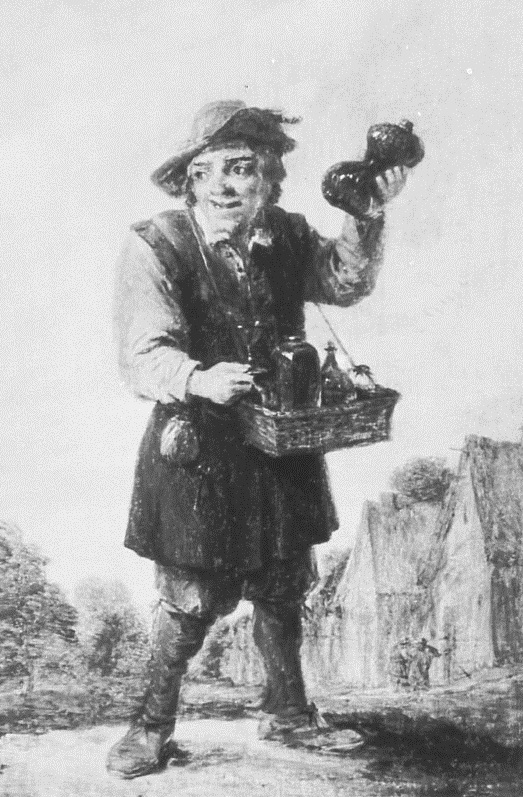
Peddler with apothecary bottles (17th c.). Source: Larsdatter.

That being the case, it should hardly surprise us that Mr Bradford would seek a licence from the civic authorities to hawk his ‘Druggs’ from a public stage in what must have been the centre of the city. This was a good spot to set up if he hoped to make a few shillings by attracting a sizable crowd of customers for his various elixirs.

But what about performing ‘Chirurgicall Cures’? On a stage? How can we explain this? Continue reading

The Conference Phenomenon

Laura Sangha

Ideally, my opening gambit on the many-headed monster would have been drawn from the research I have been doing over the summer. But as my first foray into blogging has coincided with conference season and the start of a new academic year, I have decided to offer a meditation on the former, though stay tuned for a series of posts on my summer ‘found art’ in the not too distant future.

As I entered the sixth hour of a train journey back from the European Reformation Research Group annual conference and the biannual Reformation Studies Colloquium in Durham last week, I found myself considering the phenomenon that is the academic conference. My relationship with ‘conferencing’ is probably similar to many others – sometimes they are a hassle, but they undoubtedly enrich my intellectual landscape and an early career academic certainly cannot afford to ignore them. Although expensive, time consuming, occasionally archaic, and sometimes disappointing, our discipline would be vastly impoverished without them – and in fairness, usually something can be salvaged from even the most disastrous event. And when they work well, they can really fly: assisting in the development of individual projects, establishing creative bonds between researchers, or providing the jumping off point for important proceedings and collections.

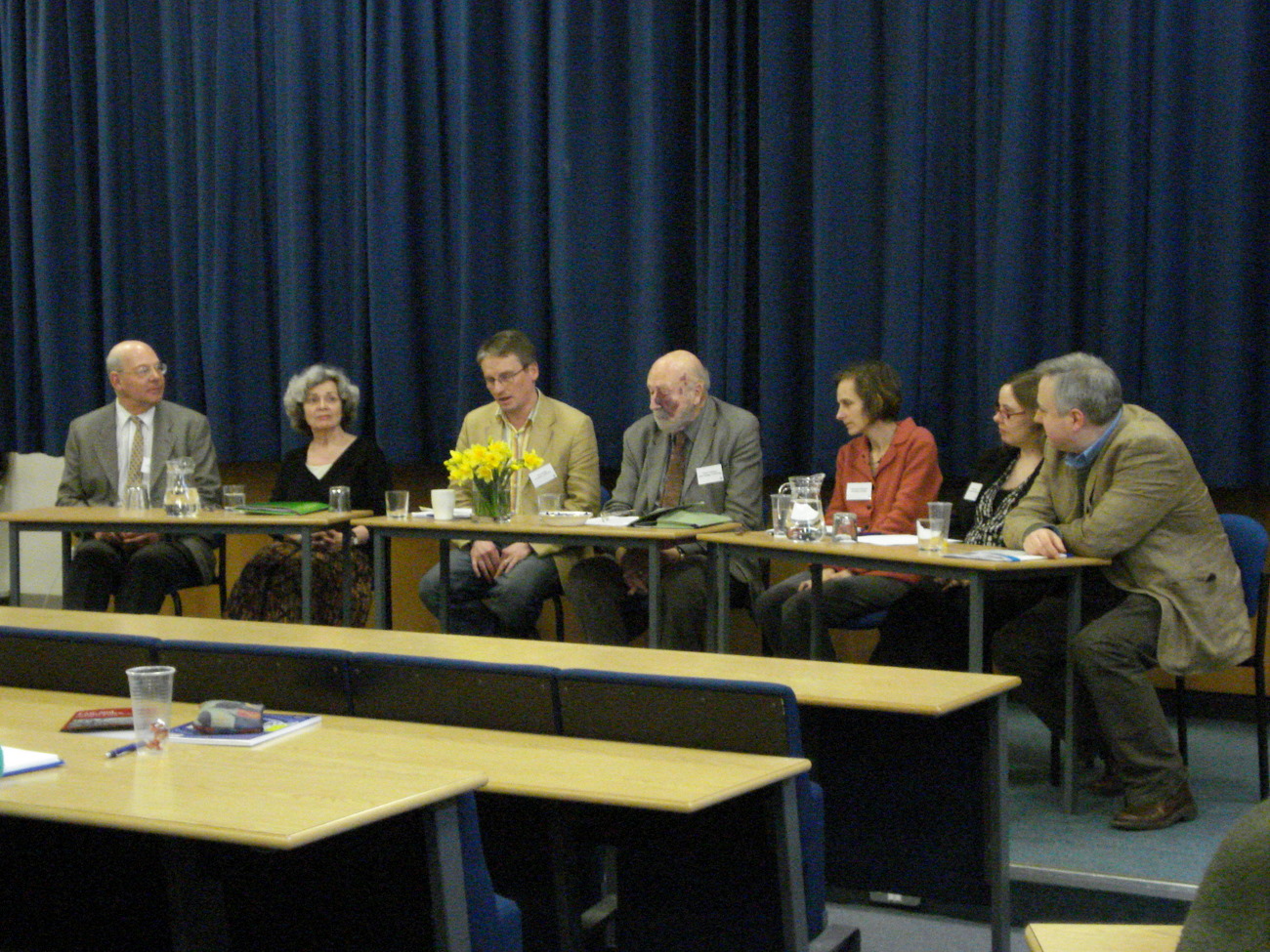
Plenty of ‘munros’ to be ‘bagged’ at this roundtable. L-R: Roger Bowers; Anne Dillon, Steve Hindle, Patrick Collinson, Alexandra Walsham, Tara Hamling, Brian Cummings.

The little name badge, the undrinkable tea and coffee, the gruelling programme, the bored looking chap on the book stall and the delegate snoring softly at the back of the room – these are all indispensable elements of the conference, but what is it that allows us to deem them a success? Here’s what I would hope for:

All the world’s a stage

The primary purpose of the conference is of course to showcase current research. The conference is the place to get my face and work known, as well as to find out about current trends in my research area, and to contact scholars working in similar areas. They are designed to encourage the exchange of ideas, and if you are lucky the responses, questions and comments on your paper will help you to develop your research in unexpected or unlooked for ways.

The Knowledge

The overall effect of a conference can be rather like attending thirty back to back mini-lectures, so it is inevitable that I learn a lot along the way. As my career has progressed, this aspect has become much more important – when I was a postgraduate I probably could follow about fifty percent of papers, but as my own knowledge has expanded I find that I am rarely completely lost these days.

Munro Bagging

A munro is a peak standing over 3,000ft (914m) above sea level, and you ‘bag’ a munro by climbing one. Some of my colleagues and I consider meeting and talking to eminent historians an academic equivalent to this, and we like to swap notes on how many renowned profs we have ‘bagged’ at the end of a conference. My broader point is, keynotes and plenary sessions give me the opportunity to see big name historians in action, as well as the chance to actually intellectually freestyle with them. Meeting your heroes can of course be a nerve wracking business (what if she’s a Tory? what if he’s got egg in his beard? etc), and I often find yourself trying to sneak a look at someone’s name badge so that I don’t find myself asking Professor Big-Wig what year of her PhD she is in. But sitting down to breakfast to find your entire bibliography sat at the table is (a) cool and (b) a wonderful opportunity to make an impression or pick someone’s brain.

Communitas

Linked to the previous section, this is undoubtedly the aspect of conferences that I most enjoy – the social side. Conferences are places to meet people, and to catch up with colleagues and friends (particularly at the bar in the evening, when many a morning session has been ruined). But from a professional point of view, the contacts I make and renew at a conference are an important part of my career development – just like at the early modern court, patronage and networks make academia tick. If you play your cards right you can identify seminar speakers, potential collaborators, external examiners, edited collection contributors or future colleagues. What’s more – we are all in it together. There is nothing like a two, three, or even four day conference to create an esprit de corps that will endure long after final talk is over.

So that’s what I think makes for a stimulating, intellectually (if not physically) invigorating meetings of minds. I’d be interested to know if people agree.

REED all about it – Part I: Fiddling at the Church Ale…

Jonathan Willis

This wasn’t originally going to be the first utterance of this particular newly-sprouted head of the many-headed monster, but Brodie’s recent musings ‘On the merits of dust‘ and the lively debate it sparked set me to thinking about one of my favourite short-cuts to a treasure-trove of brilliant archival material, the Records of Early English Drama series. REED (for short), for those of you who haven’t come across it, is an international project with its home at the University of Toronto. Since 1975 they have published almost thirty edited volumes bringing together collections of transcribed documentary material relating to drama, secular music, and community ceremonial and entertainments from the middle ages until the middle of the seventeenth century. Organised variously by city, county or region, these reassuringly sturdy big red books would be a handsome edition to any library or bookshelf (no, I’m not on commission), and even better many of them are also available to download in PDF format, perfectly legally(!), through the Internet Archive website. This is a top-notch published collection of manuscript material, gathered from record offices up and down the country, which is not only available in university libraries but also on your laptop, desktop or tablet. Continue reading