The Tudor South West at Exeter’s Royal Albert Memorial Museum: Part 1 – City Map

Laura Sangha

This is the first in a week long series of posts about a new exhibition at Exeter’s museum.
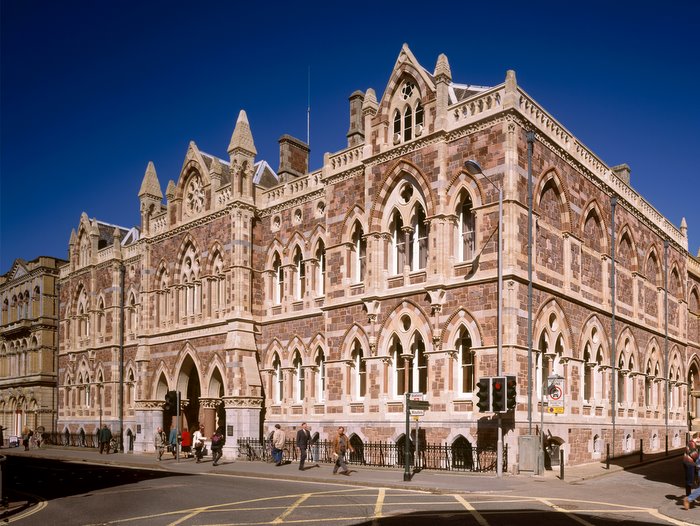
Exeter's Royal Albert Memorial Museum

Exeter’s Royal Albert Memorial Museum

I few weeks ago I had the pleasure of visiting a wonderful new exhibition at Exeter’s recently refurbished Royal Albert Memorial Museum. Titled ‘West Country to World’s End: the South West in the Tudor Age’, the publicity describes it as ‘celebrating the spirit of adventure and enterprise of south west people’ during the Elizabethan ‘Golden Age’. Along with some of my first and second year undergraduates, I was also lucky enough to attend a talking tour of the exhibition by one of its curators: Sam Smiles, Professor of Art History and Visual Culture at the University of Exeter. It was an intriguing insight into the thought and planning that goes into such a project, and I was struck by how carefully constructed museum exhibitions are in order to allow viewers to assemble a history from the objects themselves. It led me to reflect on the way that the selection, juxtaposition and display of the objects prompts the viewer to make associations and identify themes, leading to their greater understanding of the period and the subject. The exhibition runs until 2 March 2014, and each day this week I will be offering some thoughts on objects from the exhibition, explaining what the items said to me and following up on the questions that they raised. Click on pictures for enlargements.

Mapping Exeter
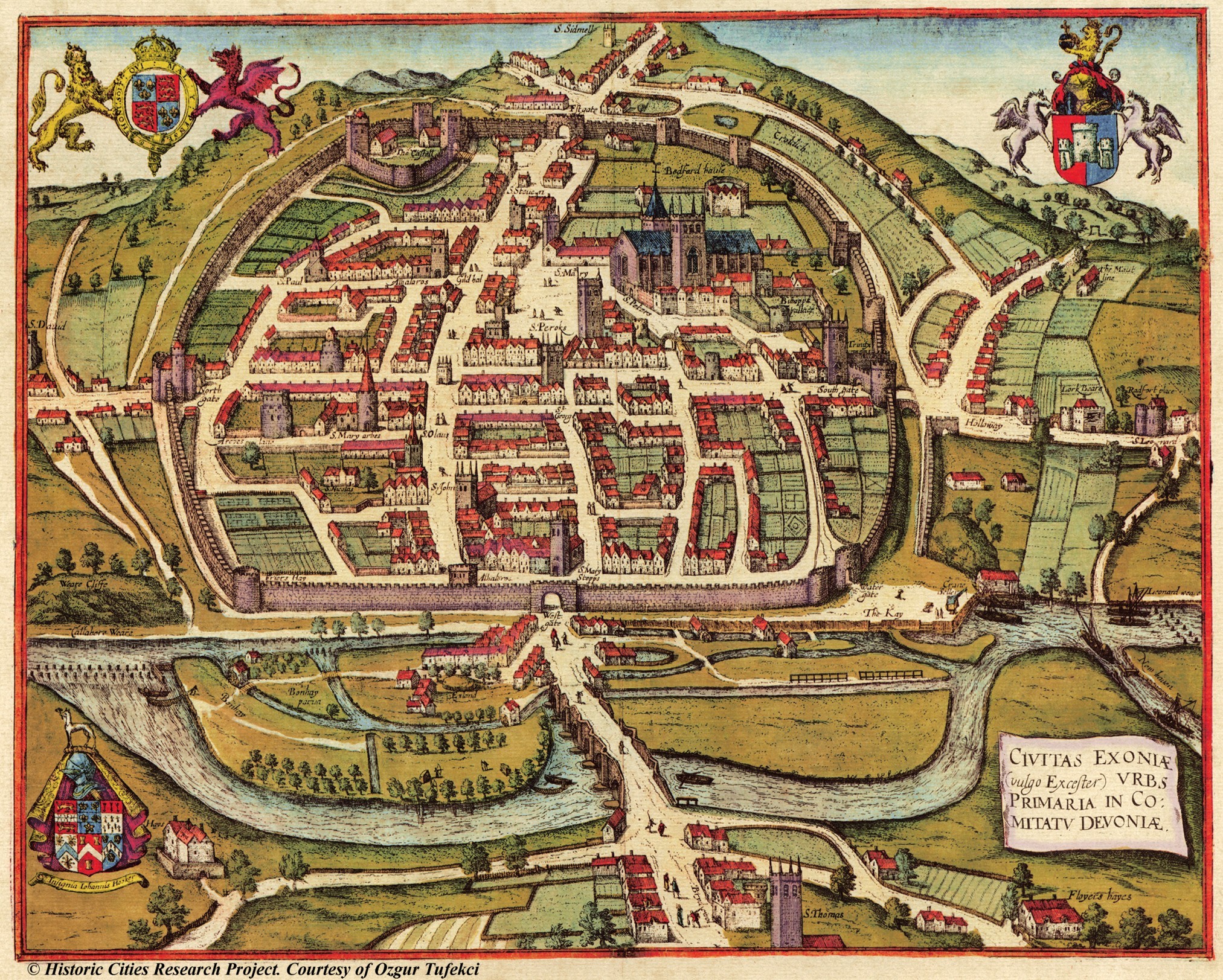
Engraving of Exeter by Hogenberg, 1587.

Engraving of Exeter by Hogenberg, 1587.

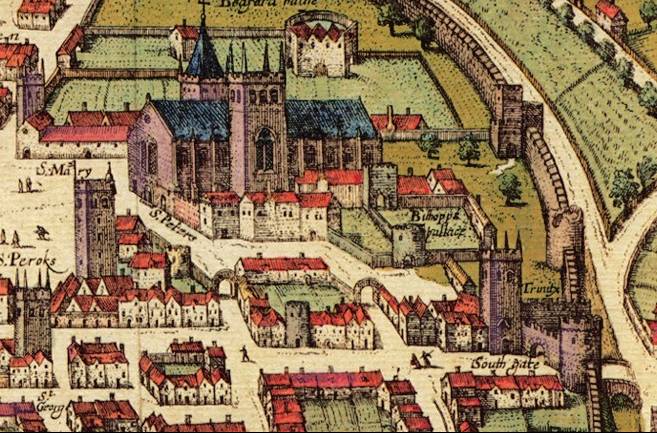
As a naturalised Exonian, I was very taken by the large scale reproduction of a map of Exeter as it was in 1587. Placed at the start of the exhibition it immediately orientates you within the early modern city, and it is fascinating for any number of reasons. The Exeter on the map has some familiar landmarks, yet the contours are not what are not what you expect: the river has been redirected in the centuries since, the castle and city walls have largely disappeared, and of course modern Exeter is far larger, incorporating parishes that were entirely separate in the early modern period and archers riversprawling suburbs where once there was only farmland. The map is incredibly detailed – there are figures promenading in the streets and a couple of archers practise their skills by the Exe bridge, whilst the tenterhooks used in Exeter’s successful cloth trade are plain to see on the banks of the river. There are at least seven churches within the walls in addition to the huge cathedral, and everywhere there are wide green open spaces: a reminder that the Tudor urban environment was vastly different to our own. The map is hard to navigate for a modern too – the perspective allows the viewer to see the city in it’s entirety, but in doing so fails to indicate the very steep incline between the river and the city centre, so buildings that appear to be next to each other on the map are not experienced like that in reality.
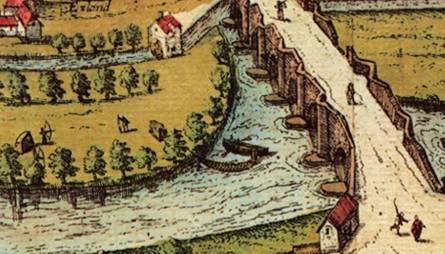
Of course maps are never realistic in the way that they present their subject, they are designed to convey specific information to the map ‘reader’, thus the map designer chooses which aspects to emphasise and which to elide. The resulting distortion might The Cathedral was surrounded by churches, and someone's fancy house.therefore tell us more about the producers’ perceptions and intent than the place they are depicting. Thus we do not see the city ‘as it actually was’, but rather we see what the producer (or patron) wants us to. This map was made for the great city atlas edited by Georg Braun and largely engraved by Franz Hogenberg, published in Cologne in six volumes 1572-1617. Many of the images in this post can be seen at ‘Historic Cities‘ which has excellent digital reproductions of city maps of the past, present and future.
Meanwhile, just outside Oxford

Meanwhile, just outside Oxford…

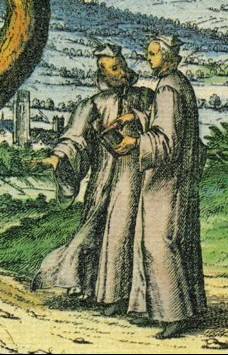
Braun and Hogenberg’s atlas contained 546 maps of cities, mainly European but there was also room for Mexico city and Casablanca. Other English cities included were London and the second city Norwich, Oxford and Cambridge, York, Canterbury, Chester and Bristol: the fact that Exeter was deemed worthy of inclusion alongside these indicates its important national status at the time. Hogenberg’s other city plans share features with Exeter’s –York is surrounded by a profusion of windmills, and in Norwich archers are also practicing their skills on the outskirts of town. There are differences too: Bristol, Cambridge and Norwich have sheep grazing in their hinterlands whilst in Exeter is surrounded by arable land, some of the maps have larger figures in contemporary dress in the foreground, indeed Oxford has what appear to be two scholars having an argument under a tree.
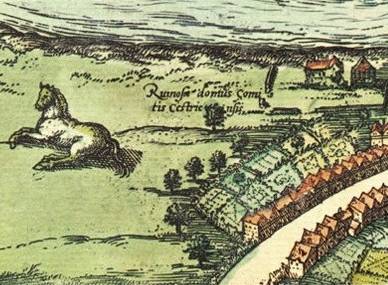
Either Chester was menaced by giant horses, or this map is not to scale.

Either Chester was menaced by giant horses, or this map is not to scale.

The Exeter map thus tells me that Hogenberg saw the city as a Godly, thriving, well defended and well connected metropolis, relatively compact though already outgrowing the limits of it’s walls. The river was clearly a central part of it’s extensive trading and manufacturing activities, the water cluttered with boats and mills. A steady stream of people cross over the bridge towards the city gates, and within the walls there were some impressive houses suggesting wealthy citizens – this was a bustling regional centre, then as now. Surprisingly there are no cows to be seen (Cambridge, Bristol, Chester and other cities have sheep and horses grazing around about them), but there are some chaps fishing near a weir at Bonhay. The wide streets and green spaces within the city and the rolling Devon countryside which form the hinterland suggest this would be a good place to live and work, it is presented as a civilised, spacious and clean environment. As such, my suspicion is that it only tells part of the story of life in urban Elizabethan England.

In tomorrow’s post: what are images of Moses and Job doing in the Protestant south west?

‘West Country to World’s End: the South West in the Tudor Age’ runs until 2 March 2014 at Exeter’s Royal Albert Memorial Museum. You can find all the details about the museum, it’s opening times, it’s wonderful café and more on their website.

Credits:

Historic Cities, a joint project of the Historic Cities Center of the Department of Geography, the Hebrew University of Jerusalem and the Jewish National and University Library.

Georg Braun and Frans Hogenberg, ‘Civitas Exoniae (vulgo Excester) urbs primaria in comitatu Devoniae’, in Civitates Orbis Terrarum, Cologne. Vol. VI 1617.

Norwich Entertainments – Part VI: Rope dancing and nine-pins

Brodie Waddell

On 1 December 1677, the Norwich Mayor’s Court granted permission for a new performer to ply her trade in the city:

Mrs Saboul Rymers hath Lycence to make shew of Dauncing upon the Rope at the Redd Lion in St Stephens for a weeke from this day.1

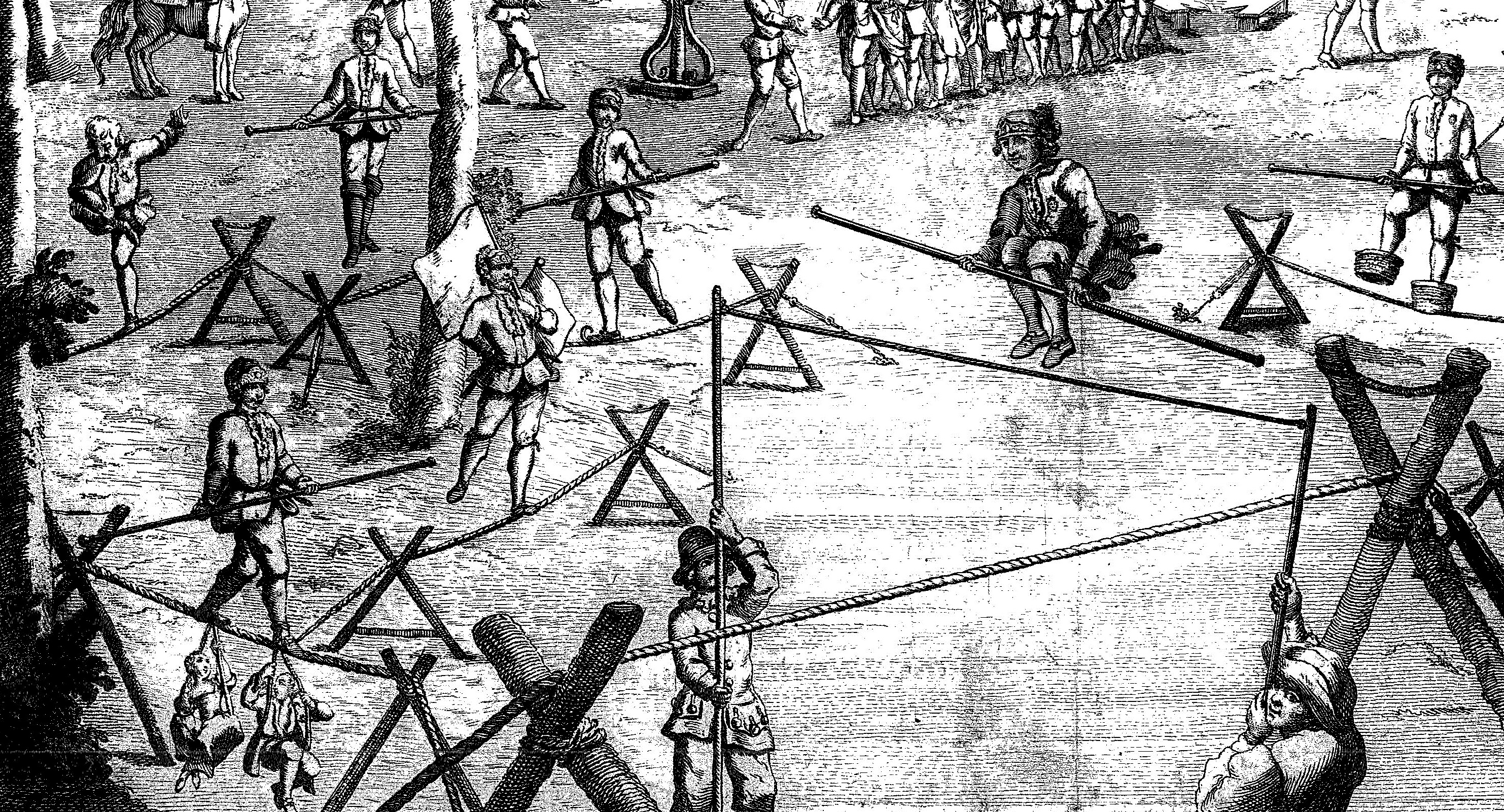
Rope dancing, now usually known as ‘tight-rope walking’, had already been a popular entertainment for thousands of years by the time Mrs Rymers arrived in Norwich. It was a common amusement in the seventeenth century, apparently beloved by rich and poor alike. The Duchess of Cleveland, King Charles II’s famous mistress, ‘greatly admired’ one these acrobats, and Samuel Pepys reported that he ‘saw the best dancing on the ropes that I think I ever saw in my life’ at Bartholomew’s Fair in 1664.

Rope dancers Continue reading

Ruth Mather, ‘The Home-Making of the English Working Class’

[This is the second piece in ‘The Future of History from Below’ online symposium (#historyfrombelow). Ruth Mather is a doctoral candidate at Queen Mary, University of London, studying the links between working-class political identities and the home in the late eighteenth and early nineteenth centuries. She also blogs about her adventures in research.]

I became interested in ‘history from below’ as an undergraduate through the encouragement of Professor Robert Poole, who introduced me to E.P. Thompson’s The Making of the English Working Class. Thompson’s book, which reaches its half-century this year, showed me a new way of doing history, one which didn’t patronise working people, or subsume them in a narrative of progress, but instead constructed a story about thinking, feeling people with their own ideas about their lives and their own strategies for living them. It’s important that our histories show the humanity of our subjects  – in my case the English labouring classes in the late-eighteenth and early-nineteenth century. This is not about glorifying poverty or writing hero narratives, but simply attempting to understand the messy, complicated details of the real lives of ordinary people.

I’m not alone in thinking this is particularly crucial at the moment, when a new history curriculum threatens to take us back to stories of great men and Whiggish progress and welfare recipients are demonised for political gain. However, other participants in this symposium will be discussing the continued relevance of ‘history from (and for) below’ in much more detail over the coming weeks, and it is not difficult to find excellent explanations of why ‘history matters’ more generally. So, having outlined why ‘history from below’ is important to me, I’d like to focus on the question of how we can find sources that can help to uncover the domestic lives of ordinary people as part of this wider project of uncovering voices that have been underprivileged in the historical record. Continue reading

A post written in the stars

Laura Sangha

According to my horoscope, consulted on the website of a popular entertainment magazine, this will be a good week for me. With six planets in my sign, I’m ‘the one to watch!’. I might be feeling the pressure, but before the week is out, ‘luck will come’. Excellent news, I am sure you will agree. Look in most entertainment magazines and tabloid papers and you would hardly be surprised to find the similar revelations in the stars, tucked away somewhere between the week’s television and the latest suduko. You might be more interested to discover that, unlike wikipedia currently suggests, astrology did not gain broader consumer popularity through the influence of ‘regular mass media products’ in the twentieth century, but in fact had a ‘popular’ following many centuries before then.

The search for order and meaning in the sky is, of course, ancient. No one would deny that there is an obvious link between the sun and events on earth. As winter finally loosens its grip here in the UK you might be particularly aware of this right now. The northern hemisphere is slowly exposed to more direct sunlight because of the tilt of the earth’s axis, the days lengthen, the altitude of the sun changes, the sun feels hotter. As a result, animals change their behaviour, plants and trees burst into life, and Brits start donning shorts and having shivery picnics at the seaside.

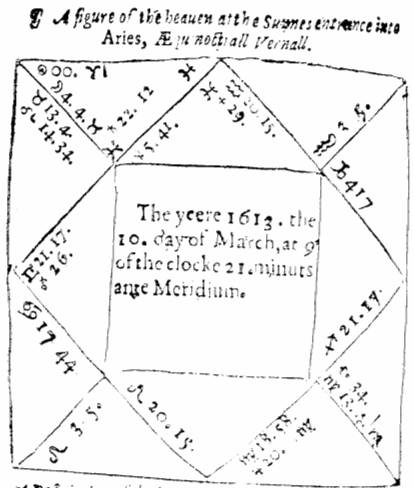
A diagram of the heavens from a 1613 almanac.The evident link between the celestial bodies and terrestrial events was no less obvious to our forebears, and it led very naturally to an interest in the heavens. It was common to wonder how else the celestial bodies might influence life on earth. Lunar cycles were being recorded on cave walls as early as 25,000 years ago; the first organised system of astrology arose in the second millennium BC in Babylon; it was developed by the Greeks and Romans, and refined by Arabic practitioners. By the early modern period it was a very well established scholarly tradition, backed up by scriptural references: Jesus’ birth was of course marked by the appearance of a new star in the sky that the wise men followed to Bethlehem (Matthew 2:1-2), and at the beginning of the world ‘God said, Let there be lights in the firmament of the heaven to divide the day from the night; and let them be for signs, and for seasons, and for days, and years’ (Genesis 1:14).

Thomas Blount gave a neat early modern definition in his 1656 Glossographia or a Dictionary (and note Blount’s qualification which preserves God’s omnipotence as well as man’s free will):

Astrology: Astrology is a Science which tels the Reasons of the Stars and Planets motions. Astrology doth promise by the motion and influence of Stars and Planets to foretel things to come, or it professeth to discover the influence and domination of the superior Globe over the inferior, and therefore may be tearmed a kind of natural divination, so long as it keeps it self in due limits, and arrogates not too much to its certainty; into which excess if it once break forth, it can then be no longer called natural Divination, but superstitious and wicked; for the Stars may incline, but not impose a necessity in particular things.

The characters of the xii signes... so that every man will understand them.

The characters of the xii signes… so that every man will understand them.

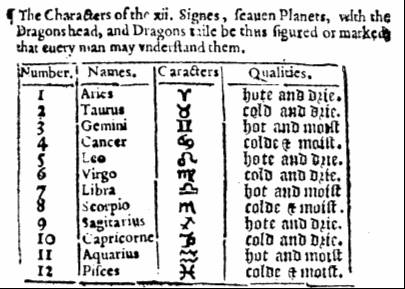
Natural astrology was concerned with the general character of planetary influences in such fields as agriculture and medicine; judicial astrology was the attempt to interpret these influences to make prediction and give advice (so tabloid stars are an example of this). Mastery of the science of astrology took skill and was intellectually demanding, and as a result, sixteenth-century astrology tended to be the domain of the learned and elite members of society. In seventeenth-century England however, this began to change, as a result of the emergence of handbooks which set out the basic rules of astrology and the rise of the ‘almanac’. Sorry wikipedia, but popular knowledge of the science was therefore probably greater in the Tudor and Stuart period than ever before or since.

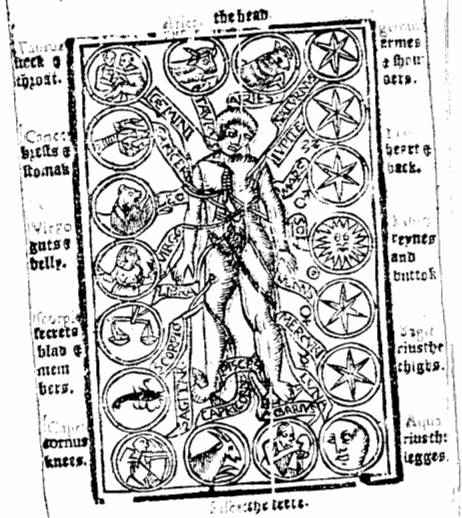
The anatomy of a mans body, as the parts thereof are governed by the 12 celestial signs

The anatomy of a mans body, as the parts thereof are governed by the 12 celestial signs.

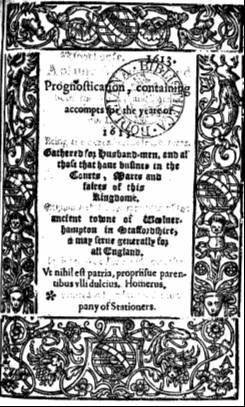
An almanac was an annual, short, cheap publication with a range of material in it. It fulfilled a variety of roles, offering religious, moral, practical as well as astrological advice. Usually the first section had a calendar and details of planetary motions and conjunctions. Along with the prognostications, there was often also an ‘Anatomy’ or ‘zodiacal man’, as well as information on local fairs, highways, the phases of the moon, feast days, medical and farming advice. Often almanacs had a secondary role as a notebook or diary (look at the front of your diary, mine still has ‘useful information’ including astronomical information), and therefore they were worth hanging on to, and many survive, luckily for us. Bernard Capp[1] has shown that the genre allowed astrology to take on a new social dimension. They served as handbooks that set out the basic rules to astrology in a clear and simple manner, for use by all sorts of people, from peers to serving-maids. Astrological terms passed into common usage: think ‘jovial’, ‘lunatic’, ‘mercurial’. And almanacs were really the starting point for this post – I was idling browsing a few from spring 1613, exactly 400 years ago, wondering what sort of things were going on back then, and I thought it would be an excellent idea to share some of that advice with monster readers, to set them up for the summer.[2] Enjoy!

WARNING: This stuff is a bit dated, for the most cutting edge advice you should probably turn to biodynamic gardening, where ‘gardeners plough, prepare, sow, plant, harvest and compost according to the phases of the moon and the constellations (signs) it passes through’.

1613 HISTORY: How many years is it since….

Frontispiece to John Woodhouse's alamanac for 1613.

Frontispiece to John Woodhouse’s alamanac for 1613.

  • The world began: 5562
  • Noah’s flood: 3906
  • Conquest of the Romans: 1664
  • Coming of the Saxons: 1163
  • Coming of the Danes: 774
  • Conquest of the Normans: 546
  • The Battle at Agincourt: 197
  • Printing first used: 153 [1460]
  • The first use of coaches in England: 58
  • Pauls Steeple burned with lightening: 52
  • The rebellion in the North: 44 [a reference to the 1569 Rebellion of the Northern Earls in reign of Elizabeth I]
  • The great snow: 34
  • The general earthquake: 33 [also known as the Dover Straits earthquake, 1580]
  • Tilburie Campe: 25 [a reference to the Spanish Armada, 1588]

PRACTICAL ADVICE:

What phase of the moon should I….

  • Cut hedges? Between the change and the full, from the end of Jan till the beginning of June
  • Geld cattle? In Aries, Libra and Sagittarius, the moon being past the full
  • ‘Dung land’ that weeds may not abound? In the old of the moon

How can I tell if there will be rain or foule weather?

If the sun is fiery at his rising. If he rise and a little after be covered with great black clouds. If the horns of the new moon are blunt. When bells are heard further than usual. When wainscot doors and wooden coverings open straighter than of custom. When swine and peacocks make a great noise. When birds be busy in washing themselves. Moles behaving busily. Cattle eating greedily, and licking their hooves.

What should I be doing in the outdoors at the moment?

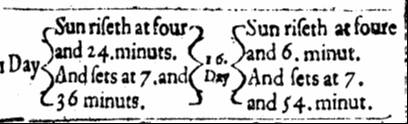
Working outside? You'll want to know when it will be light then.

Working outside? You’ll want to know when it will be light then.

In April you should sow barley, hemp, and flax, and some of your garden seeds, as cowcumbers, citrons, melons and artichokes. Good housewives should now begin to be busy about their Dairies, and tanners to pill barke.

In May you should sow barley, set and sow tender herbs and seeds, set stills to work, stir land for wheat and rye, stop lopping trees, weed winter corn, teach hops to climb, but cut off the superfluous branches, and watch your bees.

More generally, cold will diminish and living creatures will begin to recover their strength lost over the winter. Soon the earth will put on her new yearly ornaments, beasts, fowls and birds will make harmony.

When and where can I go to a fayre?

There are too many to mention, but on 1 May try Leicester, Brickhill, Reading, Warwick, Maidstone, Lichfield and Stanstead. On the 3 May try Waltham Abbey, Cowbridge, Benbigh, Knighton. In Rogation week: Beverly, Engfield, Horsham. On Ascension Day: Kidderminster, Bishops-Stratford, Wigan, Burton, Bridgend.

MORAL ADVICE: What good deeds shall I do this season?

The deeds of hospitality would be useful: feed the hungry, cloth the naked, be good to the widow and the fatherless. Remember:

Hast thou 2 Loafs, 2 Coats, give one of each
To him that pines and starves (I thee beseech)
Alas! (Rich man) thou know’st not what thy
May come unto, when thou art dead and gone.
Farmers! give th’ poor some corn. Shepherds give
Some cloth the back, some fill the Belly full
Doctors, give Physick for mere Charity:
Millers, be sure ye grind their Corn toll-free.

HEALTH

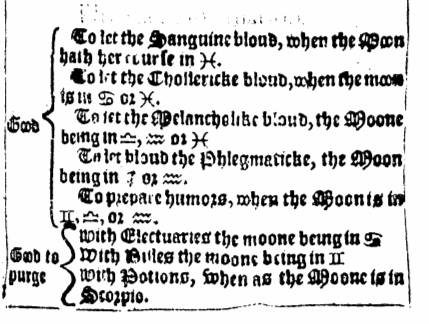
April is a good month to have a spring clean – not only of your house, but also of your body. It is the fittest time of year to ease diseased bodies, and to restore by means of evacuation and blood letting. Remember with this simple rhyme:

Learn the most ausipcious times to let blood with this simple guide.

Learn the most auspicious times to let blood with this simple guide.

This month all things their strength renew,
by letting of blood, you shall not rue
The pores open and blood abounds,
or purging, also no harme redounds.

And finally, beware. The sicknesses of spring are melancholy, madness, the falling sickness, nosebleeds, coughs, itch, scabs, ulcers , gout, pain in the joints, and also, ‘some strange diseases’….


[1] Bernard Capp, Astrology and the Popular Press (London, 1979).

[2] The extracts are taking from the following almanacs: John Dade, A new almanacke and prognostication, 1613; John Johnson, An almanacke and prognostication for this yeere of our lord and sauiour Iesus Christ 1613; William Mathew, 1613 a new almanacke and prognostication, for the yeare of our Lord God; John Woodhouse, A plaine almanacke and prognostication, 1613; John Bucknall, The Shepherds Almanack, being a diary or register for the year 1676.

Carnivalesque 94: No bishop, no king

Brodie Waddell

Welcome to the 94th edition of Carnivaleque! Today we will be introducing you to a wonderfully motley menagerie of historical blogs and bloggers.

Finding any overall unifying theme is impossible with a collection of this sort, but there are a few key subjects that emerged from the nominations, each of which receives a section below:

  • The historian as detective
  • Bodily functions
  • A venerable criminal enterprise
  • Places, spaces and sites
  • Thinking about the historian’s craft

I think it is particularly interesting what’s not in the links below, namely kings and queens and ‘great battles’, the traditional material for popular histories. Not that political history and military history are entirely absent, just that they are approached from a different direction than usual. Although there are a few of gentlemen and noblewomen as well as a famous scientist, the vast majority of the nominated posts are focused on people who would have been largely excluded from textbooks written fifty years ago. What should we make of this? Is old-fashioned ‘top down’ history dying off? Or is it just that the type of people who read this blog and pay attention to Carnivaleque are predisposed against reading yet another story about Henry VIII and his wives or Charles I and his parliaments? I’d be interested to hear what you think.

However, before wandering into the carnival below, take a look at this truly heart-warming short animation that tells the tale of ‘the damnable life and death of one Stubbe Peeter, 1590’, a German werewolf. For more details, see the two posts at LOLManuscripts, but in the meantime, watch the video and be amazed.

Now, on with the show…

Continue reading

An Easter larceny, 1691

Brodie Waddell

I was browsing the Old Bailey Online for seasonal crimes, as one does, and came across this case from the Proceedings of 27 May 1691:

Rebekah Williams, Widow, was Tryed for Robbing Edward Veron , on Easter-day last, of Goods to a considerable value. Mr. Veron swore, That his Shop was broke open at Ipswich, and that the Prisoner offered several of the Goods to sale in London, at a Goldsmiths, where she was taken; but she proving her self a Married Woman, by vertue of the Covering she was Acquitted.

We have, in other words, a woman who allegedly participated in stealing from a shop on Easter, but escaped unpunished because she was married at the time.

Early Modern John recently described an Old Bailey case from around the same time as ‘both amazing and infuriating at the same time’ – and the case of Rebekah Williams undoubtedly falls into that same category. The record includes tantalising hints about the culture of the time, but also fails to explain the parts that seem to be most in need of explanation.

The first question is about the significance of the day of the crime. It is obvious why criminals might plan a break-in for ‘Easter-Day’ – presumably everyone else would be at church and the theft would be less likely to be detected. But what would the jurors think of such a crime? Would they be inclined to treat the accused more severely because the crime was both a theft and a profanation of the year’s holiest day? Would the prosecutor draw attention to this? Sadly, the record is entirely silent on this point.

The second issue is influence of Williams’ marital status. This seems to be a case of ‘feme covert’. As the OBO explains:

The legal principle of the feme covert, by which women could not be held responsible for crimes committed in the presence of their husbands (since they were presumed to be following their husbands’ commands) was not often applied, but it may have led juries to exonerate some married women, particularly when their husbands were convicted for the same crime.

The principle had a much more significant role in commerical affairs and inheritance than in criminal law, but it theoretically applied to cases of theft as well.1 But why, then, was Williams listed as a ‘widow’? How did she ‘prove’ her marriage? Why wasn’t her husband mentioned and, in fact, prosecuted? I’m inclined to imagine a scenario something like this … Williams and her husband robbed the shop in Ipswich, but only she was caught selling the goods in London. She admitted the crime but claimed that she was coerced by her husband, who – conveniently – died before the trial. But this is all merely speculation. Here too the record is silent.

In the end, what we are left with is a woman who seems to have committed a potentially capital crime on the most sacred day of the Christian calendar, and who walked away from the court unscathed.

Footnotes

1 For the significance of ‘feme covert’ in the economic sphere, see Joanne Bailey, ‘Favoured or oppressed? Married women, property and ‘coverture’ in England, 1660-1800′, Continuity and Change, 17:3 (2002), pp. 351-372 (ungated); and the work of Amy Erickson. For the role of gender in early modern crime, see Jenny Kermode and Garthine Walker (eds) Women, Crime and the Courts in Early Modern England (1994); Garthine Walker, Crime, Gender and Social Order in Early Modern England (2003). The law of coverture is also described on Wikipedia.

Something for Good Friday (it would be Rood not to)…

Jonathan Willis

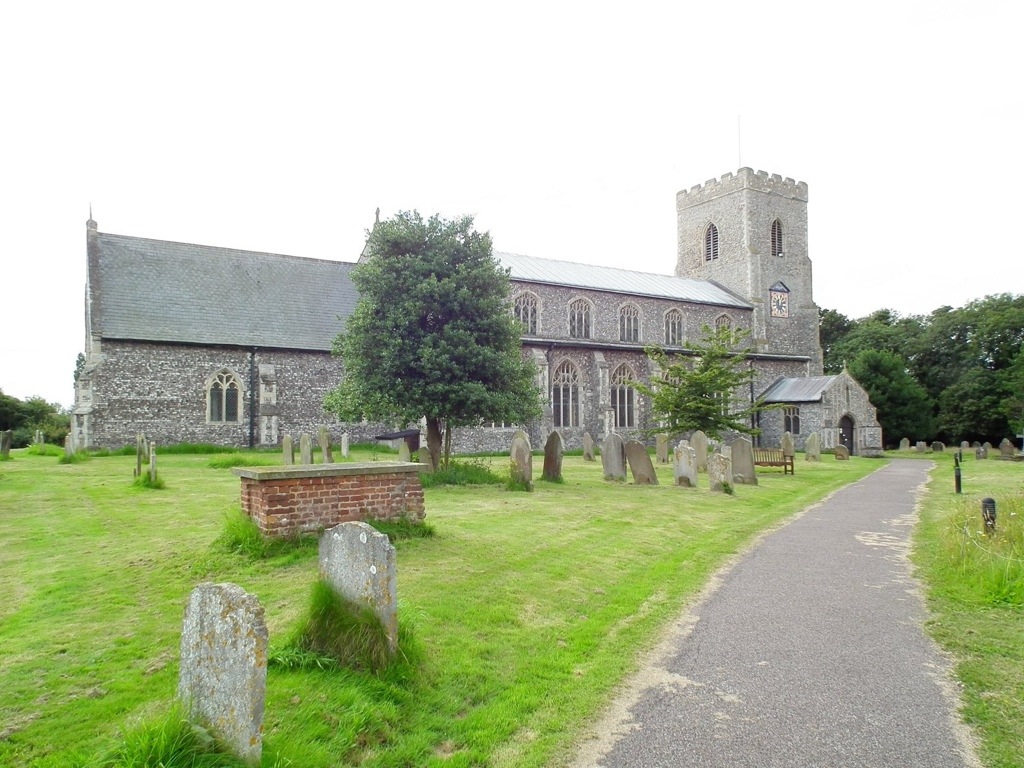
Just a little something for Good Friday: I don’t know how many of you know the parish church of St Catherine, Ludham, Norfolk, but like so many of the county’s churches it has a solid medieval pedigree and is really worth a visit!

20130329-090718.jpg
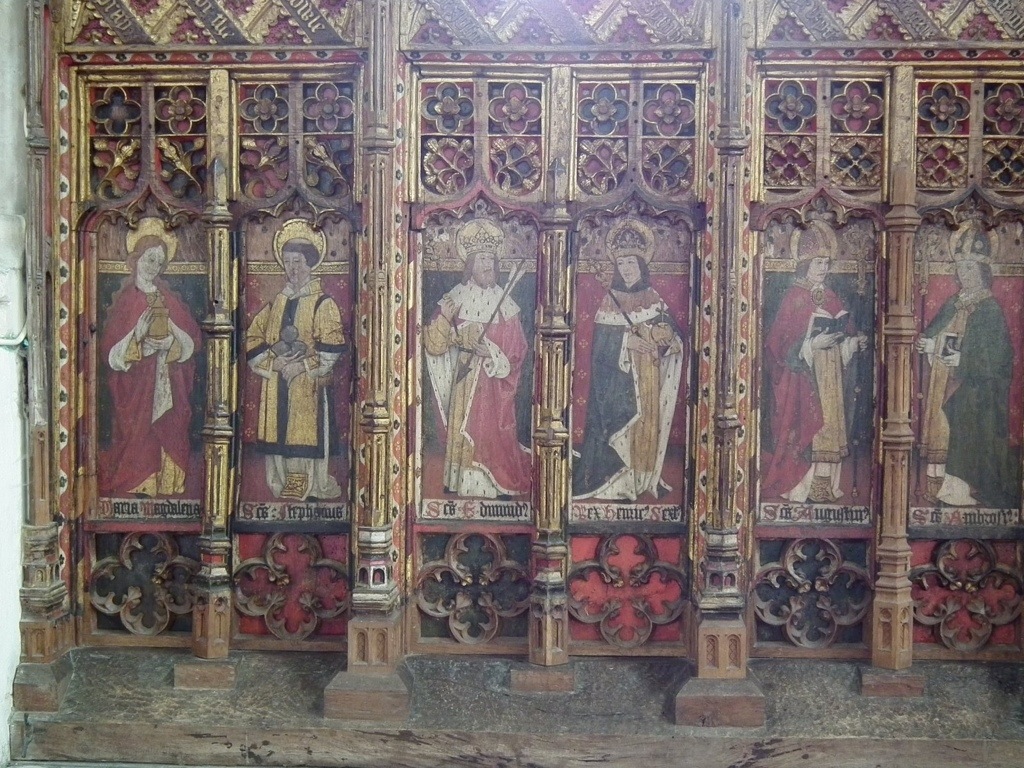
I went there last summer (remember summer?!) on the trail of an early commandment board, and while I’m still not convinced that I found one there, I did come across something rather special. Ludham has one of those vast, flint-clad churches so characteristic of East Anglia, a result of huge wealth generated by a thriving local economy, and particularly the strength of the cloth trade. Anyway, one of the main attractions is its beautiful, intricate medieval painted screen:

20130329-091344.jpg
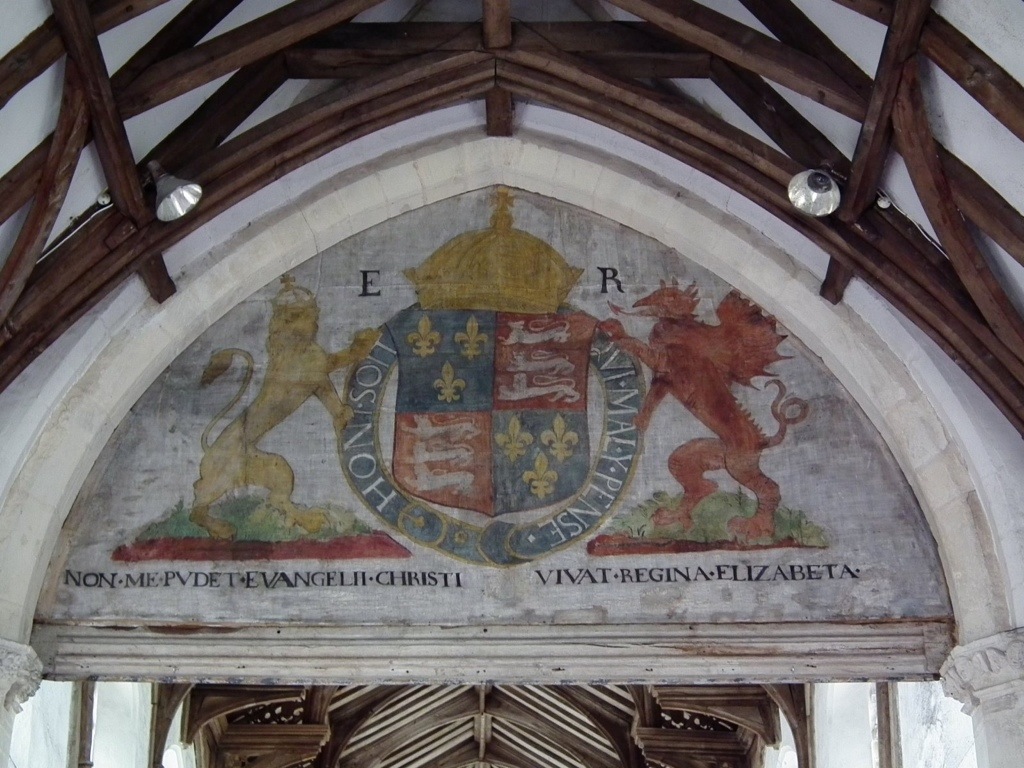
But more interesting I think, at least from an early modern perspective, is the contents of the chancel arch. Viewed from the nave, it contains a striking, early example of an Elizabethan Royal Arms, declaring Vivat Regina Elizabeta alongside the motto Non me pudet evangilium Christi, ‘Let me not be ashamed of the Gospel of Christ’.

20130329-092339.jpg
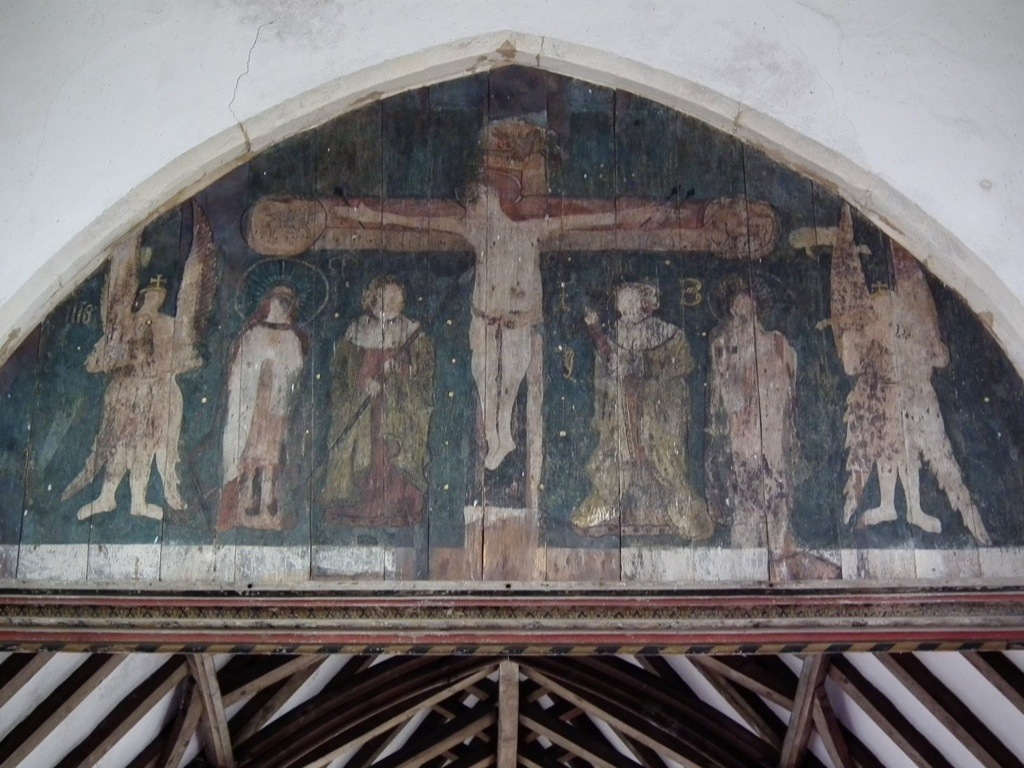
Arms like this are rare enough, and I’ve not come across any other examples with this particular motto, but on the reverse side, facing into the Chancel, is something quite spectacular: a rare survival from the Catholic restoration of the reign of Mary I, a painted Rood. Christ crucified in the centre is surmounted (I think) by the dove of the Holy Spirit, and flanked by (probably) Mary and John the Baptist, two other saints, and two crowned, winged figures who I think are unmistakably angels:

20130329-093026.jpg
Beyond that, the rest is speculation. We have very little to compare either example to, and it may be that Ludham was just an extremely compliant parish when it came to obeying the capricious religious policies of the Tudor monarchs. Perhaps this Rood was nothing special, just a rare example of the sort of stop-gap measure adopted by hundreds of churches across the country, and which the death of Mary prevented from achieving greater permanence. But (and this is surely the reformation historian inside me) it is also tempting to read a more polemical narrative into the actions of Ludham. Was their strident Elizabethan declaration not to be ashamed of the gospel in part a defence against charges of conservatism of the type embodied by their Marian Rood? Both Rood and Arms survive today purely by chance, hidden away until they were rediscovered at the end of the nineteenth century. How fortunate for us that they do: now we just have to figure out what to make of them!

The wandering, pipe-smoking Jacobite

Brodie Waddell

King William III was a greedy, irreligious, oppressive usurper. Worse still, he was a Dutchman. Or at least these were the sort of things one might hear in many of the alehouses of northern England at the end of the seventeenth century.

Definitely a bit too Dutch for his own good.

I’m going to be giving a talk at the Institute of Historical Research on Thursday (March 14th) on ‘The Present State of England: Modernity and Memory in the Hard Times of the 1690s’, and I thought I’d share one of the many, many seditious denunciations of William III’s regime that I’ve come across during my research into this topic. Sadly, this one probably won’t make it into the talk, but I’ll be sure to include a couple of others.

This case comes from amongst the mess of unsorted and unnumbered despositions from the Palatinate of Lancaster held at The National Archives at Kew, specifically PL 27/2. In May of 1700, according to a chapman from Manchester named David Smith,

one James Scott a wandering person this day … did declare … that his present Majestie King William had noe more religion in him then his pipe in his hand & that all that he cared for was to please his people & to gett mony together & that he love a finger of King James’ hand more then he loved King Williams body

One needn’t have a detailed knowledge of later Stuart political culture to decipher the complaint. William III had a reputation as an aloof, cold monarch, which may partly explain why Scott had so much more ‘love’ for James II’s finger than for the current king. Likewise, the king’s continental Calvinism was regarded as somewhat suspect by many Church of England clergymen, which may help to explain Scott’s reference to his atheistical pipe.

However, I’d guess that Scott’s dislike come primarily from the other fault that he mentions here: ‘all he cared for was to please his people & to gett mony together’. This was surely a reference to William’s foreignness and his very aggressive fiscal policies: ‘his people’ were presumably the Dutch courtiers whom he brought over with him, and his need ‘to get mony together’ resulted in taxation more than doubling in less than a decade. As I’ll explain on Thursday, these were ‘hard times’ and, as a result, the king’s regime was widely resented for his foreignness, his favouritism and his predilection for expensive European wars.

If anyone else has come across similar material from this period, I’d love to hear about it.

A seventeenth-century Christmas: mince pies, jollity and witchcraft

Brodie Waddell

Between the large stack of papers to mark and an increasingly nocturnal ten-month-old, the planned post on microhistory has had to be postponed until the new year. However, the season calls for at least one celebratory tribute to the peculiarities of early modern Christmastide. The case of Oliver Cromwell and the mince pies has already been discussed at length elsewhere, so I suppose I’d better share another serendipitous discovery from the archives.

This time of year had long been a season of charity and hospitality. As Ronald Hutton has shown, the Twelve Days of Christmas were an occasion for feasting but also giving. He quotes Thomas Tusser, the sixteenth-century poet-farmer:

At Christmas we banquet, the rich and the poor,
Who then (but the miser) but openeth his door.1

The ‘better sort’, ranging from well-off villagers to the richest nobles, showed their generosity by inviting neighbours to dine with them and by giving alms to the poor. Or at least that is how it was supposed to work.

But a court case from Devon suggests that the season was not always so jolly. Here it seems a failure of seasonal good spirits had dire consequences. Sarah Byrd of Luppitt, testifying in 1693, tells the story: Continue reading

Norwich Entertainments – Part V: Ballad-singers and dangerous news, with coffee

Brodie Waddell

The people of late seventeenth-century Norwich did not get their entertainment solely from hairy children and pieces of plays. They also amused themselves with the ever-growing numbers of printed works that were pouring from the presses at that time.

In June 1680, for example, the Norwich Mayor’s court ordered that ‘Twoe Ballad singers haveing Lycence to Sell ballads, pamphlets small bookes & other bookes Lycensed from the Office of the Revells have leave to doe soe until Monday senight [?seven-night]’.1

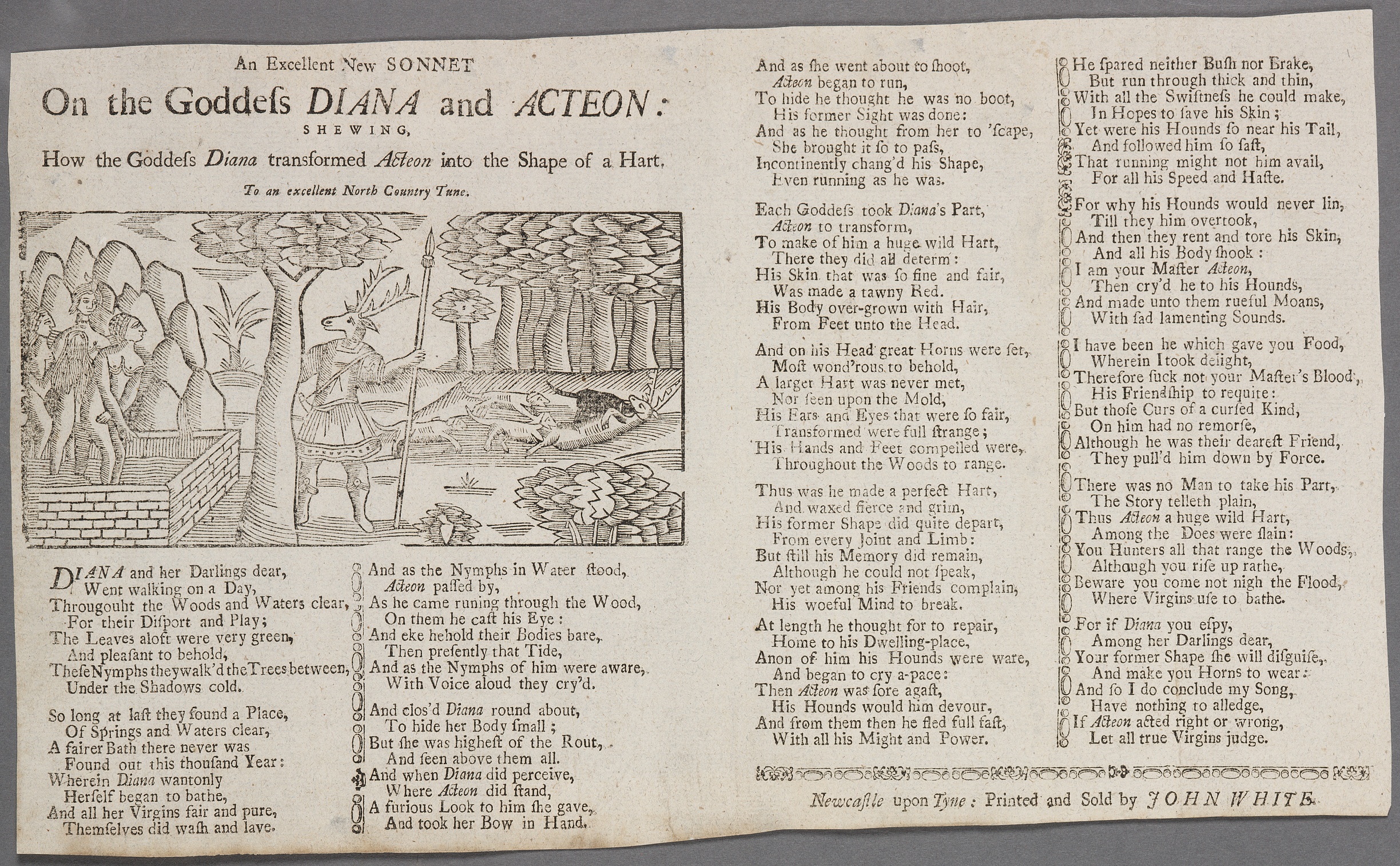
Ballad entitled ‘An Excellent New Sonnet On the Goddess Diana and Acteon’ (c.1725-69). EBBA.

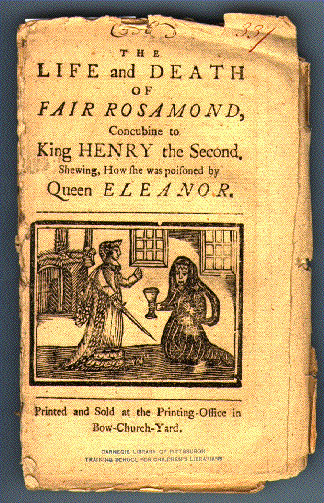
Title-page of a chapbook titled ‘The Life and Death of Fayr Rosamond’ (1755). SF.

These balladeers were just two of the hundreds that traipsed through the city streets and country lanes of early modern England, singing to advertise their wares. The exact contents of a peddler’s sack could be very diverse. In addition to all sorts of petty trinkets, they sold tales of drunken sailors, royal mistresses, industrious spinsters, and much else besides. Often these were in the form of broadside song sheets, but they might also be ‘pamphlets’ and ‘small books’, sometimes called chapbooks, written in prose to provide merriment or salvation for the price of penny or two. Margaret Spufford and Tessa Watt, among many others,  have discussed this ‘cheap print’ in much more detail, noting that ballad-sellers were often condemned by the authorities as vagrants. But in late seventeenth-century Norwich at least they seem to have been welcomed by both the townspeople and city officials.

Rather more unusual, however, was the license issued to a man a year earlier. In November 1679, the court declared that ‘Lawrence White is allowed to reade & sell Pamphlets on Horsebacke untill Wednesday next’.2 Continue reading