The Tudor South West at Exeter’s Royal Albert Memorial Museum: Part 4 – The Spanish Armadas

Laura Sangha

This is the fourth post in a week long series about an exhibition at Exeter’s museum. Click on pictures for enlargements.

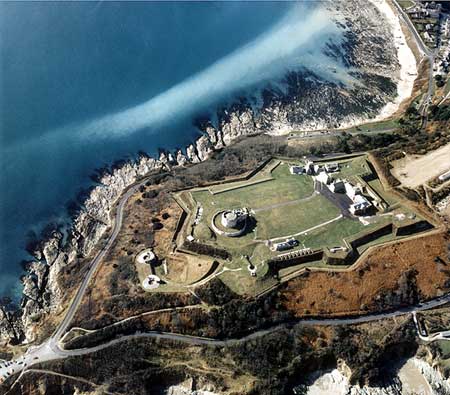
Pendennis Castle, Cornwall.

Pendennis Castle, Cornwall.

Politically, the south west was of crucial importance during Elizabeth’s reign when hostilities with Spain put Devon and Cornwall in the front line. This drew the region into events of national importance, but these events were also experienced on a local level and were of particular significance for the region. The 1588 Spanish Armada is probably the best known event of Elizabeth’s realm, and is certainly the most iconic, but for the south west things didn’t end there: two more invasion fleets sailed for Britain in 1596 and 1597. From the exhibition catalogue I learned that the region had in fact had been repeatedly strengthened militarily during the Tudor era – forts were constructed at western harbours in the reign of Henry VIIII, including the impressive examples at St Mawes (1543) and Pendennis (1546). In Elizabeth’s reign, Plymouth’s St Nicholas Island was heavily fortified in 1583-85 and Sir Richard Grenville was given command of the defence of Devon and Cornwall in March 1587, when he readied the equipment and defences of the peninsula. Anxieties remained high throughout the 1590s, Plymouth received more fortifications, and a small force landed at Mousehole, Newlyn and Penryn in 1595, doing extensive damage when they set them afire.

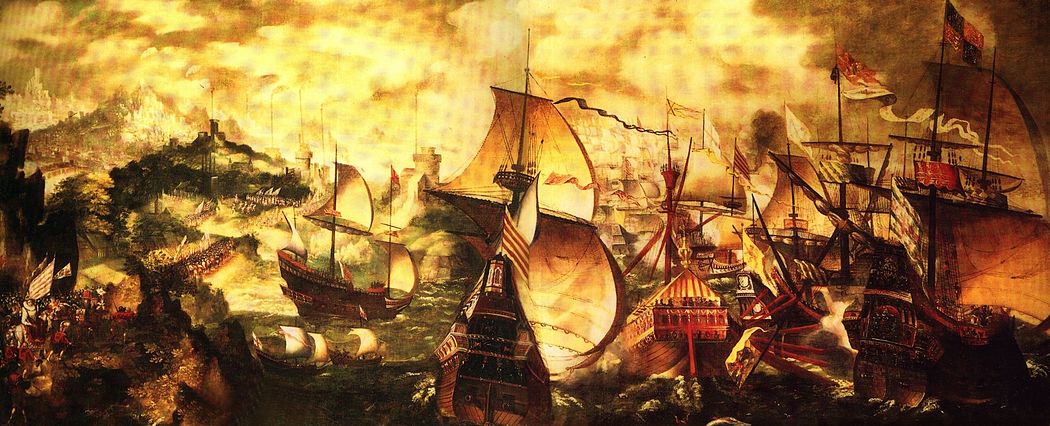
But it was the 1588 Spanish Armada that really became embedded in national consciousness and whose memory has endured. This is surely because the failed invasion was accorded with such importance at the time. Special forms of prayer were issued by the government giving thanks for the nation’s deliverance, and celebrations wind-blowing-on-armadamarking the defeat became a regular fixture in a rapidly developing new national ‘Protestant’ calendar, as David Cressy has documented. In the epic struggle between Catholicism and Protestantism, God appeared to have revealed his hand, assisting the numerically inferior and poorer Protestant forces to miraculously defeat the mighty fleet of a Catholic superpower. This was not a mere fluke convergence of bad weather and inspired naval leadership, this was a providential deliverance. The ‘Protestant wind’ that sent the Spanish ships into disarray was proof of God’s special care and protection of his chosen people, those Protestants who professed the ‘true’ faith.
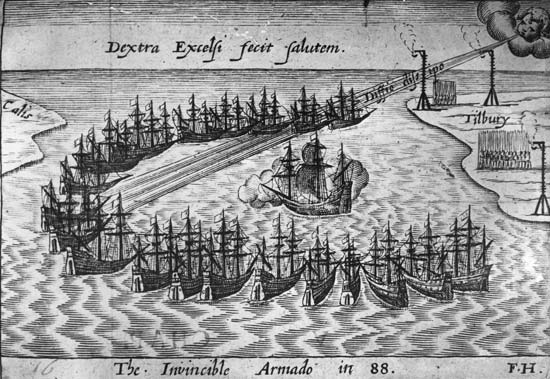
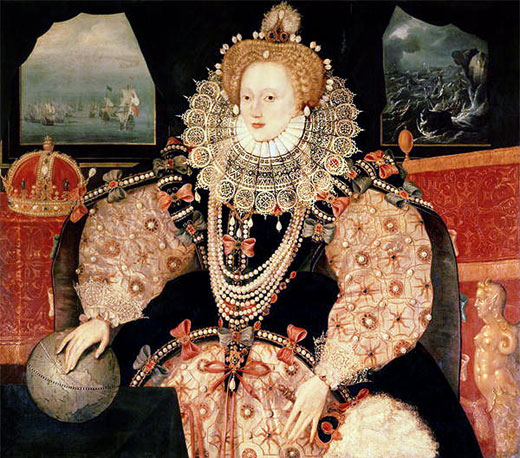
ELIZ portraitEven at the time the iconography of the Armada was well developed (again giving lie to the ‘iconophobia’ discussed in a previous post). If you see a crescent of tall masted ships you are probably looking at a representation of the Armada of 1588, and there a few examples of these crescents in the RAMM’s exhibition. Most obviously, there is the ‘Armada Portrait’ of Elizabeth I, so called because the queen is framed by two images of the naval action. Above the queen’s left shoulder the English ships are shown bravely sailing towards a confrontation with the Spanish fleet in its distinctive crescent formation; over her right shoulder a wreckage strewn seascape represents the remains of the once proud Spanish fleet.
Augustine Ryther engraving, note Exeter top right.

Augustine Ryther engraving, note Exeter top left.

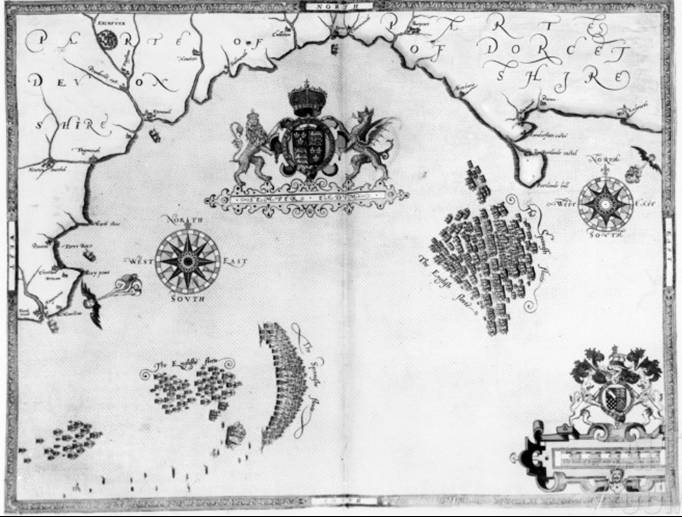
The exhibition also houses a wonderful series of exquisite hand coloured engravings, telling the story of the engagements off the Devon and Cornish coasts. The engravings were produced by Augustine Ryther from charts which recorded the route of the Armada around the coast. They really do provide the story of the events – this black and white copy shows the recognisable crescent shape of the fleet, and collapses the timing of the events so that two parts of the action are shown simultaneously, creating an easily understood narrative. This is a technique that I often encounter when examining early printed material with my students, particularly those ballads and broadsheets that seem to be aimed at the least literate members of society.
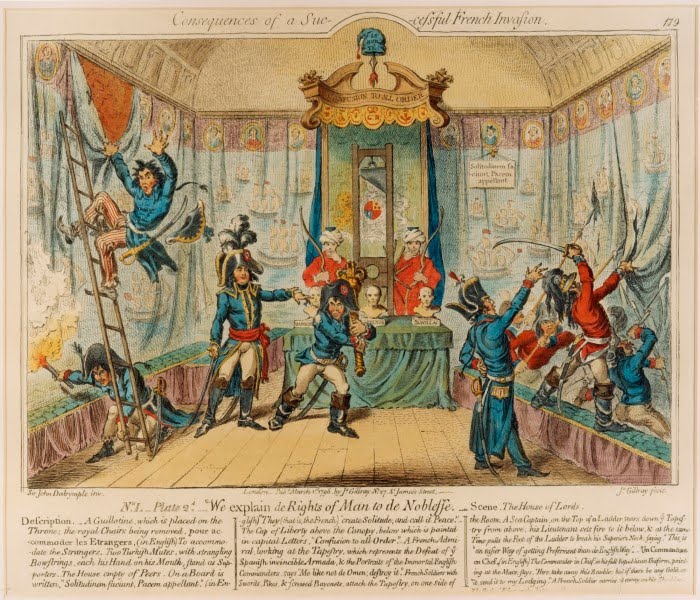
cartoon with tapestriesThe prints are similar to the tapestries that were hung in Parliament in 1650. Commissioned in 1592, the ten tapestries were enormously expensive, costing £1,582 (the equivalent of 87 years wages for a labourer in 1590); and enormous in size: we think they measured 14 feet in height and between 17 and 28 feet in width. In 1650 they found their way into the Houses of Parliament, where they were mentioned in debate on several occasions. As if further evidence were needed of the longevity and significance of the Spanish Armada, in 1798 when there were concerns about a possible French invasion, the artist James Gillray was commissioned to produce images that would rouse patriotic fervour in the English people – the series of satirical prints he produced included one (above) depicting a French Admiral ordering his men to destroy the Armada tapestries.
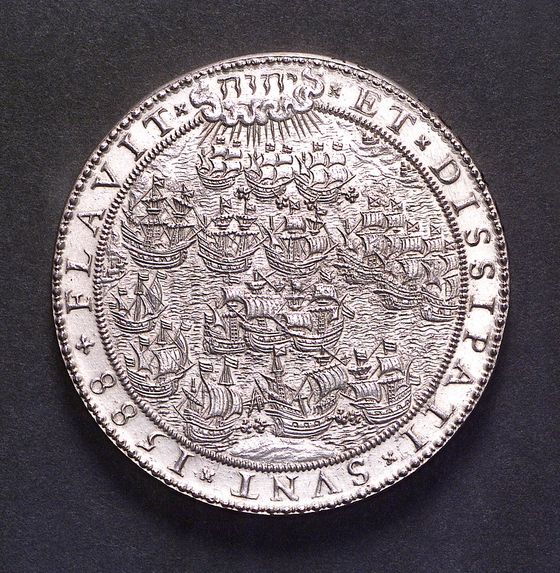
medalFinally, amongst other Armada memorabilia in the collection there is also a commemorative medal similar to the one in the picture. These were not only produced in England but also in other Protestant nations, indicating the way that the defeat of Catholic Spain reverberated throughout Europe, an important symbolic victory for international Protestantism. The medal in the RAMM collection is from the Netherlands. In the 1580s the Dutch United Provinces were in revolt against Catholic Spain, and Spanish hostilities against the English were in part an attempt to stop the English aiding their European Protestant allies.

The museum medal depicts the Armada in its familiar crescent shape. It bears the famous inscription ‘Flavit Jehovah et Dissipati Sunt’ (with ‘Jehovah’ in Hebrew letters, the Tetragrammaton יהוה): ‘Jehovah blew with His wind and they were scattered’. It is a reference to Job 4: 8-11:

Even as I have seen, they that plow iniquity, and sow wickedness, reap the same.

By the blast of God they perish, and by the breath of his nostrils are they consumed.

 The roaring of the lion, and the voice of the fierce lion, and the teeth of the young lions, are broken.

The old lion perisheth for lack of prey, and the stout lion’s whelps are scattered abroad. [King James Version]

Spanish Armada - so famous it made it into the Simpsons.

Spanish Armada – so famous it made it into the Simpsons.

References like this are deeply suggestive of one of the ways that Protestantism was changing English society. Scriptural allusions were commonplace, and from the way that they are used (casually, briefly) it strongly suggests that people were expected to recognise them and the deeper religious truths that they stood for. Job has of course already cropped up in this series of posts (see day two, domestic decoration), here the brief quotation serves a similar purpose as an image: a reminder, a prompt to reflection, a stepping stone to a more profound appreciation of one’s own faith.

In the final post tomorrow: a round up of the prominent themes.

‘West Country to World’s End: the South West in the Tudor Age’ runs until 2 March 2014 at Exeter’s Royal Albert Memorial Museum. You can find all the details about the museum, it’s opening times, it’s wonderful café and more here

Further reading:

Sam Smiles (ed.), West Country to World’s End: The South West in the Tudor Age [essays to accompany the RAMM exhibition].

David Cressy, ‘The Spanish Armada: Celebration, Myth and Memory’, in J. Doyle and B. Moore (eds), England and the Spanish Armada (Canberra, 1990) or Bonfires and Bells: National Memory and the Protestant Calendar in Elizabethan and Stuart England (London, 1989).
The Tudor South West at Exeter’s Royal Albert Memorial Museum: Part 3 – Goldsmiths and urban redevelopment

Laura Sangha

This is the third post in a week long series about an exhibition at Exeter’s museum.

Today I want to talk filthy lucre. One of the things I learnt at the RAMM was that Exeter was an important centre for the goldsmith trade from as early as the thirteenth century, and this set off a train of thought that ended up in the surprisingly short-term world of town planning. I’ll try to recreate the train here.

The goldsmiths golden age

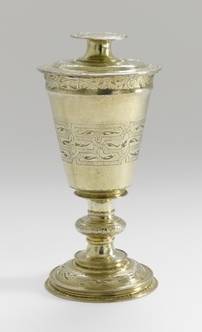
cup editMany of Exeter’s early modern artisans had their workshops in Goldsmith Street, an impressive thoroughfare that had a church at either end, almshouses, and a handsome hall used by the Company of Tailors. The exhibition houses a variety of related items, but the one that took my eye was a communion cup made by John Jones, one of the wealthiest goldsmiths in early modern Exeter. It is indicative of the fact that in this society, ‘fine art’ did not necessarily mean paintings (though there are some wonderful Holbeins in the exhibition, if that’s your thing). This cup, manufactured from silver with delicate engraving around the gilt-edged rim and foot, is extremely accomplished, in fact I was rather surprised by quite how fancy it was, given that this was over ten years into the Calvinist-inspired Elizabethan reign. The cup is still a thing of beauty, it could easily be a lot plainer and less ostentatious.

The uniqueness of the Church of England

My first thought was that perhaps this is proof that the Elizabethan Settlement acted as a ‘broad umbrella’, incorporating a number of different types of Protestants and a range of churchmanship? Christopher Haigh has argued that the adjustments made to the Prayer Book at the start of Elizabeth’s reign, particularly additions to the words used during the administration of the Lord’ Supper, deliberately introduced ambiguity into the ceremony, encouraging a range of opinion about what actually happened during the sacrament to survive or evolve. Diarmaid MacCulloch has argued along similar lines, suggesting that these changes were to bring the English Reformation in line with what was happening in the rest of Europe, particularly in Germany and Geneva. It is entirely plausible that the fancy cup could be a part of these processes – the use of a silver work of art, rather than a plain wooden cup, would have been deeply suggestive to a congregation versed in the ritual and symbolic importance of the liturgy.

The impact of the Reformation

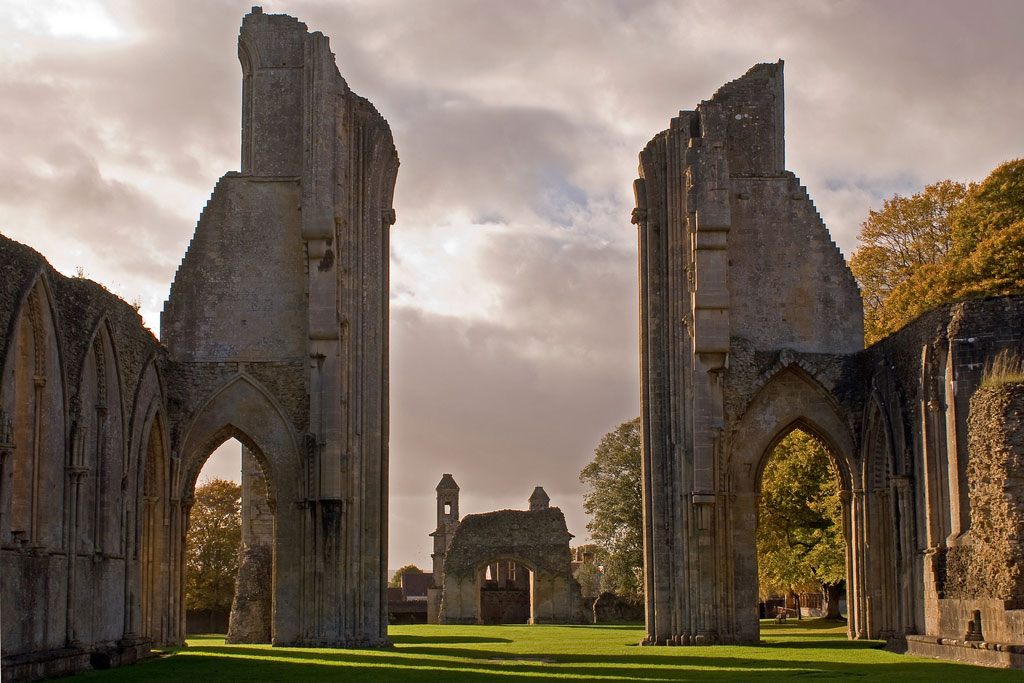
Beyond the sometimes obscure and Glastonbury2always complicated world of Reformation theology, the goldsmiths can also tell us much about the way in which changes in belief left a deep and enduring imprint on early modern society. For part of the reason for the continued success and prestige of the goldsmith community in Exeter was the dissolution of the City’s priory and friaries in 1538 and ongoing changes in religious policy that sent a lot of work their way. Historians have discovered that far from being isolated and cut off from their local communities, monasteries were in many ways integral to the social and economic functions of their local region, providing charity and education, and as producers and consumers. Following their abrupt closure, the shock waves were swift, reshaping the landscapes of local communities physically as well as spiritually. Large, imposing buildings were torn down or their functions changed, and Henry VIII quickly appropriated the vast riches of these institutions. This not only meant that the crown took control of church lands, they also seized their more moveable treasures. For the large group of goldsmiths in Exeter, this would have meant a very welcome steady source of work and income, as church plate was confiscated, some of which had to be melted down and reworked in a more acceptable shape, suitable to the new reformed liturgy. This was a lucrative business, as at each stage of the process the participants could take their cut, not to mention that the parishes had to buy new plate from the goldsmiths to replace the old throughout the Tudor era. Similar processes happened in parish churches – the RAMM’s information card tells us that the churchwarden accounts of St Petrock’s church in Exeter show that Jones was paid £1 15s 5d in 1572 for ‘converting’ this communion cup to make it suitable for Protestant worship. Thus the redistribution of wealth that the dissolution triggered is not restricted to the property market but bought benefits and profits to other groups that can easily be overlooked.

Heritage and Urban Planning

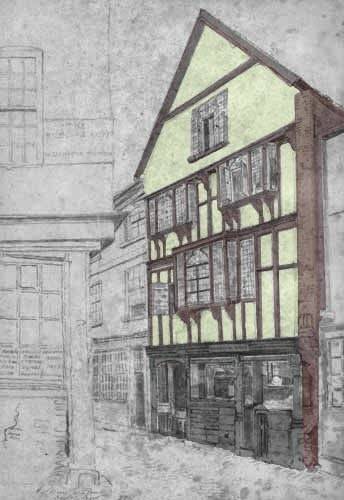
Exeter's Goldsmith's Street as it once was.

Exeter’s Goldsmith’s Street as it once was.

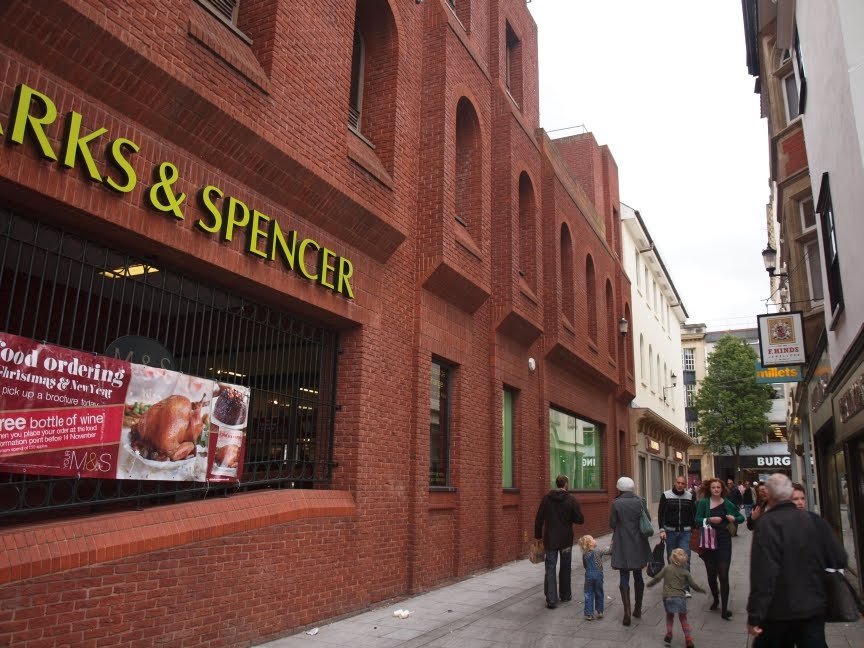
Finally, I was also interested to discover the fate of Goldsmith Street – the majority of the historic buildings there were demolished by the City Council in the 1970s to make way for redevelopment – today you will find Marks and Spencer and Millets where the goldsmiths used to ply their trade. Although one of our enduring national myths is that bombing raids in World War II were responsible for the destruction of much of our pre-modern urban architecture, more recently historians have begun to question this narrative. They have drawn attention to the fact that many cities were already undergoing a programme of redevelopment that included sweeping away inconveniently narrow medieval streets that were seen as obstacles to modern infrastructure and progress. Though the blitz did account for damage in many historic centres, our society’s own decision to prioritise the needs of economic and industrial advancement over our historic past may be the real explanation of urban change. A recent article on the BBC website revealed that this is even true of Coventry, which suffered devastating destruction in a terrible air raid in 1940, but where demolition had actually started before the war and continued after it. Exeter too suffered, in a severe raid in 1942 1,500 houses were destroyed, 2,700 were seriously damaged, and the Cathedral itself was hit, narrowly escaping the destruction of the nave. But much of value was left, though not all of it was subsequently retained – wiped away just as Goldsmiths was to make way for shopping centres and fast food joints.

The shock of the new

Exeter's Goldsmith Street now.

Exeter’s Goldsmith Street now.

In many ways modern redevelopment of our urban landscapes is now just as shocking and significant as the deliberate destruction of the monasteries and the properties of the parish churches in the 1500s, and increasingly we are now beginning to see it that way. Each was an iconoclastic act, signalling a rejection of and moving away from the past. They were both inspired by a shift in the prevailing ideology and the emergence of something new: Protestantism, capitalism, modernity. Each are shocking to us now because these acts display a complete lack of respect for the past and for beautiful treasures which can now never be recreated. Each seems to have been driven by ‘the authorities’ in the face of limited public resistance, and in many cases the public seem unable to prevent the change even where they disagree with it. Perhaps this can helps us to understand the ‘compliance conundrum’ – the question of why there was a relative lack of any widespread resistance to the dissolution, despite the commitment that most English women and men had previously shown to the institutions. Perhaps they felt as helpless as we do in the face of development, perhaps they also felt a sense in which they were swimming against the tide in trying to preserve the past or stand in the way of state sponsored change. Or perhaps they came to terms with and even embraced the changes, regretting the passing of the old ways and the destruction of beautiful things, but eager to make the most of the opportunities that the new future offered them, and keen to create new and more beautiful – but different – things to replace those that had been lost.

In tomorrow’s post: the Spanish Armada arrives off the south west coast.

‘West Country to World’s End: the South West in the Tudor Age’ runs until 2 March 2014 at Exeter’s Royal Albert Memorial Museum. You can find all the details about the museum, it’s opening times, it’s wonderful café and more here

The Tudor South West at Exeter’s Royal Albert Memorial Museum: Part 2 – Domestic Decoration

Laura Sangha

This is the second post in a week long series about an exhibition at Exeter’s museum. View the first post on a map of Exeter here.

In early modern England the population was expanding incredibly rapidly and massive inflation led to the deterioration of living standards for many of the lower sorts. In contrast, changes in income tended to increase the number of middling groups in society, those merchants, artisans and gentry who benefited from rising property prices. In the west country, the prosperous cloth trade and various mercantile enterprises meant that the middling sorts had money to invest in the arts. You are perhaps already aware of the National Portrait Gallery’s current exhibition on Elizabeth I and her People, and if that is your sort of thing, there are lots of paintings at the RAMM too, including ‘The Armada Portrait’ of Elizabeth I; several from the school of Holbein; numerous works by Exeter’s most significant artist to date, the miniature-painter Nicholas Hilliard; and a huge piece that tells the story of the arrival of Armada in the South West in 1588. Click on images for enlargements.

attributed hilliard armardaAll are deeply impressive, but the artistic accomplishment of the south west is also to be found in the crafts – in the production of jewellery, elaborate drinking vessels, church plate (more on that in tomorrow’s post), household utensils, decorative plasterwork, moveable furniture, architectural stone and woodwork, and fine needlework. Some of these were functional, but all displayed the taste, wealth and status of their owners in this society.

Two of my favourite objects in the exhibition seem to be less about status, but certainly fall within the category of the decorative arts. They are a set of boards with an image painted on each them. Both are reasonably small – perhaps the size of an A3 sheet of paper – and one depicts Moses, the other Job. Each has a scriptural extract painted above the image. On loan from the V&A, they are part of a series of Old Testament figures. The drawings are plain but relatively accomplished: Job wears a long red tunic, cinched at the waist with a belt with a tasseled pouch hanging from it. He has a long brown pointed beard and wears a small turban and long boots, an interesting suggestion of ethnic stereotyping. He looks as if he is walking somewhere, and his hands are together and raised in supplication. The figure stands on some scraggly grass, and it is against a black background, in contrast to the scriptural text in black letter against a white background that forms a strip across the top of the board. It reads: ‘I ame sure that my redemer liveth and that I shall rise [oute?] of the earth at the latter day. Job [19?].’

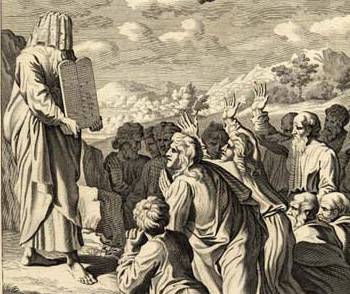
Moses wears a white tunic and his extra long, brownish belt flaps around his legs as if in a breeze. He has tights tucked into his high brown boots, and wears a warm looking hat. He has a brown beard, much shorter than Job’s, and he also looks like he is walking. In his arms is a large tablet divided in two, dashed lines across it representing the Commandments. There is a skull between his feet, and I was intrigued to see that Moses is blindfolded – I am assuming this represents the Lord’s impartial justice but would be delighted to hear of other examples of this. His inscription reads ‘The Lord will stirr up amonge the brethren a Profet, like unto me. Deutrinomy 18’.

The RAMM’s information card informs us that the boards might have been displayed in a church or private house near Plymouth, but immediately my little grey cells started humming. I doubted that it was the former in Elizabethan England, where the work of iconoclasm in parish churches was relatively complete. To me, these images were a surprise – what were images of scriptural figures doing here, in an era when images had been rejected by the reformers as leading to wrong belief and wrong practice?

When iconoclasts attack.

When iconoclasts attack.

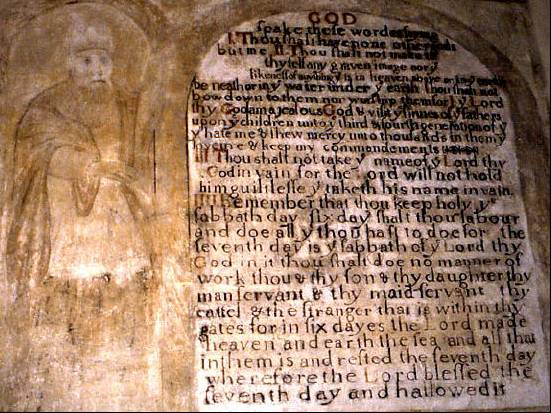
The scholarship on visual culture in early modern England can help to answer this question, as it has been rapidly developing in recent years. Earlier historians had to an extent been won over by Patrick Collinson’s argument that throughout Elizabeth’s reign, English Protestantism became less, not more popular in character. Crudely summarised, Collinson asserted that the first generation of Protestant publicists and propagandists made polemical use of cultural vehicles (songs, drama, cheap print, the visual arts), using these forms to transmit the evangelical message with the aim of converting the English people to Protestantism. Protestant plays were written and produced, godly ballads were published and sung, images were used to attack Catholicism and to commend their own religious beliefs and values. But around 1580 Collinson thought that a new generation of evangelicals began to reject visual and performative culture, judging it to be unsuitable for their religious message. This later generation of Protestants thought that plays, songs and images were distracting the audience and confusing the religious message. Worse, the arts mixed sacred ideas with filthy ‘popular’ forms, doing violence to religious truth by associating it with base, bawdy and inappropriate behaviour and language. In this new world, Collinson argued that Protestants came to completely refuse any appeal to the senses in religious matters. All images were ‘Popish’, most Elizabethan and Jacobean bibles therefore had no illustrations, the only decoration in the parish church was to be the Royal Arms and perhaps a table of the ten commandments. England had moved from iconoclasm in the first stages of reform (rejection of abused, dangerous and false images), to complete iconophobia (rejection of all images).

And yet…, whilst Collinson’s argument is enormously useful in thinking about the continuing repercussions of religious change, it is perhaps more useful for thinking about reforming clergymen than it is English society more broadly. Objections have been raised, and work is afoot to provide a corrective to the ‘iconophobia’ argument. It is easy to point to the continued existence of images in England – British Printed Images to 1700 is a website that hosts a database of several thousand printed images produced in Protestant Britain, and much decorated medieval furniture can be found in parish churches across the country to this day (though of course some of this may have been restored during a later era). Our Moses and Job boards are of course another example of later imagery.

Images persisted despite reforming disapproval. So how can we explain Moses and Job? Are these a rare surviving example of something from the bottom of the Tessa Watt’s ‘ladder of sanctity’ – inoffensive Old Testament figures that Protestants were comfortable displaying in a secular context? Watt has taught us that those scriptural figures who were the least sacred in the Catholic tradition, those that did not have cults associated with them and who were therefore unlikely to be the focus of devotion, were often still depicted in post-Reformation England. Moses and Job fit the bill – they are Old Testament figures, and both are strongly associated with moral teaching and practices. You are not meant to worship them but to learn from their stories and they were probably a new element of visual language in the post-Reformation church – there are no wall paintings of Job in Anne Marshall’s excellent catalogue of medieval wall paintings, and only one of Moses – which was painted after the Reformation.

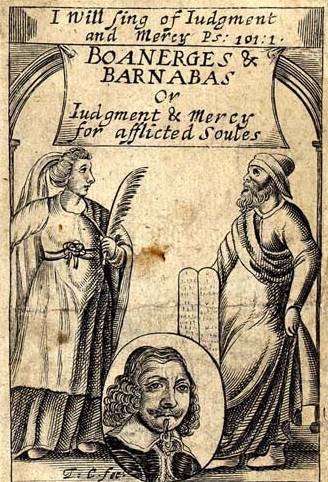
Watt’s theory therefore helps us to explain images that survived in the face of fierce criticism of the Catholic use of imagery in worship. It seems that the purposes of post-Reformation images were usually didactic, images were used symbolically to recall to mind important beliefs or Christian principles. Here the scriptural texts above the images suggest that these figures were intended as an aid to memory, representative of bigger theological and moral truths. Job stood for the trials, temptations and suffering that an ordinary family man might face in everyday life, the text the hope of release from them. Moses would call to mind the Ten Commandments (perhaps displayed for all to see in the parish church) and their Picture1importance as the basis of Christian morality and behaviour. Both are eminently suitable for display in a secular sphere such as the household, reminders of everyday Christian beliefs that could comfort and guide people as they went about their lives. Incidentally the British Printed Images database throws up eight images of Moses and two of Job, all from the seventeenth century, suggesting that these images might be less suitable for publication than for display in the household. Often these images are found in the frontispiece: Drexel’s School of Patience (1640) has an image of Job with the caption ‘Patience’; in Francis Quarles 1646 collection of miscellaneous reflections Boanerges and Barnabas Moses represents justice (in opposition to mercy) and wears a similar outfit to that depicted on our boards (see below); whilst a 1695 edition of Richard Allestree’s Works shows the prophet wearing a veil. Does the latter represent squeamishness over showing Moses’ face, or is it just because the book contains a section on the topic of veiling?

quarles mosesIt appears then that Moses and Job need not have been out of place in the Elizabethan south west after all. Tara Hamling’s recent work on domestic decoration supports such an interpretation, and these boards indeed suggest that Elizabethan England ‘still contained many images to help its inhabitants in converting the words of the Protestant religion into a visualised experience’, as Tessa Watt has argued. These images were complementing and supporting preaching and reading, those activities more traditionally seen as the heart of Protestant practice. The physical environments that people inhabited had also been changed as a result of reform, reconfigured to encourage the development of the Godly society that the evangelicals strove to create.

In tomorrow’s post: musings on the impact of the Reformation, goldsmiths and contemporary urban redevelopment.

‘West Country to World’s End: the South West in the Tudor Age’ runs until 2 March 2014 at Exeter’s Royal Albert Memorial Museum. You can find all the details about the museum, it’s opening times, it’s wonderful café and more here

Further reading:

Patrick Collinson, ‘From Iconoclasm to Iconophobia: the Cultural Impact of the Second English Reformation’, The Stenton Lecture 1985 (University of Reading:1986). Reprinted in Peter Marshall (ed.), The Impact of the English Reformation (London, 1997).

Tessa Watt, Cheap Print and Popular Piety (Cambridge, 1991), chapter 4, ‘Idols in the frontispiece’.

Tara Hamling, Decorating the ‘Godly’ Household: Religious Art in Post-Reformation Britain (London, 2010).

The Tudor South West at Exeter’s Royal Albert Memorial Museum: Part 1 – City Map

Laura Sangha

This is the first in a week long series of posts about a new exhibition at Exeter’s museum.

Exeter's Royal Albert Memorial Museum

Exeter’s Royal Albert Memorial Museum

I few weeks ago I had the pleasure of visiting a wonderful new exhibition at Exeter’s recently refurbished Royal Albert Memorial Museum. Titled ‘West Country to World’s End: the South West in the Tudor Age’, the publicity describes it as ‘celebrating the spirit of adventure and enterprise of south west people’ during the Elizabethan ‘Golden Age’. Along with some of my first and second year undergraduates, I was also lucky enough to attend a talking tour of the exhibition by one of its curators: Sam Smiles, Professor of Art History and Visual Culture at the University of Exeter. It was an intriguing insight into the thought and planning that goes into such a project, and I was struck by how carefully constructed museum exhibitions are in order to allow viewers to assemble a history from the objects themselves. It led me to reflect on the way that the selection, juxtaposition and display of the objects prompts the viewer to make associations and identify themes, leading to their greater understanding of the period and the subject. The exhibition runs until 2 March 2014, and each day this week I will be offering some thoughts on objects from the exhibition, explaining what the items said to me and following up on the questions that they raised. Click on pictures for enlargements.

Mapping Exeter

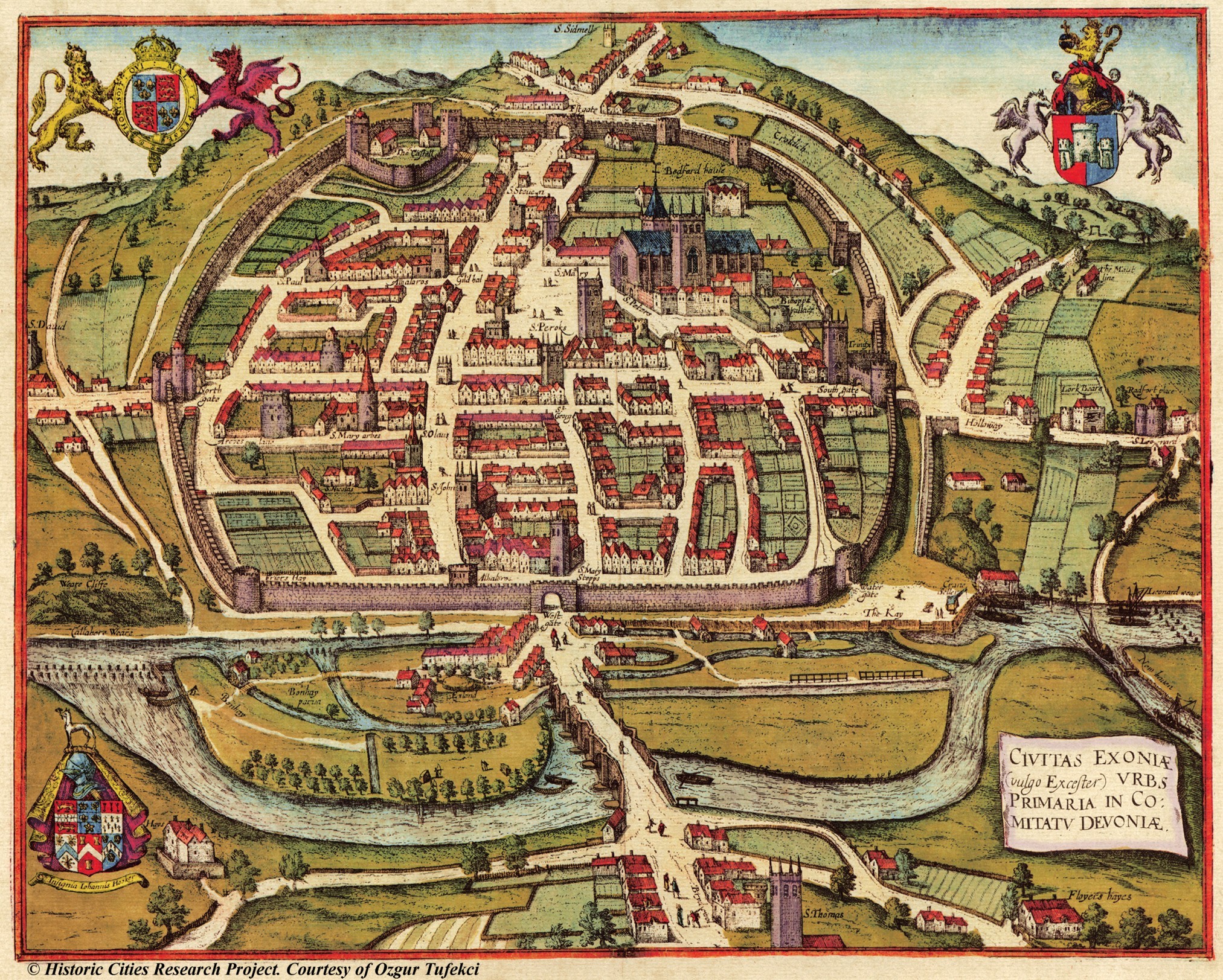
Engraving of Exeter by Hogenberg, 1587.

Engraving of Exeter by Hogenberg, 1587.

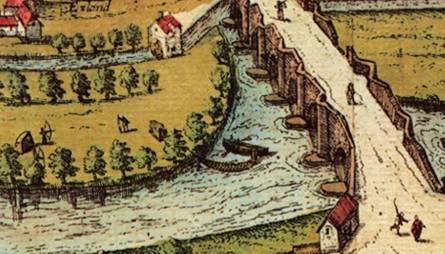
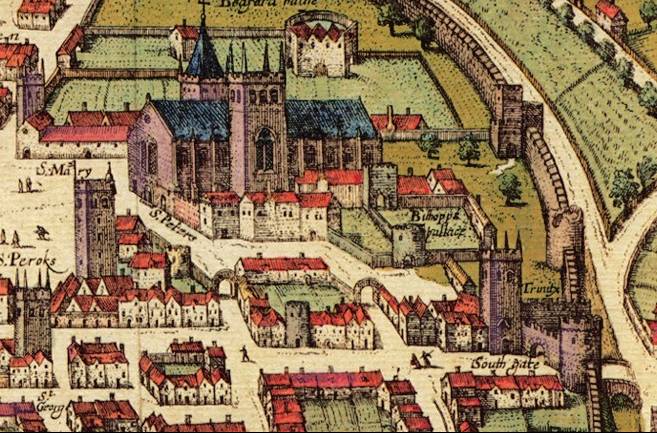
As a naturalised Exonian, I was very taken by the large scale reproduction of a map of Exeter as it was in 1587. Placed at the start of the exhibition it immediately orientates you within the early modern city, and it is fascinating for any number of reasons. The Exeter on the map has some familiar landmarks, yet the contours are not what are not what you expect: the river has been redirected in the centuries since, the castle and city walls have largely disappeared, and of course modern Exeter is far larger, incorporating parishes that were entirely separate in the early modern period and archers riversprawling suburbs where once there was only farmland. The map is incredibly detailed – there are figures promenading in the streets and a couple of archers practise their skills by the Exe bridge, whilst the tenterhooks used in Exeter’s successful cloth trade are plain to see on the banks of the river. There are at least seven churches within the walls in addition to the huge cathedral, and everywhere there are wide green open spaces: a reminder that the Tudor urban environment was vastly different to our own. The map is hard to navigate for a modern too – the perspective allows the viewer to see the city in it’s entirety, but in doing so fails to indicate the very steep incline between the river and the city centre, so buildings that appear to be next to each other on the map are not experienced like that in reality.

Of course maps are never realistic in the way that they present their subject, they are designed to convey specific information to the map ‘reader’, thus the map designer chooses which aspects to emphasise and which to elide. The resulting distortion might The Cathedral was surrounded by churches, and someone's fancy house.therefore tell us more about the producers’ perceptions and intent than the place they are depicting. Thus we do not see the city ‘as it actually was’, but rather we see what the producer (or patron) wants us to. This map was made for the great city atlas edited by Georg Braun and largely engraved by Franz Hogenberg, published in Cologne in six volumes 1572-1617. Many of the images in this post can be seen at ‘Historic Cities‘ which has excellent digital reproductions of city maps of the past, present and future.

Meanwhile, just outside Oxford

Meanwhile, just outside Oxford…

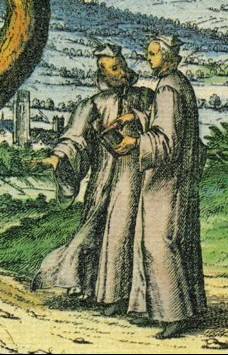
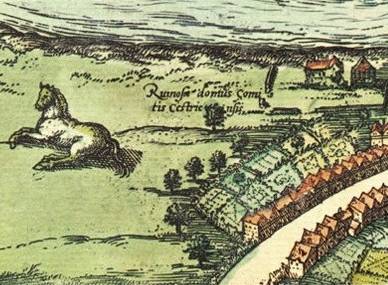
Braun and Hogenberg’s atlas contained 546 maps of cities, mainly European but there was also room for Mexico city and Casablanca. Other English cities included were London and the second city Norwich, Oxford and Cambridge, York, Canterbury, Chester and Bristol: the fact that Exeter was deemed worthy of inclusion alongside these indicates its important national status at the time. Hogenberg’s other city plans share features with Exeter’s –York is surrounded by a profusion of windmills, and in Norwich archers are also practicing their skills on the outskirts of town. There are differences too: Bristol, Cambridge and Norwich have sheep grazing in their hinterlands whilst in Exeter is surrounded by arable land, some of the maps have larger figures in contemporary dress in the foreground, indeed Oxford has what appear to be two scholars having an argument under a tree.

Either Chester was menaced by giant horses, or this map is not to scale.

Either Chester was menaced by giant horses, or this map is not to scale.

The Exeter map thus tells me that Hogenberg saw the city as a Godly, thriving, well defended and well connected metropolis, relatively compact though already outgrowing the limits of it’s walls. The river was clearly a central part of it’s extensive trading and manufacturing activities, the water cluttered with boats and mills. A steady stream of people cross over the bridge towards the city gates, and within the walls there were some impressive houses suggesting wealthy citizens – this was a bustling regional centre, then as now. Surprisingly there are no cows to be seen (Cambridge, Bristol, Chester and other cities have sheep and horses grazing around about them), but there are some chaps fishing near a weir at Bonhay. The wide streets and green spaces within the city and the rolling Devon countryside which form the hinterland suggest this would be a good place to live and work, it is presented as a civilised, spacious and clean environment. As such, my suspicion is that it only tells part of the story of life in urban Elizabethan England.

In tomorrow’s post: what are images of Moses and Job doing in the Protestant south west?

‘West Country to World’s End: the South West in the Tudor Age’ runs until 2 March 2014 at Exeter’s Royal Albert Memorial Museum. You can find all the details about the museum, it’s opening times, it’s wonderful café and more on their website.

Credits:

Historic Cities, a joint project of the Historic Cities Center of the Department of Geography, the Hebrew University of Jerusalem and the Jewish National and University Library.

Georg Braun and Frans Hogenberg, ‘Civitas Exoniae (vulgo Excester) urbs primaria in comitatu Devoniae’, in Civitates Orbis Terrarum, Cologne. Vol. VI 1617.

Ruth Mather, ‘The Home-Making of the English Working Class’

[This is the second piece in ‘The Future of History from Below’ online symposium (#historyfrombelow). Ruth Mather is a doctoral candidate at Queen Mary, University of London, studying the links between working-class political identities and the home in the late eighteenth and early nineteenth centuries. She also blogs about her adventures in research.]

I became interested in ‘history from below’ as an undergraduate through the encouragement of Professor Robert Poole, who introduced me to E.P. Thompson’s The Making of the English Working Class. Thompson’s book, which reaches its half-century this year, showed me a new way of doing history, one which didn’t patronise working people, or subsume them in a narrative of progress, but instead constructed a story about thinking, feeling people with their own ideas about their lives and their own strategies for living them. It’s important that our histories show the humanity of our subjects  – in my case the English labouring classes in the late-eighteenth and early-nineteenth century. This is not about glorifying poverty or writing hero narratives, but simply attempting to understand the messy, complicated details of the real lives of ordinary people.

I’m not alone in thinking this is particularly crucial at the moment, when a new history curriculum threatens to take us back to stories of great men and Whiggish progress and welfare recipients are demonised for political gain. However, other participants in this symposium will be discussing the continued relevance of ‘history from (and for) below’ in much more detail over the coming weeks, and it is not difficult to find excellent explanations of why ‘history matters’ more generally. So, having outlined why ‘history from below’ is important to me, I’d like to focus on the question of how we can find sources that can help to uncover the domestic lives of ordinary people as part of this wider project of uncovering voices that have been underprivileged in the historical record. Continue reading

Everyday Life and the Art of the Dutch Masters: A Social Historian’s Perspective

Mark Hailwood

The visual culture of the early modern period has been a prominent theme here on the many-headed monster, what with Jonathan’s recent post on what God looked like, and my own series of posts on woodcut workers, so I thought another contribution to these musings would be welcome.

So, below is an essay I was recently asked to write for a guidebook for an art exhibition being held at The Collection Museum, Lincoln. ‘Masterstrokes: Great Paintings from York Art Gallery’ runs until 26th August, and contains some of the highlights from York Art Gallery’s collection, on temporary display in Lincoln.

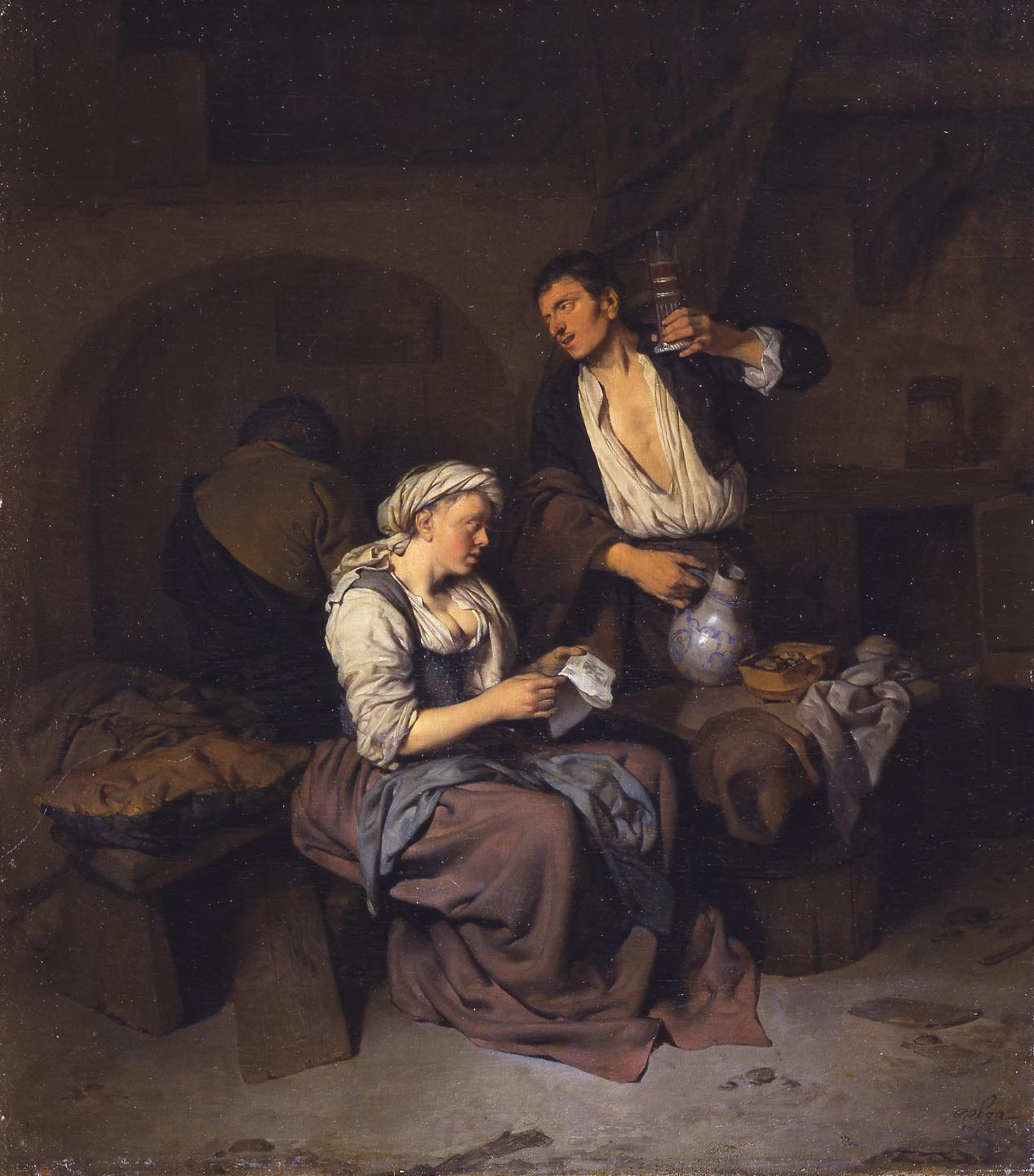
The painting I was asked to comment on is Cornelis Bega’s ‘Tavern Scene’, 1662, approaching it from the angle of what it might be able to tell a social historian. Here is what I came up with:

What is a social historian? The main thing that marks us out from our colleagues in political or economic history is that we are concerned not so much with the ‘great men’ or macro-economic developments—which have undoubtedly played their part in shaping our past and present—but with the everyday lives and experiences of ordinary men and women. We want to know what life was like in the past for the majority of our ancestors.

Recovering these experiences is far from straightforward. For the period that I study—the seventeenth century—the subjects of my research have rarely left behind any of their own accounts of what their lives were like. Only 30% of men, and 10% of women, were fully literate, and those that were tended to come from the upper ranks of society. As such, there are few letters or diaries surviving from humble men and women recording the fine details of their day-to-day trials and pleasures.

As a result, the social historian needs to be ‘omnivorous’ in their search for useful sources of evidence. They need to cast their net wide and glean what they can from surviving court records such as witness statements, from surviving popular ballads and songs, or from the indirect evidence provided by the extant writings of elite social groups. They might also be able to gain insights from the visual culture of the period they study.

In this regard, Dutch Golden Age paintings—such as Cornelis Bega’s ‘Tavern Scene’ on display here—are a tantalising prospect for the social historian. Many adopt a realist focus on the everyday life of seventeenth-century peasants and artisans. Moreover, many of them depict scenes of tavern culture, an aspect of everyday life that has increasingly come to attract the attention of social historians. There is a frustration here though for the historian of seventeenth-century England: there is no English equivalent in this century for the vibrant genre of everyday life paintings being produced in the Netherlands (I’m not quite sure why, but it is a common subject of speculation in conversation with my colleagues). So there is an obvious problem inherent in trying to use paintings of Dutch tavern culture to draw conclusions about English tavern culture, but if we put that to one side for the moment we might think about what sorts of questions a social historian could ask of paintings such as Bega’s ‘Tavern Scene’.

Thanks to York Art Gallery for permission to reproduce this image (YORAG782)

Thanks to York Art Gallery for permission to reproduce this image (YORAG782)

At first glance we might wonder if the utility of this painting lies more in what it tells us about contemporary attitudes towards tavern culture than what it can tell us about what actually took place in them from day to day. It could be taken to encapsulate a common negative stereotype of taverns that was most closely associated in England with Puritans—those who enthusiastically embraced the new Protestant religion—who were known to be particularly vociferous in condemning drunkenness as an ‘odious’ and ‘loathsome’ sin. Is the standing male character slightly off-balance perhaps, his shirt falling open as the decorum slips, drunkenly leering at the bosom of the… serving maid? Taverns were often criticised as sites of inappropriate sexual promiscuity, and we could read this depiction as a visual equivalent to the many sermons that were preached against the immorality of tavern culture in the period.

A closer look suggests that Bega is offering us much more than well-trodden moralising in his tavern scene. The social historian’s gaze is drawn to some of the more quotidian aspects in the painting. There seems, for instance, to be crumpled bedding laid out on the bench behind the central female character. This highlights an important fact about seventeenth-century taverns (or as they were more commonly called in England, alehouses) that the modern viewer may not appreciate: unlike the pubs of today, the primary purpose of an alehouse in this period was not to provide a location for recreational drinking. Rather, it had two main functions: one was to sell ale to local people who did not have the means to brew their own at home. Ale (usually weaker than our modern equivalent) was an important part of the daily diet and a key source of calories and nutrients, and was consumed with all meals by men, women and children. In this sense the alehouse was meant to serve more as an off-license. In practice, of course, many allowed drinking on site and they did become sites for recreational drinking and drunkenness, but this was forbidden in legislation.

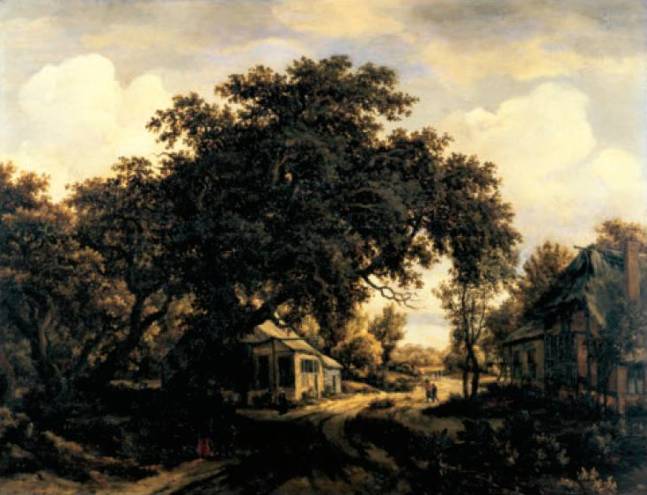
Their other (legitimate) purpose was to provide lodging to travellers. As such they were invariably situated on main roads, something we can see in another painting in this exhibition, Meindert Hobbema’s ‘A Wooded Landscape’. It looks like a drinking house on the left, identifiable by its ‘ale-post’, the ancestor of the pub sign, protruding into the road to show that ale was available.

Thanks to York Art Gallery for permissions (YORAG2005.608)

Thanks to York Art Gallery for permissions (YORAG2005.608)

With this is mind another reading of this tavern scene is possible. What we have is not a scene of drunken debauchery, but a party of travellers who have spent the night asleep on the alebench (alehouse accommodation was rarely plush, and often involved simply sleeping on a bench or sharing a bed with landlord and landlady!) The man with his back to us is still rousing himself from sleep. The standing character is not yet fully dressed, but is nonetheless taking his ‘morning draught’ of ale, the seventeenth-century equivalent of that first cup of coffee. What we might be seeing is the depiction of a morning routine after an overnight stay at the tavern, a far from untypical experience in an age when the lower orders did most of their travelling on foot, and only limited distances could be covered in a day.

We are also struck, of course, by the act of reading taking place at the centre of the scene. It is intriguing, given the statistics of female literacy, that it is the female character doing the reading. What is she reading? Could it be a broadside ballad? These were songs printed on a single (sometimes folded) sheet of paper that were sold cheaply—usually for a penny, the same price as a pint of ale—and often took the form of drinking songs to be sung in alehouses, or even pasted up on their walls. Is that one pasted up in the alcove on the back wall? Perhaps one discarded on the floor in the fore ground to the right? These drinking songs have received a lot of recent attention from social historians, who have mined them for insights they may offer into seventeenth-century tavern culture. Is this a depiction of one being performed? Is the standing male responding to a call that was common in these songs to raise a toast to his companions, or to raise a loyal toast to the King, another familiar feature of these songs?

Arguably the scene is too sedate to be a raucous rendition of a drinking song. Another interpretation may be that the reader is relaying the latest news from a printed newsheet—possibly news of a successful sea battle that is spurring the toast of her companion, or even a satirical political broadside that is the root of his mirth. Both of these were common subjects for cheap printed wares that circulated in taverns. Indeed, the discussion of news and politics in taverns was common and widespread long before the emergence of the coffeehouse in both England and the Netherlands from the mid-seventeenth century, the drinking establishment which is more commonly associated with a public thirst for news and politics. Is Bega looking to capture the fact that the politics of ‘great men’ were not as detached from the world of everyday tavern culture as historians have often thought?

It is, of course, beyond us to know for sure what Bega wanted us to take from his tavern scene, and at best it remains a somewhat indirect form of evidence of everyday life in the past for the social historian. That said, there are a number of aspects of his scene—the tavern as a place of lodging, the circulation of printed ware in these locations—that accord with the evidence of tavern culture in the seventeenth century that social historians have garnered from other sources. It reinforces our sense that tavern culture was about more than mindless drunkenness and sexual promiscuity, providing vital services and a venue for the dissemination and discussion of the issues of the day. Given these areas of overlap between Bega’s scene and what we can recover from other sources there may well be cause for optimism for social historians that such paintings can be a reliable guide to everyday life in the past. Or at the least, another component of our omnivorous diet of sources.

Idols of the mind; or, what on earth does God look like?

Jonathan Willis

Term has ended, I’m organising a big conference next week, and I also urgently need to start writing the paper I am giving at said conference; so what better time, I thought, to write a blog post on an entirely unrelated topic? Frankly, it was either this or finally write that book review I’ve been putting off for weeks…

This post is about God; or more specifically, about what God looks like; or, more specifically still, about how people may have thought about and/or visualised God in Reformation England. I’ve been thinking about this for some time, largely related to different aspects of my work on the ten commandments. First of all, the commandments as a whole derived much (let’s not beat around the bush, pretty much all) of their authority from the fact that they had been given by God himself. Exodus 19 describes how God came down upon mount Sinai in ‘thunders and lightnings, and a thick cloud upon the mount’. He ‘descended’ upon the mountain ‘in fire’ and delivered his commandments. Afterwards, Moses, Arron, Nadab, Abihu and seventy elders came up the mountain to see God, although only Moses himself was given leave to come near to God. Exodus 24:10 describes the supernatural encounter:

And they saw the God of Israel: and there was under his feet as it were a paved work of a sapphire stone, and as it were the body of heaven in his clearness.

Several chapters later, Exodus 31:18 describes another pivotal moment, the point at which the commandments were passed to Moses:

And he gave unto Moses, when he had made an end of communing with him upon mount Sinai, two tables of testimony, tables of stone, written with the finger of God.

william-blake-god-writing-the-commandments-boards_i-G-59-5923-ZI3RG00Z

Blake’s vision of God, writing the Commandments

God’s presence in Exodus is suitably awe-inspiring and mysterious, cloaked as it is in fire, earthquakes, trumpets and smoke. But for the careful reader and listener there are some rather intriguing human details. Firstly, God spoke. Now we in the twenty-first century have seen and read enough works of science-fiction and fantasy fiction to imagine a booming voice emitting from nowhere, or perhaps beaming telepathically directly into our heads. But for most early moderns, surely a voice would have implied a mouth, a tongue, a head… Exodus 24:10 talks of a sapphire pavement under God’s feet, and perhaps most crucially, the ten commandments are described as having been written with the finger of God.There is a marvellous depiction of God doing precisely that, engraving stone tablets with his right index finger extended like some sort of divine welding torch, by the romantic poet and painter William Blake. But such a depiction would have been unthinkable in Reformation England, because of the great weight placed upon the commandments themselves, and in particular the first, ‘Thou shalt have no other gods before me’, and the second. Exodus 20:4 stated quite clearly,

Thou shalt not make unto thee any graven image, or any likeness of any thing that is in heaven above, or that is in the earth beneath, or that is in the water under the earth.

Michaelangelo's God as shown creating Adam on the ceiling of the Sistine Chapel

Michaelangelo’s God as shown creating Adam on the ceiling of the Sistine Chapel

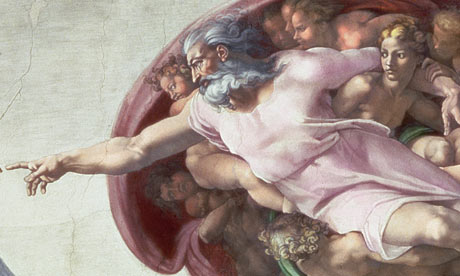
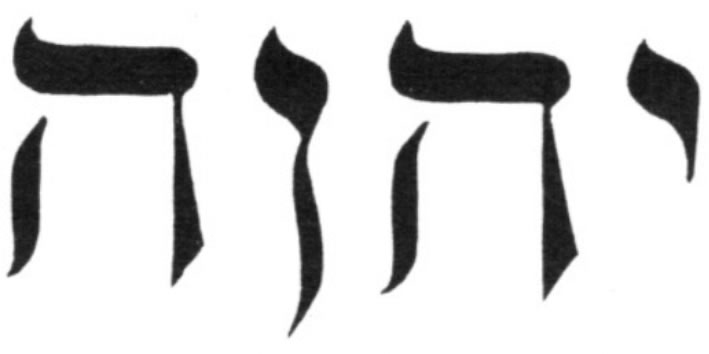
This is in large part a familiar story. Depictions of God the Father as a white-bearded old man (like the rather famous one above) were out in Protestant Reformation England, and so imaginative painters, printmakers and carvers resorted to figurative alternatives like the Hebrew ‘tetragrammaton’:

YHWH, or 'Yaweh', in Hebrew

YHWH, or ‘Yaweh’, in Hebrew

People recognised this as a symbolic depiction of God, the newest element of a longstanding visual language which recognised that rays of light and prominent doves could function as representations of the holy spirit, and that indeed Christ could be represented as a lamb, or by the ‘holy monogram’ IHS and other Christograms.

But people recognised the lamb and the holy name as symbols. They did not think that Christ was a sheep – the bible was rather insistent on the fact that he had been both God and man. So when people saw the tetragrammaton, or heard references to God’s voice, and feet, and fingers, what could they do but picture somebody in the form of a man, a man old enough to be the ‘father’ of the ‘son’ who had died for their sins? It is therefore easy to see an unresolved tension in the way in which most writers discussed the second commandment, with its absolute ban on images of the divine directly contradicted by the partial painting of a picture of God in words, through references to hands, feet, mouth, voice, and other physical elements of fleshy human bodies.

While most ministers and godly authors like Samuel Purchas and John Brinsley were happy to speak of a law ‘renued by the voice and finger of God on Mount Sinai’,[1] or of ‘the Ten Commandements written by the Lords owne finger’,[2] others recognised this inherent contradiction and were more careful. Calvin, in his sermons on Deuteronomy, explained that while God had chosen to write his law on stone tables with his own finger, we should not believe

that God hath anie hands: but that the holy scripture speaketh so by a resemblance as if it were saide, the lawe was note written or ingrauen by mans hand: but God approoued and ratified it by way of miracle.[3]

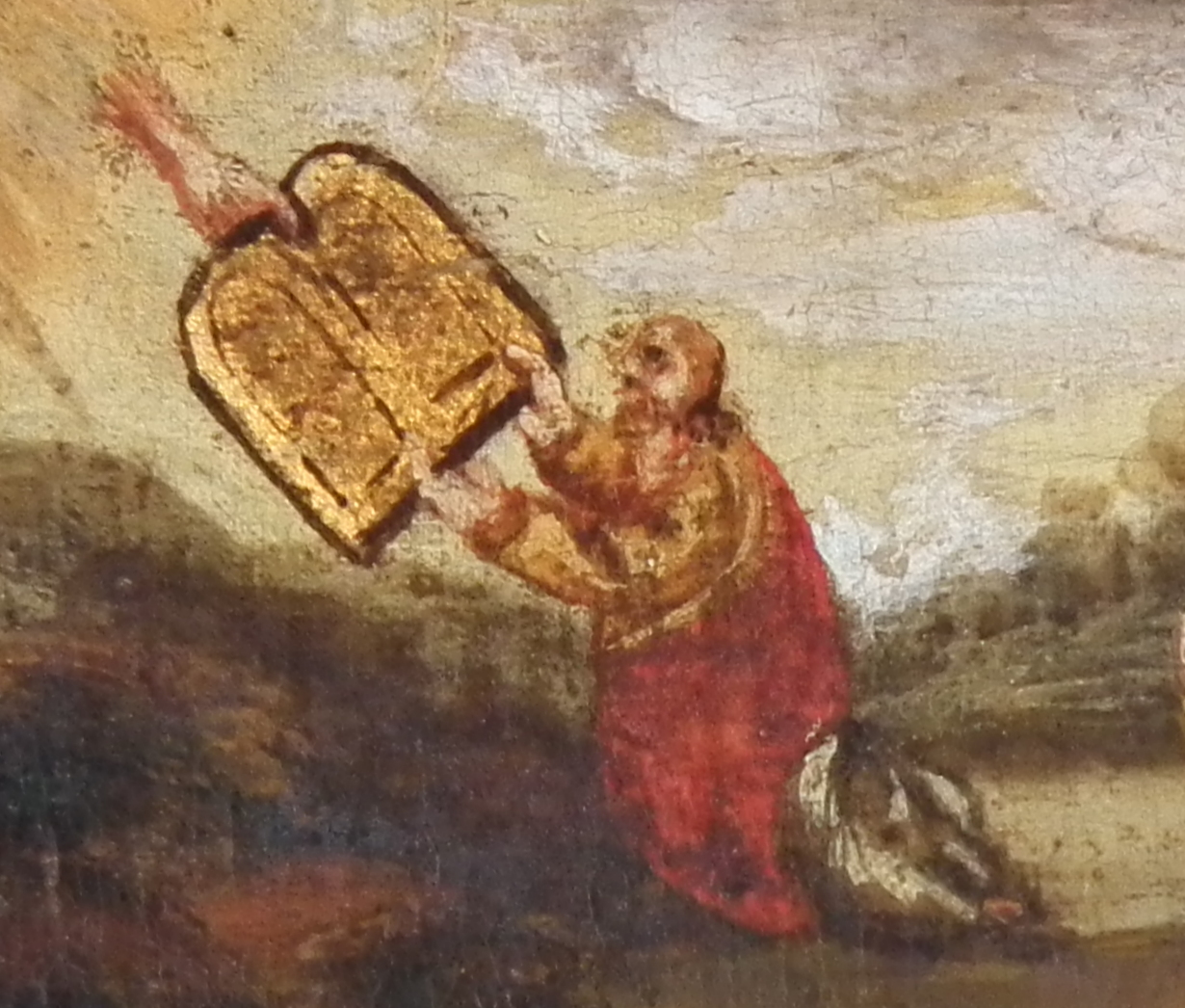
Not many people could maintain such a rigid division in their heads, however, and occasionally idols of the mind could be made partially manifest. I want to share just two examples today. The first, taken from a rare Elizabethan commandment board hanging in a Hampshire church, shows what is unmistakeably a divine hand, fully formed with four celestial fingers and a god-like thumb, handing the ten commandments out of the sky to a kneeling Moses.

Gravatar

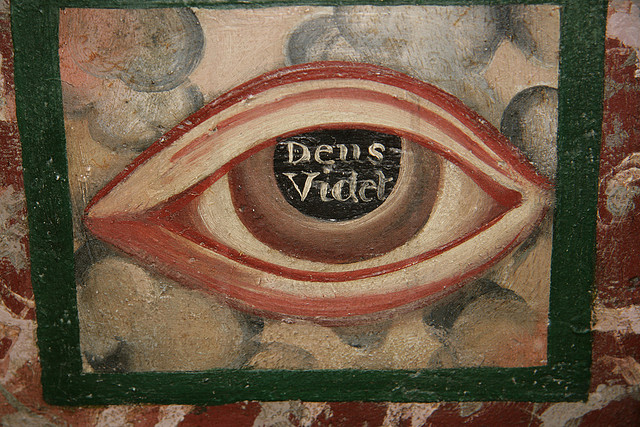
The second, knowledge of which I very gratefully owe to University of Birmingham PhD student Susan Orlik, is the baleful eye of God staring down at the occupants of an astonishing family pew in a Berkshire church, the pupil of which is inscribed with the words deus videt – God watches.

3780847851_57fff22182_z

If any monster readers have come across any interesting, unusual or incongruous representations or descriptions of, or references to, God, I’d be very interested to hear about them here!


[1] Samuel Purchas, Purchas his pilgrimage (1613), p. 17.

[2] John Brinsley, The fourth part of the true watch containing prayers and teares for the churches (1624), p. 78.

[3] Jean Calvin, The sermons of M. Iohn Caluin vpon the fifth booke of Moses called Deuteronomie, trans. Arthur Golding (1583), p. 391.

Carnivalesque 94: No bishop, no king

Brodie Waddell

Welcome to the 94th edition of Carnivaleque! Today we will be introducing you to a wonderfully motley menagerie of historical blogs and bloggers.

Finding any overall unifying theme is impossible with a collection of this sort, but there are a few key subjects that emerged from the nominations, each of which receives a section below:

  • The historian as detective
  • Bodily functions
  • A venerable criminal enterprise
  • Places, spaces and sites
  • Thinking about the historian’s craft

I think it is particularly interesting what’s not in the links below, namely kings and queens and ‘great battles’, the traditional material for popular histories. Not that political history and military history are entirely absent, just that they are approached from a different direction than usual. Although there are a few of gentlemen and noblewomen as well as a famous scientist, the vast majority of the nominated posts are focused on people who would have been largely excluded from textbooks written fifty years ago. What should we make of this? Is old-fashioned ‘top down’ history dying off? Or is it just that the type of people who read this blog and pay attention to Carnivaleque are predisposed against reading yet another story about Henry VIII and his wives or Charles I and his parliaments? I’d be interested to hear what you think.

However, before wandering into the carnival below, take a look at this truly heart-warming short animation that tells the tale of ‘the damnable life and death of one Stubbe Peeter, 1590’, a German werewolf. For more details, see the two posts at LOLManuscripts, but in the meantime, watch the video and be amazed.

Now, on with the show…

Continue reading

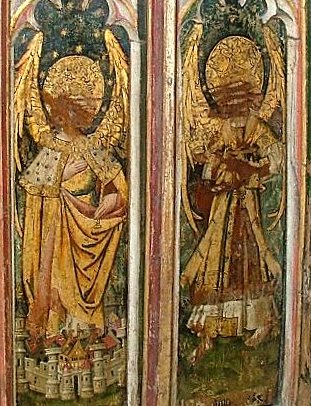
Something for Good Friday (it would be Rood not to)…

Jonathan Willis

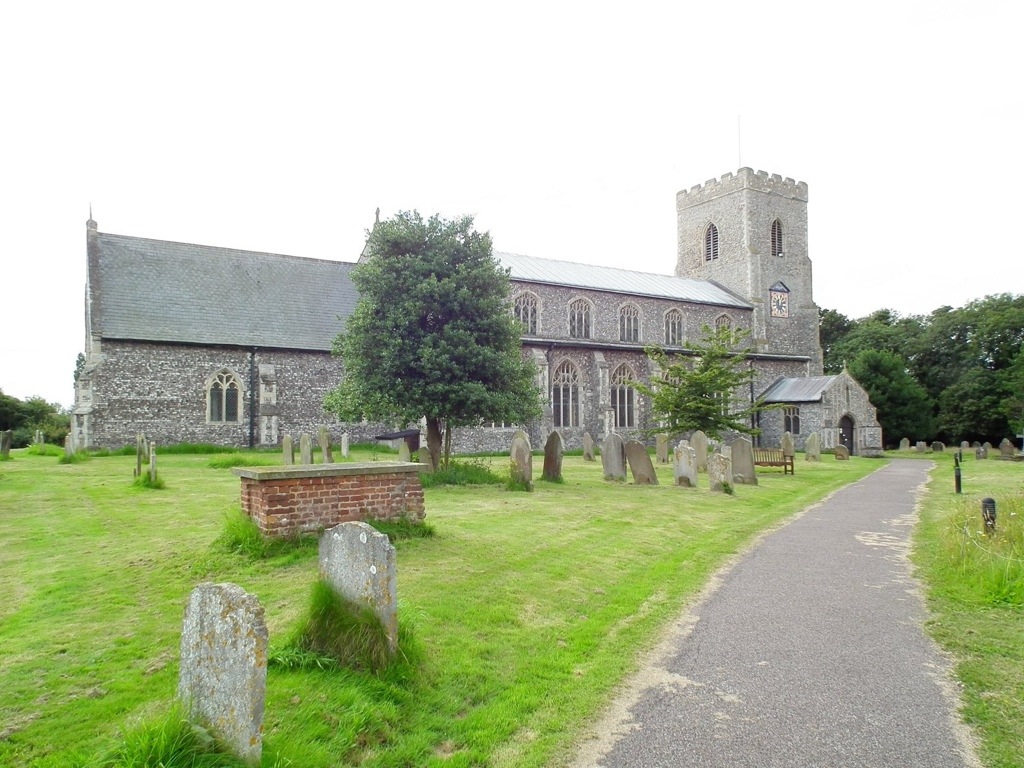
Just a little something for Good Friday: I don’t know how many of you know the parish church of St Catherine, Ludham, Norfolk, but like so many of the county’s churches it has a solid medieval pedigree and is really worth a visit!

20130329-090718.jpg
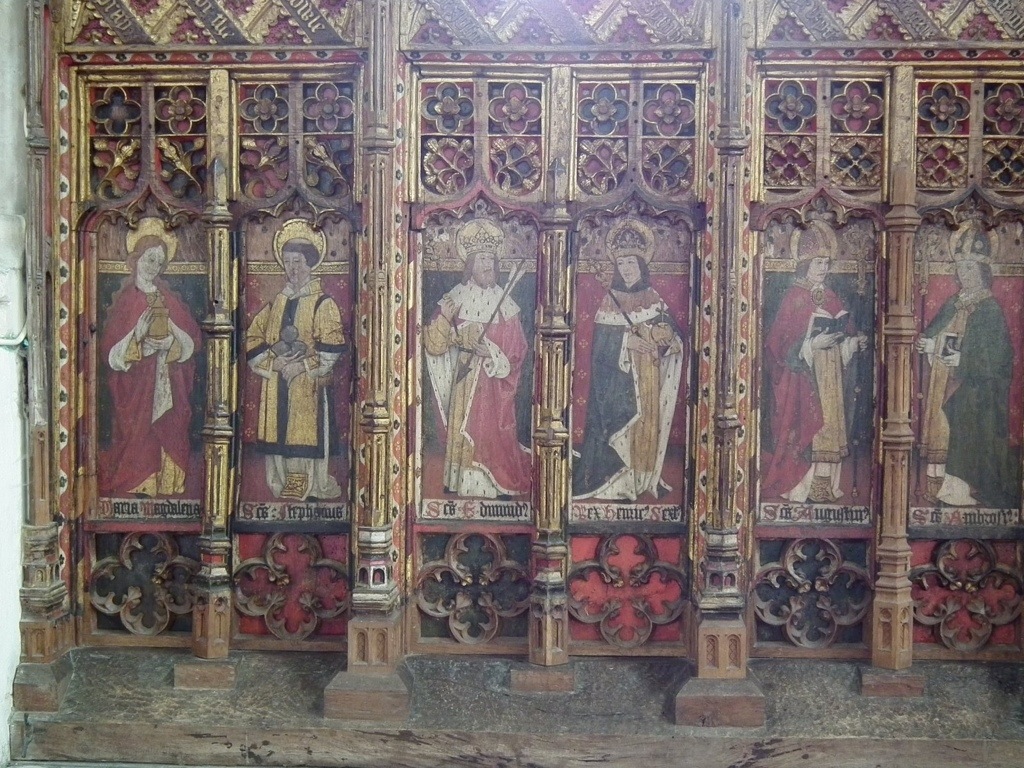
I went there last summer (remember summer?!) on the trail of an early commandment board, and while I’m still not convinced that I found one there, I did come across something rather special. Ludham has one of those vast, flint-clad churches so characteristic of East Anglia, a result of huge wealth generated by a thriving local economy, and particularly the strength of the cloth trade. Anyway, one of the main attractions is its beautiful, intricate medieval painted screen:

20130329-091344.jpg
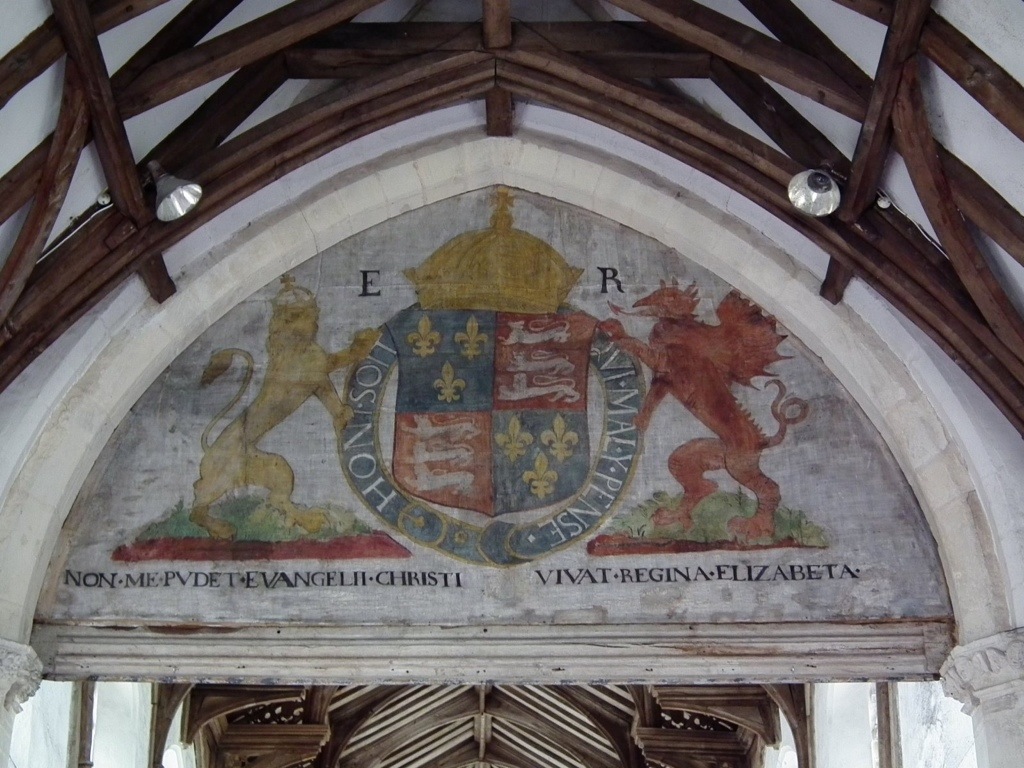
But more interesting I think, at least from an early modern perspective, is the contents of the chancel arch. Viewed from the nave, it contains a striking, early example of an Elizabethan Royal Arms, declaring Vivat Regina Elizabeta alongside the motto Non me pudet evangilium Christi, ‘Let me not be ashamed of the Gospel of Christ’.

20130329-092339.jpg
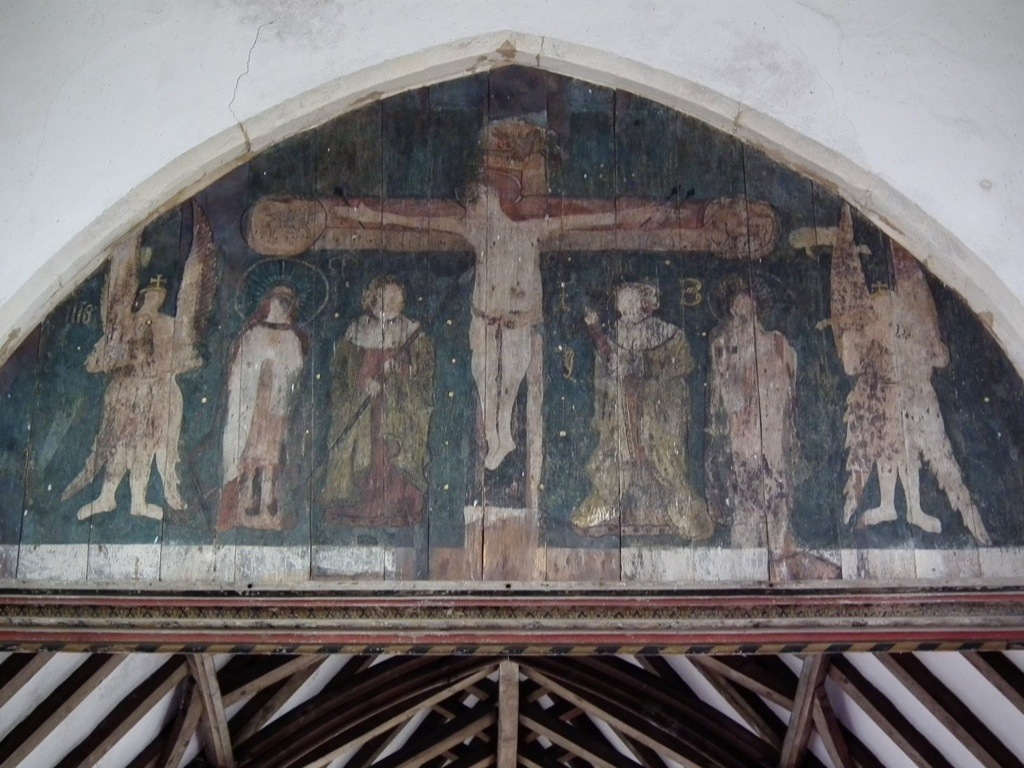
Arms like this are rare enough, and I’ve not come across any other examples with this particular motto, but on the reverse side, facing into the Chancel, is something quite spectacular: a rare survival from the Catholic restoration of the reign of Mary I, a painted Rood. Christ crucified in the centre is surmounted (I think) by the dove of the Holy Spirit, and flanked by (probably) Mary and John the Baptist, two other saints, and two crowned, winged figures who I think are unmistakably angels:

20130329-093026.jpg
Beyond that, the rest is speculation. We have very little to compare either example to, and it may be that Ludham was just an extremely compliant parish when it came to obeying the capricious religious policies of the Tudor monarchs. Perhaps this Rood was nothing special, just a rare example of the sort of stop-gap measure adopted by hundreds of churches across the country, and which the death of Mary prevented from achieving greater permanence. But (and this is surely the reformation historian inside me) it is also tempting to read a more polemical narrative into the actions of Ludham. Was their strident Elizabethan declaration not to be ashamed of the gospel in part a defence against charges of conservatism of the type embodied by their Marian Rood? Both Rood and Arms survive today purely by chance, hidden away until they were rediscovered at the end of the nineteenth century. How fortunate for us that they do: now we just have to figure out what to make of them!

A miscellany: wandering woodcuts, Greifswald glosses, digital Defoes and Thompson tributes

Brodie Waddell

Several things have come to my attention over the last few weeks that deserve wider attention. Although I don’t have time to provide much commentary, I think our readers will find some of them of interest.

The first concerns the wonderfully rough images that so frequently appear in our posts: broadside ballad woodcuts. The Bodleian Library recently announced the launch of an image-matching tool that will allow researchers to easily search for the many versions of a specific image across the library’s whole collection of ballad sheets. Eleanor Shevlin discusses the new tool in more detail over at EMOB. In light of Mark’s posts on early modern representations of working people, it would be fascinating to know how particular ‘occupational’ images are reused and recycled in different contexts and perhaps given quite different meanings.

The second is Beat Kümin’s historical travelogue, Greifswald Glosses, exploring the largely autonomous parish communities in early modern Northern Germany. As a professor at Warwick, Beat is well-known to us here at the Monster and his blog offers a remarkable (and remarkably well-informed) look at the towns, churches, landscapes and even graffiti of this part of the former Holy Roman Empire. I think my personal favourite was the fourteenth-century gargoyle/collection-box at St Jacobi in Göttingen, but you may prefer the ruminations on low-ranked local football teams or the semi-fortified round churches of Bornholm.
The third is an amusing ‘pop history’ article in The Atlantic on Daniel Defoe’s A Journal of the Plague Year (1722). It’s a well-researched piece, based on an interview with the Defoe scholar Katherine Ellison and incorporating plenty of (anachronistic) pictures, but what makes it interesting to me it that it is written by the magazine’s tech writer. The short version of his argument is basically that Defoe was an early modern blogger and, unlike some of today’s bloggers, he approached the wealth of information provided by that era’s new technology (e.g. newspapers) with a critical eye. I’m not sure I’m actually convinced, but it’s great to see another side of early modern history (beyond Henry VIII, Shakespeare and Oliver Cromwell) receiving some thoughtful discussion in such a high profile outlet.

Finally, Katrina Navickas has a post at History and Today on E. P. Thompson’s The Making of the English Working Class (1963). There are, as she notes, a great many tributes and events happening this year to mark the fiftieth anniversary of its publication. However, what I enjoyed was hearing a little about her relationship with the materiality of the book itself, in all its tattered, dog-eared glory. I think I probably find myself reaching for Thompson’s Customs in Common (1991) more often than MEWC, yet I’m still strangely comforted to have a decent edition of the latter nearby. In her words, ‘despite my “digital humanism”, I still need those yellowed and annotated pages of the Penguin paperback to really get to the heart of Thompson’s writing’.

Shorter notices

Our very own Laura Sangha has set up a twitter feed for her students of ‘Religion, Society and Culture in Tudor England’: Tudorists rejoice! Grad students in and around London interested in early modern history really ought take a look at the talks hosted by the Birkbeck Early Modern society (and their tweets too). And lastly I belatedly wanted to thank the Birkbeck History PhD bloggers for reblogging one of our posts and recommend that all BBK doctoral students check them out.

[Update (07/02/13): Co-blogger Jonathan Willis is also tweeting (@CREMS_Bham) for Birmingham’s Centre for Reformation and Early Modern Studies.]