We are delighted to welcome our next guest blogger for our #SchOnline series (scholarly conversations online). Here Jennifer Farrell (@dr_j_farrell) reflects on her experience as a delegate of an online conference.
Jennifer Farrell
Last week saw the return of the International Medieval Congress (IMC) at the University of Leeds. This annual conference attracts thousands of medievalists from all over the world, eager to network with one another, to road-test their research, and to enjoy hearing about the work being done by others in their field. I have attended the IMC numerous times in the past, both as a delegate and as a speaker, but the major difference this year was that I did so from the comfort of my own living room!
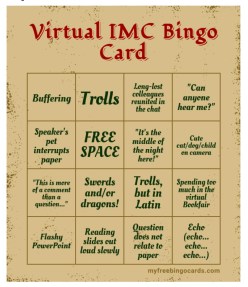
Sadly moving a conference online will still not stop you spending too much time at the book stalls.
The Covid pandemic has impacted researchers in various ways, but one of the major changes we are seeing is the willingness and indeed tenacity of conference organisers to find ways of facilitating networking and the sharing of research via online platforms. The sheer scale of the IMC means that its move to a virtual conference was nothing short of heroic. This year the virtual IMC supported the delivery of c.530 research papers, attended by c.3,200 delegates from across 60 countries. The organisers, moderators, panellists, and facilitators deserve to be commended for this.
Speaking purely from the perspective of a delegate, with no need to worry about my paper being interrupted by poor internet connection, bad sound, disruption from trolls, or just the generally odd sensation of talking about your research to a computer screen, my own experiences of the vIMC were very positive. Of course, a virtual environment is by no means the same as experiencing the conference in person, but that is not necessarily a bad thing. Like many of the changes that have occurred to our working conditions on account of Covid, there are good and bad sides. Continue reading
 That might need some explanation: a BOOC is a new, fully open access platform that allows for multi-form contributions across time. Living books for the digital age, if you will.
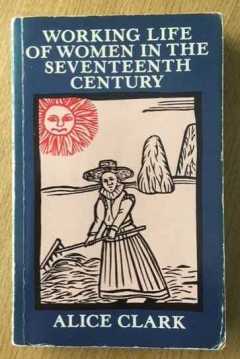 I’m reading the chapter in my 1982 edition of Alice Clark (the only history book I stole from my mother’s bookshelves), complete with a woodcut of a woman haymaking on the cover (although this image has been edited to remove the couple canoodling in the background which is present in the original below). Is this deeply significant? Probably not …
 the many-headed monster