Seventeenth-century England: A Symposium to celebrate Professor Bernard Capp’s 50 Years at Warwick

Laura Sangha

On Saturday 20 October I had the great pleasure of returning to my alma mater to attend ‘Seventeenth-Century England’, a symposium to mark and celebrate Professor Bernard Capp’s fifty years at the University of Warwick. All of the many-headed monster co-authors were fortunate enough to benefit from Bernard’s advice and knowledge when we were postgraduates at Warwick in the 2000s, so this review of the Symposium is our way of joining the chorus of congratulations and commendations that characterised the day.

Fifty years’ service.

Professor Capp was appointed as Lecturer in History in 1968, when Harold Wilson was Prime Minister, the Kray twins were arrested, the M1 was completed, and the Race Relations Act was passed. The University of Warwick had admitted its first undergraduates just four years earlier.

alex W

Alexandra Walsham exhorting us to undertake our own ‘generation work’

Whilst at Warwick Professor Capp became established as one of the leading historians of early modern England, his teaching and publications demonstrating an extraordinary breadth of research interests and expertise. The Symposium organisers, Peter Marshall and Naomi Pullin, did an excellent job of creating a programme that gave space to all the themes that underpin this work. Many papers explored gendered aspects of the seventeenth-century as well as the ‘religious marketplace’ of the age. Amanda Flather discussed the impact of Laudian ceremonialism on women worshippers, explaining how matters of conscience could be corrosive of female obedience. Tim Reinke-Williams regaled us with the masculine ‘banter’ of the early modern jestbook and laid bare the emotions that structured them. Ann Hughes’ paper on dissenting culture in Restoration England revealed the ways that religion connected single women to broad social networks and kinship. Hughes’ focus on the Gell family of Hopton Hall and the siblings in the family connected neatly to Alexandra Walsham’s paper on the ‘revolutionary generation’ of the 1640s and in particular the Fifth Monarchy Men, religious radicals bonded in solidarity by their conception of Christian history and the conviction that they were the ones to carry out a turbulent age’s vital ‘generation work’. Continue reading
The Power of Petitioning in Seventeenth-Century England: The Long Road to a New Project

Brodie Waddell

[Update, April 2019: ‘The Power of Petitioning’ project website is now online.]

How can people without official political power push the authorities to act? Historically, one of the most common tactics was to create a petition or supplication. Even today, every year hundreds of thousands of ordinary citizens sign e-petitions addressed to parliament which can lead directly to high-profile debates in the House of Commons.

In seventeenth-century England, petitioning was ubiquitous. It was one of the only acceptable ways to address the authorities when seeking redress, mercy or advancement. As a result, it was a crucial mode of communication between the ‘rulers’ and the ‘ruled’. People at all levels of society – from noblemen to paupers – used petitions to make their voices heard. Some were mere begging letters scrawled on scraps of paper; others were carefully crafted radical demands signed by thousands and sent to the highest powers in the land. Whatever form they took, they provide a vital source for illuminating the concerns of supposedly ‘powerless’ people and also offer a unique means to map the structures of authority that framed early modern society …

****

That was our pitch to the Arts and Humanities Research Council for a grant of over £200,000. To my surprise and delight, they liked it.

So, from January 2019, I’ll be running a project looking at ‘the power of petitioning in seventeenth century England’. The co-investigator is Jason Peacey at UCL and we will hire a full-time postdoctoral research associate for twelve months as well. There will be much more information available once we have the project website up and running, but in the meantime I thought I’d announce it here and explain how it came to be. I hope it might be useful, or at least interesting, to other scholars thinking about their own projects. Continue reading

The Living, the Dead and the Very Very Dead: Ethics for Historians

Laura Sangha

Students of history are no strangers to ethics. Indeed, universities have ethics committees and policies which cover instances where the conduct of research involves the interests and rights of others. For historians, this usually means that they must reflect on the possible repercussions of their research on the living – particularly those relatives, friends, descendants and other groups or communities otherwise connected to the subjects that the historian writes about. Indeed, many ethical statements produced by historians concentrate on the interests and rights of the living – for examples see the Royal Historical Society statement on ethics, or the American Historical Association ‘Statement on Standards of Professional Conduct’.[1]

But I don’t work on the living.

I work on the dead. In fact, I work on the very very dead. People who died at least 300 years ago, and in some cases half a millennium ago. And since the dead don’t have any human rights for a while I was rather dismissive of ethics policies. They were for modern colleagues working on the recent past.

Yet eventually I came to think differently. Continue reading

Historical Fiction and the ‘Pastness’ of the Way People Think

Mark Hailwood

Once upon a time, I wrote a blog post about the story telling techniques that historians use in their writing.

This was not a long time ago, and nor was it far away – you can read it here in fact. Inspired by the ‘Storying the Past’ reading group, and a series of ‘Creative Histories’ events, the post reflected on some of the ways academic historians draw on the writing methods associated with more creative genres, and considered how they might fruitfully do more of this.

One example of the latter that I discussed was Philip Ziegler’s attempt at an ‘imaginative reconstruction’ of the experience of the Black Death in a medieval English village. In essence it is a piece of creative writing, informed by historical evidence, intended to ‘evoke the atmosphere’ of that moment in time. As Ziegler himself put it, he was essentially borrowing the approach of the ‘historical novelist’ to try and recover an aspect of the past that his cold, hard analysis of the facts – the supposed purview of the historian – could not: how people at the time felt about their villages being ravaged by the plague.

But can the approach of the historical novelist really bridge this gap? Continue reading

“As I Went Forth One Summer’s Day”: Putting the Story in Early Modern History

Mark Hailwood

Twas the night before Christmas, in the year 1681, and one Soloman Reddatt was drinking in the Nag’s Head in Reading, with his sister, Elizabeth, and a friend, George Parfitt, when, at around 9pm, their sociability was disturbed by the shattering of glass. Moments earlier, Debora Allen had burst into the alehouse in search of her husband Edward. After locating him in the kitchen drinking with the alehousekeeper, William Newbury, she flew into a rage, picking up a quart pot and throwing it through a window. As a startled Reddatt and his companions looked up from their drinks, Debora Allen emerged from the kitchen into the room where they were drinking, where the angry wife ‘levelled her passion’ against Sara Newbury, the alehousekeeper’s wife, who was busy serving customers. Debora Allen called Sara Newbury a whore and a bawd, and accused her of running the alehouse as a bawdy house, before turning her fire onto the alehousekeeper William Newbury, labelling him a cuckold. The furious Debora Allen repeated the accusations several times, both within the alehouse and at the street door, ensuring that her opinion of this alehouse and its proprietors received a public airing.


A version of this vignette appears at the start of a chapter that I have written for a forthcoming Bloomsbury textbook on the cultural history of alcohol in the early modern world. The focus of the chapter is the relationship between gender, sexuality and alcohol in the sixteenth and seventeenth centuries, and I use an analysis of this opening anecdote to highlight several of the themes that run through the essay: the gendered character of alcohol retailing; the extent and character of women’s public consumption of alcohol; the complex relationship between masculinity and drinking; and so on.

It is a classic technique of historians in my field – that is, the social history of early modern England – to start an article or a chapter with a story; a telling anecdote that draws the reader in and sets up the analysis that is to follow. Indeed, I have just used it here. More often than not, though, the storytelling ends there – the historian steps out of the role of fireside narrator, and proceeds to offer up their analysis in a cool, detached, ‘academic’ register, deemed more suitable for the pages of a peer-reviewed journal or academic monograph.

This is a writing convention that I myself have followed many times, and one that I relatively uncritically absorbed and mimicked from my own academic mentors and inspirations. But the endeavours of the ‘Storying the Past’ virtual reading group, and associated ‘Creative Histories’ events, have encouraged me to become more reflective about the storytelling techniques that I use in my writing as an academic historian, and those employed in my particular field of academic history.


What storytelling techniques, other than the trusty opening anecdote, do the historians that I spend most of my time reading deploy? Continue reading

Creative history is … ?

Laura Sangha

This post was inspired by the conversations, presentations, exhibitions and performances at ‘Creative Histories’, Bristol Zoo, 19-21 July 2017. The conference was organised by Will Pooley, and you can read more of the posts that came out of the conference here.


Creative history is…?[1]

not a luxury[2]

an active part of the historical process at every stage of the process[3]

a way to uncover and reveal the research process[4]

a way to work out how others look and see[5]

a curiosity, a delight[6] Continue reading

A ‘Creative Histories’ Mini-Series

Mark Hailwood & Laura Sangha

Over the past couple of years the pair of us have had the pleasure of being involved in a series of events around the theme of ‘creative histories’, curated by the fertile brains behind the Storying the Past reading group.

Put simply, the aim of these conversations has been to encourage participants – which have included academic historians, authors, singer-songwriters, teachers, filmmakers and many others – to talk and think about the creative elements of historical research, writing, teaching, and consumption.

If this sounds like your kind of thing then you can read a whole host of blog posts that have emerged from these events, over at the Storying the Past blog. No need to do anything creative at this stage, simply click here.

But we thought it might be nice to collate the contributions that we have made to these conversations into a monster mini-series, to draw them to the attention of any of our readers who might have missed them, and hopefully to whet your appetite for reading more over at Storying the Past.

So, this week we will be re-blogging our posts here, as follows: Continue reading

A Page in the Life

Brodie Waddell

Long before writing became a skill that every child was expected to learn, all sorts of people still scribbled away.

Some men and women did so for mostly practical reasons – keeping track of their finances, corresponding with distant family and friends, or preserving successful recipes for future use. Many others wrote in order to monitor the state of their soul or to record godly wisdom preached at the pulpit. A few tried to create texts that told the story of their life in more self-consciously ‘literary’ ways, sometimes even aiming for eventual publication.

AN00640205_001_l

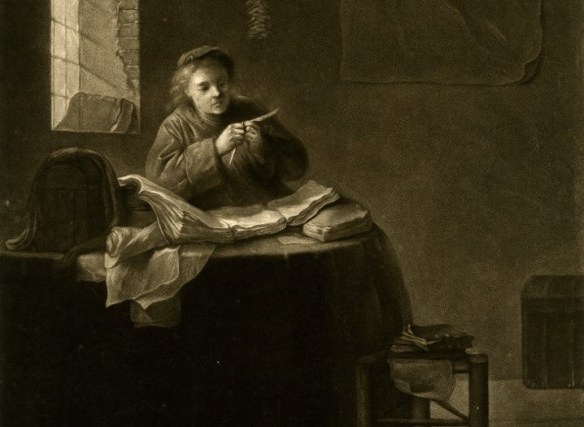
Preparing to write (British Museum, F,6.161)

Scholars have long used such ‘personal’ sources to study the early modern period, often mining them for information about topics that are more rarely documented in ‘official’ archives. More recently, a growing number of researchers have turned to analysing such sources as texts in their own right, seeking to understand how and why these writers wrote. The study of ‘life-writing’ and manuscript culture is now a well-established academic field, with excellent studies of the process of writing diaries, letters, financial accounts, sermon notes, commonplace books, and so on. As you’ll see from even the very abbreviated bibliography below, there is no lack of interest in early modern writing practices.

Thanks to the efforts of several tireless groups of scholars and students, there are also some great online resources cataloguing and illuminating such sources, such as the Perdita Project, Early Modern Letters Online, and – for a more recent period – Writing Lives. These often build on the more traditional lists and catalogues created by William Matthews, Heather Creaton and others. Laura Gowing has now started a crowdsourced handlist of early modern first-person writing in print. As a result, we now know about hundreds of writers who would otherwise be forgotten.

However, I think there is more that can be done. In a new article on ‘Writing History from Below’ in early modern England, I tried to use material from some writers who have received little or no scholarly attention yet, focusing in particular on those who lacked substantial wealth or education. Why did they decide to write chronicles and gather archives? What did they select to preserve for posterity? How did they tell the story of their lives and their communities? Continue reading

Striking parallels, c.1700 and 2018 (part 2)

Brodie Waddell

I know very little about modern labour relations beyond what I’ve learned over the past few weeks as a lecturer on strike. However, I do know a fair bit about labour relations between about 1550 and 1750.

In my previous post, I talked about the vital role played by a wider ‘strike culture’ of objects and actions in enhancing the power of labour action, both then and now. Yet focusing exclusively on ‘culture’ risks underestimating the hard structural barriers that worker mobilisation regularly bumps up against.

Law matters

Although undoubtedly there is ‘power in a union’, there is also a great deal of coercive power held by our employers and the state.

British law is, as far as I can tell, unusually hostile to trade union action, another unhappy inheritance from the Thatcher years. This means that employers can threat – and implement – all sorts of nasty things that seem like they ought to be illegal but are actually within the bounds of the law.

The biggest shock for me was discovering that many universities were threatening to dock some or all of their staff’s wages for ‘action short of a strike’ (ASOS) a.k.a. working to contract. There has been a strong push from the strikers and their allies to get these universities to reverse these policies, with much success. But at the time of writing, eight institutions (Bristol, City, Heriot-Watt, Leeds, Liverpool, Royal Holloway, Salford, and Surrey) were still threatening this.

CrushAnti-UnionLaws1971

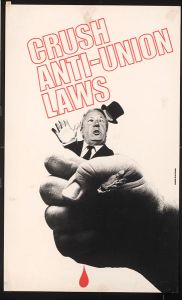
Poster by Ken Spague, 1971: V&A


Even more thorny is the problem of the pensions themselves. Suffice to say the issue is complex, but it is clear enough that the Pensions Regulator and various official rules have made it more difficult to get a clear sense of how much room for negotiation is actually available. As has been expertly discussed by Josephine Cumbo and Michael Otsuka, while these formal structures are not entirely rigid or immovable, they still impose very real boundaries on the options available.

Three or four hundred years ago, workers taking action encountered some similar problems. The economy was of course very different, with very few large-scale employers and many more household-sized economic units. Nonetheless, as I noted in my previous post, there were still ‘strikes’ and other labour disputes. And in most of these conflicts, the broader legal context favoured ‘masters’ (employers) over their workers. Continue reading

Striking parallels, c.1700 and 2018 (part 1)

Brodie Waddell

I’m not a labour relations expert, nor a union organiser, nor a seasoned activist. I am, however, a lecturer who has been on strike over the past few weeks alongside tens of thousands of other university staff.

As historian of, roughly, the seventeenth century, I’ve felt frustrated that I could add so little to the wonderful teach-outs on contemporary politics or to the brilliant online commentary on the technicalities of the dispute. I’d be useless at trying to predict what is going to happen next and I can’t even offer any practical advice to our tireless UCU representatives who are trying to save our pensions. The only thing I can hope to contribute is a few thoughts on some of the echoes – and dissonances – between those long-past struggles and our own.

Striking isn’t just about striking

The current strike started when UCU members voted overwhelmingly to withdraw their labour in an attempt to get our employers to negotiate, rather than simply impose a new poorer, riskier pension scheme. This refusal to work is what defines a strike. It is painful: students don’t get taught, research grinds to a halt, administrative services slow or cease, and we don’t get paid. This is also precisely why it is such an important tactic if we want our employers to compromise.

But it is hardly the only tactic being used during this strike. It is merely a small part of a broader ‘strike culture’. Continue reading