
Jonathan Willis
Term has ended, I’m organising a big conference next week, and I also urgently need to start writing the paper I am giving at said conference; so what better time, I thought, to write a blog post on an entirely unrelated topic? Frankly, it was either this or finally write that book review I’ve been putting off for weeks…
This post is about God; or more specifically, about what God looks like; or, more specifically still, about how people may have thought about and/or visualised God in Reformation England. I’ve been thinking about this for some time, largely related to different aspects of my work on the ten commandments. First of all, the commandments as a whole derived much (let’s not beat around the bush, pretty much all) of their authority from the fact that they had been given by God himself. Exodus 19 describes how God came down upon mount Sinai in ‘thunders and lightnings, and a thick cloud upon the mount’. He ‘descended’ upon the mountain ‘in fire’ and delivered his commandments. Afterwards, Moses, Arron, Nadab, Abihu and seventy elders came up the mountain to see God, although only Moses himself was given leave to come near to God. Exodus 24:10 describes the supernatural encounter:
And they saw the God of Israel: and there was under his feet as it were a paved work of a sapphire stone, and as it were the body of heaven in his clearness.
Several chapters later, Exodus 31:18 describes another pivotal moment, the point at which the commandments were passed to Moses:
And he gave unto Moses, when he had made an end of communing with him upon mount Sinai, two tables of testimony, tables of stone, written with the finger of God.

Blake’s vision of God, writing the Commandments
God’s presence in Exodus is suitably awe-inspiring and mysterious, cloaked as it is in fire, earthquakes, trumpets and smoke. But for the careful reader and listener there are some rather intriguing human details. Firstly, God spoke. Now we in the twenty-first century have seen and read enough works of science-fiction and fantasy fiction to imagine a booming voice emitting from nowhere, or perhaps beaming telepathically directly into our heads. But for most early moderns, surely a voice would have implied a mouth, a tongue, a head… Exodus 24:10 talks of a sapphire pavement under God’s feet, and perhaps most crucially, the ten commandments are described as having been written with the finger of God.There is a marvellous depiction of God doing precisely that, engraving stone tablets with his right index finger extended like some sort of divine welding torch, by the romantic poet and painter William Blake. But such a depiction would have been unthinkable in Reformation England, because of the great weight placed upon the commandments themselves, and in particular the first, ‘Thou shalt have no other gods before me’, and the second. Exodus 20:4 stated quite clearly,
Thou shalt not make unto thee any graven image, or any likeness of any thing that is in heaven above, or that is in the earth beneath, or that is in the water under the earth.
Michaelangelo’s God as shown creating Adam on the ceiling of the Sistine Chapel
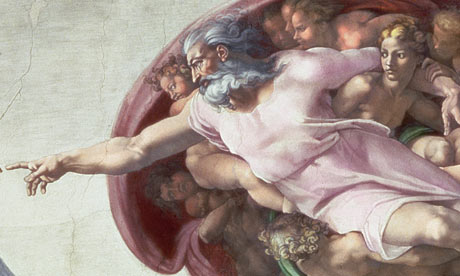
This is in large part a familiar story. Depictions of God the Father as a white-bearded old man (like the rather famous one above) were out in Protestant Reformation England, and so imaginative painters, printmakers and carvers resorted to figurative alternatives like the Hebrew ‘tetragrammaton’:
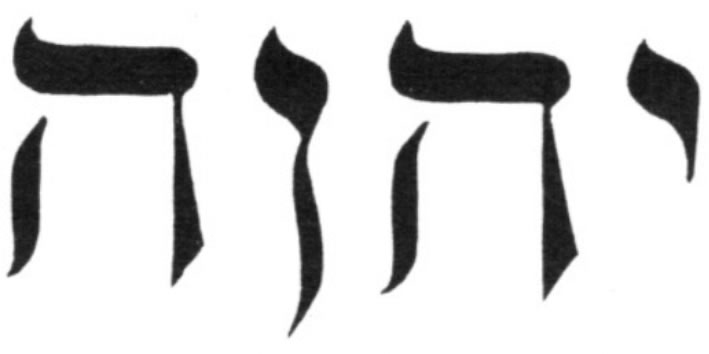
YHWH, or ‘Yaweh’, in Hebrew
People recognised this as a symbolic depiction of God, the newest element of a longstanding visual language which recognised that rays of light and prominent doves could function as representations of the holy spirit, and that indeed Christ could be represented as a lamb, or by the ‘holy monogram’ IHS and other Christograms.
But people recognised the lamb and the holy name as symbols. They did not think that Christ was a sheep – the bible was rather insistent on the fact that he had been both God and man. So when people saw the tetragrammaton, or heard references to God’s voice, and feet, and fingers, what could they do but picture somebody in the form of a man, a man old enough to be the ‘father’ of the ‘son’ who had died for their sins? It is therefore easy to see an unresolved tension in the way in which most writers discussed the second commandment, with its absolute ban on images of the divine directly contradicted by the partial painting of a picture of God in words, through references to hands, feet, mouth, voice, and other physical elements of fleshy human bodies.
While most ministers and godly authors like Samuel Purchas and John Brinsley were happy to speak of a law ‘renued by the voice and finger of God on Mount Sinai’,[1] or of ‘the Ten Commandements written by the Lords owne finger’,[2] others recognised this inherent contradiction and were more careful. Calvin, in his sermons on Deuteronomy, explained that while God had chosen to write his law on stone tables with his own finger, we should not believe
that God hath anie hands: but that the holy scripture speaketh so by a resemblance as if it were saide, the lawe was note written or ingrauen by mans hand: but God approoued and ratified it by way of miracle.[3]
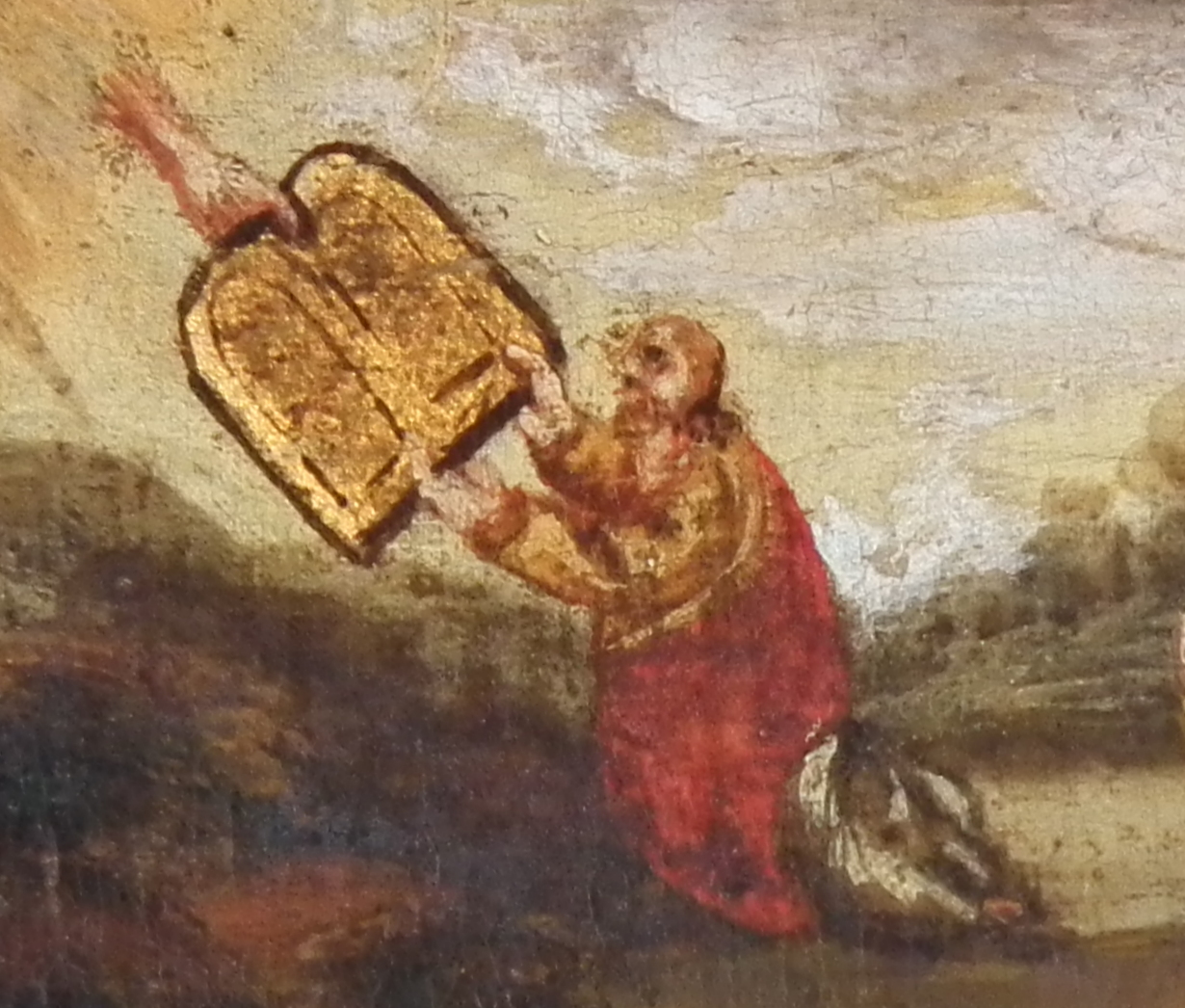
Not many people could maintain such a rigid division in their heads, however, and occasionally idols of the mind could be made partially manifest. I want to share just two examples today. The first, taken from a rare Elizabethan commandment board hanging in a Hampshire church, shows what is unmistakeably a divine hand, fully formed with four celestial fingers and a god-like thumb, handing the ten commandments out of the sky to a kneeling Moses.
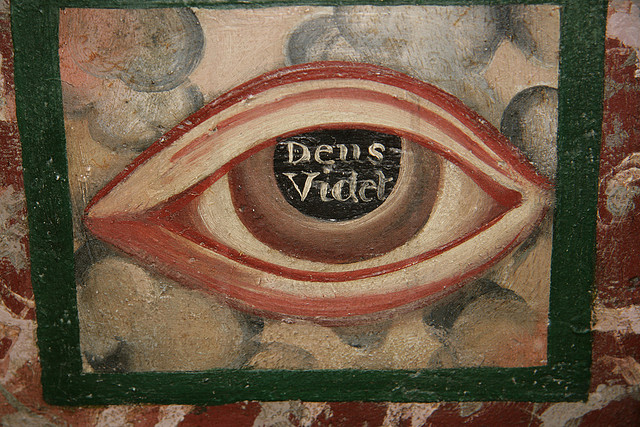
The second, knowledge of which I very gratefully owe to University of Birmingham PhD student Susan Orlik, is the baleful eye of God staring down at the occupants of an astonishing family pew in a Berkshire church, the pupil of which is inscribed with the words deus videt – God watches.
If any monster readers have come across any interesting, unusual or incongruous representations or descriptions of, or references to, God, I’d be very interested to hear about them here!
[1] Samuel Purchas, Purchas his pilgrimage (1613), p. 17.
[2] John Brinsley, The fourth part of the true watch containing prayers and teares for the churches (1624), p. 78.
[3] Jean Calvin, The sermons of M. Iohn Caluin vpon the fifth booke of Moses called Deuteronomie, trans. Arthur Golding (1583), p. 391.






 the many-headed monster

