
This post is part of our #AliceClark100 Online Reading Group. In it Amy Erickson offers some reflections on the third main chapter of The Working Life of Women in the Seventeenth Century, on ‘Textiles’. Amy is a University Lecturer in British Economic and Social History 1500-1750 at the University of Cambridge. You can access the book here.
Amy Erickson
Alice Clark’s chapter on textiles concentrates on spinning, the textile production process which involved the most people, the overwhelming majority of whom were female. The production of cloth required several times more spinners than weavers (who were primarily male), whether the fibre in question was derived from a plant (flax or hemp) or an animal (wool or silk). As Clark puts it, ‘From the general economic standpoint, the textile industries rank second in importance to agriculture … but in the history of women’s economic development they hold a position which is quite unique.’ This was not only true of England: textiles were the principal export of most European countries over 300 years.
An early post on Many Headed Monster by Mark Hailwood explored the ubiquity of spinning and included two woodcut images of women sitting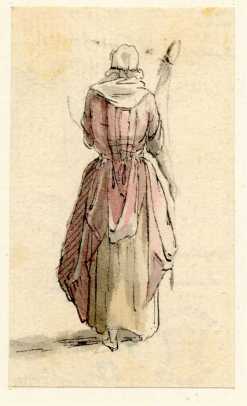 at spinning wheels that were used to illustrate early modern ballads. The term ‘hand-spinning’ describes spinning both by wheel and by distaff or drop spindle, a method which can be used while walking, as in Paul Sandby’s mid-18th century drawing of a woman carrying a distaff (courtesy of the trustees of the British Museum).
A decade after Working Life, Ivy Pinchbeck provided further evidence on spinning in the period 1750-1850, when hand spinning in the home was largely replaced by water-powered factory spinning. This transition from hand to machine, from home to factory, has recently received detailed attention. Craig Muldrew (2012) estimated that by the later 18th century hand spinning employed nearly 75% of all women over age 14, or 1,500,000 women. The transition to mechanisation, which not only increased productivity but also employed increasing numbers of men rather than women, would have caused mass female unemployment and thereby significant impoverishment. Continue reading
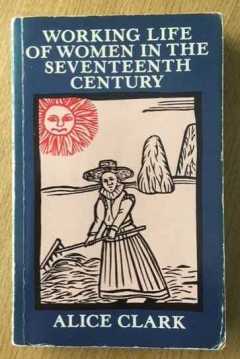 I’m reading the chapter in my 1982 edition of Alice Clark (the only history book I stole from my mother’s bookshelves), complete with a woodcut of a woman haymaking on the cover (although this image has been edited to remove the couple canoodling in the background which is present in the original below). Is this deeply significant? Probably not …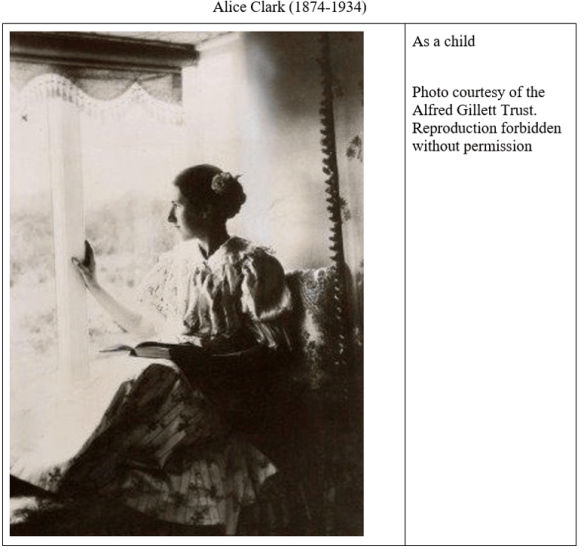
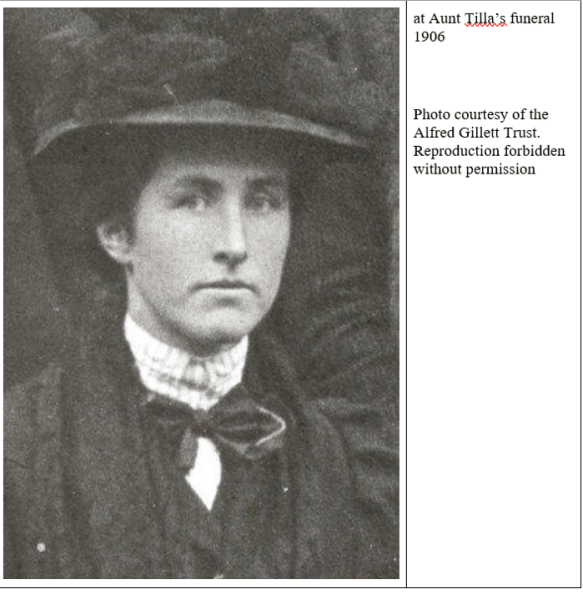
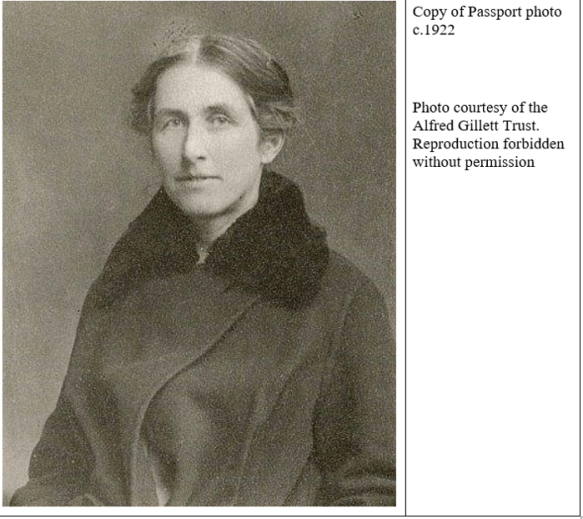
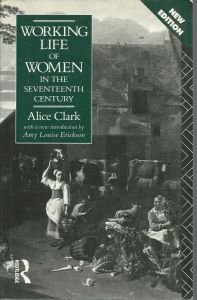 Those who have never read Alice Clark’s Working Life of Women might wonder why we would pay any attention to a work that is a hundred years old, and superseded by recent research on women. Yet anyone who works on the history of women, and particularly the history of women’s work, in early modern England owes a debt to Alice Clark’s work. It was reissued in 1982 with an introduction by Miranda Chaytor and Jane Lewis, and again in 1992 with an introduction by Amy Erickson. As Natalie Davis noted in a paper delivered at the Second Berkshire Conference in 1974, Clark consulted archives, differentiated among women, and had an overarching theory.
