Mark Hailwood Continue reading
Marooned on an Island Monographs: A History of Bristol Reading List
Reply

Mark Hailwood Continue reading
[In our mini-series ‘A Page in the Life’, each post briefly introduces a new writer and a single page from their manuscript. In this post, Tawny Paul introduces us to a frustrated eighteenth-century artisan whose life she explores in more detail in her new article on ‘Accounting for Men’s Work’.]
In 1769, Thomas Parsons, a young stonemason in Bath, penned a daily account of his life. He may have written quite a lot over the years, but only one volume of his diary survives, covering a period of eight months. Though relatively modest in size, the text provides an entry into the world of a young man at a formative stage of life.
Parsons was twenty-five years old when he produced the diary. At this age, many young people in the eighteenth century married, finished training, assumed occupational status, and became more independent. Parsons’ diary therefore gives us insights into many themes related to lifecycle. This makes the text extremely valuable, because while histories of women have done remarkable work in uncovering the nuances of female lifecycle experiences, we know rather less about how men transitioned through life’s stages.
His entry for 13 April 1769 shows this in vivid detail as it centres on his struggles with his father: Continue reading
[In our mini-series ‘A Page in the Life’, each post briefly introduces a new writer and a single page from their manuscript.]
Laura Sangha
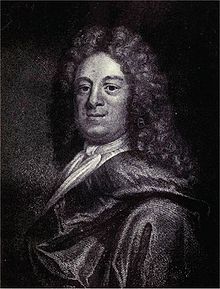 The Leeds antiquarian and pious diarist Ralph Thoresby (1658-1725) wrote a lot. An awful lot. Between the ages of nineteen and sixty-seven he kept a diary, often recording entries on most days of the week. Seven volumes of Thoresby’s life-writing survive, and at approximately 500 pages per volume that’s 3,500 pages of text. The page transcribed below is fairly typical at 550 words, so that makes close to two million words of Thoresby’s self-reflection out there. You don’t have to read them all though, because this page below provides a relatively good sense of the content and scope of Thoresby’s written self:
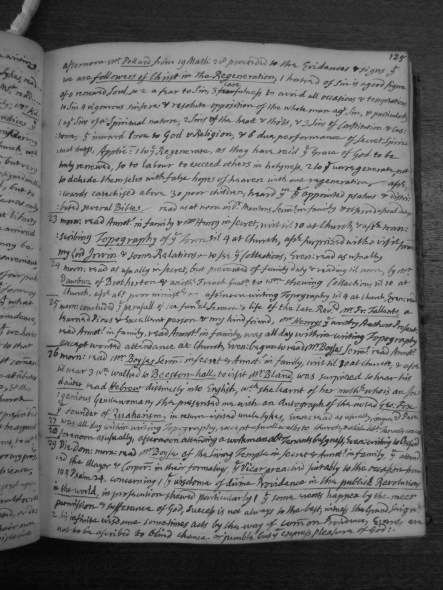
Brotherton Library, Yorkshire Archaeological Society MS 24.
[22 May 1709][1]
afternoon Mr Pollard from 19 Math:28 proceeded to the Evidences & signs that we are followers of Christ in the Regeneration, 1 hatred of sin is a good signe of a renewed Soul, so 2 a fear to Sin, 3 carefulness to avoid all occasions and temptations to Sin 4 vigorous sinsere & resolute opposition of the whole man against Sin, & particularly 1 against sins of a spiritual nature, 2 Sins of the heart and tho’ts, & 3 Sins of Constitution & Custome, 5 inward love to God & Religion, & 6 due performance of secret Spiritual dutys, Application: 1 to the Regenerate, as they have rec’d the Grace of God to be truly renewed, so to labour to exceed others in holiness, 2 to the unregenerate, not to delude themselves with false hopes of heaven with out regeneration – afterwards catechised above 30 poor children, heard them the appointed psalms & distributed several Bibles – Read as at noon in Dr. Mantons Sermons in family & observed usual duties
23 morn: read Annotations in family & Mr Henry in secret, writ til 10 at Church, & after transcribing Topography of the Town til 4 at Church, after surprized with a visit from my Lord Irwin & some Relations, to see the Collections, Even: read as usually Continue reading
[In our series ‘A Page in the Life’, each post briefly introduces a new writer and a single page from their manuscript. In this post, Emily Vine examines the daily records of a remarkably busy woman in late eighteenth-century London.]
From 1773 to 1830, Anna Margaretta Larpent, the wife of John Larpent, Examiner of Plays, kept a diary of her daily life divided between Newman Street, London and Ashtead in Surrey. She recorded the time she woke up and went to bed each day, the meals she ate, the details of the books she read, the letters she wrote, her daily prayers, her time spent sewing and shopping, her family business, and her significant contribution to her husband’s work in theatre licensing. The delight is in the detail; even in predictable repetitions such as ‘Rose at 8. Breakfasted. Prayed’, Larpent is brought to life on every page.
In the first week of February 1792, she recorded the following: Continue reading
[In our series ‘A Page in the Life’, each post briefly introduces a new writer and a single page from their manuscript. In this post, Brodie Waddell introduces us to another ‘chronicler’ who appears his new article on ‘Writing History from Below’ in early modern England.]
Jacob Bee was a glover and skinner who lived out his whole life in the city of Durham. Over the course of about twenty-five years, beginning in 1681, he filled a notebook with records of the births, deaths and marriages of his fellow townspeople. Bee also kept a patchy chronicle of notable local and national events, including a prize fight in the town’s marketplace and the execution of the Rye House Plot conspirators in 1683.
Intermixed with his historical register were a few pages of rather scrappy financial accounts. The most detailed and consistent fit on a single page and ran from January to March 1689: Continue reading
[In our series ‘A Page in the Life’, each post briefly introduces a new writer and a single page from their manuscript. In this post, Brodie Waddell introduces us to the main character in his new article on ‘Writing History from Below’ in early modern England.]
Between 1679 and 1699, an inconsequential tradesman named Joseph Bufton kept a chronicle of his town of Coggeshall in Essex. He wrote it in the blank pages of an old almanac, Rider’s 1677 British Merlin, in which he also recorded notes about local births, deaths, marriages and various other miscellaneous memorandums.
Between printed pages listing the saints’ days and predicting the weather in November, Bufton inscribed the events from late 1684 to early 1686 that he considered worthy of remembrance: Continue reading
Brodie Waddell
Long before writing became a skill that every child was expected to learn, all sorts of people still scribbled away.
Some men and women did so for mostly practical reasons – keeping track of their finances, corresponding with distant family and friends, or preserving successful recipes for future use. Many others wrote in order to monitor the state of their soul or to record godly wisdom preached at the pulpit. A few tried to create texts that told the story of their life in more self-consciously ‘literary’ ways, sometimes even aiming for eventual publication.
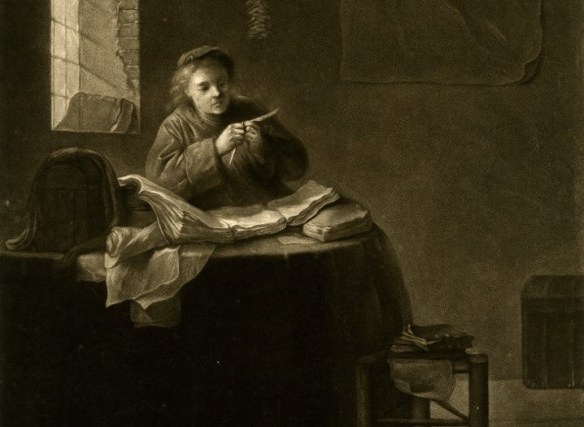
Preparing to write (British Museum, F,6.161)
Scholars have long used such ‘personal’ sources to study the early modern period, often mining them for information about topics that are more rarely documented in ‘official’ archives. More recently, a growing number of researchers have turned to analysing such sources as texts in their own right, seeking to understand how and why these writers wrote. The study of ‘life-writing’ and manuscript culture is now a well-established academic field, with excellent studies of the process of writing diaries, letters, financial accounts, sermon notes, commonplace books, and so on. As you’ll see from even the very abbreviated bibliography below, there is no lack of interest in early modern writing practices.
Thanks to the efforts of several tireless groups of scholars and students, there are also some great online resources cataloguing and illuminating such sources, such as the Perdita Project, Early Modern Letters Online, and – for a more recent period – Writing Lives. These often build on the more traditional lists and catalogues created by William Matthews, Heather Creaton and others. Laura Gowing has now started a crowdsourced handlist of early modern first-person writing in print. As a result, we now know about hundreds of writers who would otherwise be forgotten.
However, I think there is more that can be done. In a new article on ‘Writing History from Below’ in early modern England, I tried to use material from some writers who have received little or no scholarly attention yet, focusing in particular on those who lacked substantial wealth or education. Why did they decide to write chronicles and gather archives? What did they select to preserve for posterity? How did they tell the story of their lives and their communities? Continue reading
Brodie Waddell
I know very little about modern labour relations beyond what I’ve learned over the past few weeks as a lecturer on strike. However, I do know a fair bit about labour relations between about 1550 and 1750.
In my previous post, I talked about the vital role played by a wider ‘strike culture’ of objects and actions in enhancing the power of labour action, both then and now. Yet focusing exclusively on ‘culture’ risks underestimating the hard structural barriers that worker mobilisation regularly bumps up against.
Law matters
Although undoubtedly there is ‘power in a union’, there is also a great deal of coercive power held by our employers and the state.
British law is, as far as I can tell, unusually hostile to trade union action, another unhappy inheritance from the Thatcher years. This means that employers can threat – and implement – all sorts of nasty things that seem like they ought to be illegal but are actually within the bounds of the law.
The biggest shock for me was discovering that many universities were threatening to dock some or all of their staff’s wages for ‘action short of a strike’ (ASOS) a.k.a. working to contract. There has been a strong push from the strikers and their allies to get these universities to reverse these policies, with much success. But at the time of writing, eight institutions (Bristol, City, Heriot-Watt, Leeds, Liverpool, Royal Holloway, Salford, and Surrey) were still threatening this.
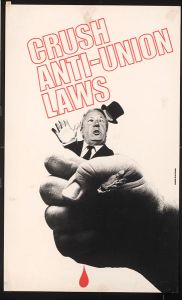
Poster by Ken Spague, 1971: V&A
Even more thorny is the problem of the pensions themselves. Suffice to say the issue is complex, but it is clear enough that the Pensions Regulator and various official rules have made it more difficult to get a clear sense of how much room for negotiation is actually available. As has been expertly discussed by Josephine Cumbo and Michael Otsuka, while these formal structures are not entirely rigid or immovable, they still impose very real boundaries on the options available.
Three or four hundred years ago, workers taking action encountered some similar problems. The economy was of course very different, with very few large-scale employers and many more household-sized economic units. Nonetheless, as I noted in my previous post, there were still ‘strikes’ and other labour disputes. And in most of these conflicts, the broader legal context favoured ‘masters’ (employers) over their workers. Continue reading
Brodie Waddell
I’m not a labour relations expert, nor a union organiser, nor a seasoned activist. I am, however, a lecturer who has been on strike over the past few weeks alongside tens of thousands of other university staff.
As historian of, roughly, the seventeenth century, I’ve felt frustrated that I could add so little to the wonderful teach-outs on contemporary politics or to the brilliant online commentary on the technicalities of the dispute. I’d be useless at trying to predict what is going to happen next and I can’t even offer any practical advice to our tireless UCU representatives who are trying to save our pensions. The only thing I can hope to contribute is a few thoughts on some of the echoes – and dissonances – between those long-past struggles and our own.
Striking isn’t just about striking
The current strike started when UCU members voted overwhelmingly to withdraw their labour in an attempt to get our employers to negotiate, rather than simply impose a new poorer, riskier pension scheme. This refusal to work is what defines a strike. It is painful: students don’t get taught, research grinds to a halt, administrative services slow or cease, and we don’t get paid. This is also precisely why it is such an important tactic if we want our employers to compromise.
But it is hardly the only tactic being used during this strike. It is merely a small part of a broader ‘strike culture’. Continue reading
Brodie Waddell
Palaeography – the art of reading old handwriting – is a very specialized skill that will not be any use to 99.9 percent of the population. However, if you want to explore original sources produced before c.1750 for a dissertation, genealogy or local history, it may be essential.
The problem is that the script below was a perfectly normal way to write in the seventeenth century.
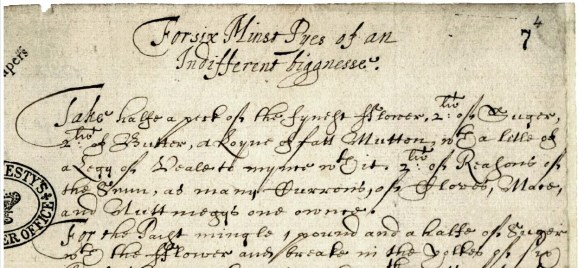
‘For six Minst Pyes of an Indifferent biggnesse’ (The National Archives, SP 14/189, folio 7)
Luckily, for those of you who would like to learn the basics of reading early modern documents, there are a huge number of helpful resources available, including many that are free and online. They are widely scattered, so this post is an attempt to collect them in a single place. Continue reading
the history of 'the unruly sort of clowns' and other early modern peculiarities
the history of 'the unruly sort of clowns' and other early modern peculiarities
An Open Access Graduate Course on Utopian Thought.
A blog about bodies and medicine c.1500 - 1780
Adventures in the world of history
history/folklore/writing
stories from a nineteenth-century prison
the history of 'the unruly sort of clowns' and other early modern peculiarities
Leverhulme Funded Project at University of Exeter: Adopting a New Methodological Approach to Early Modern Women's Work
Early Modern Material Culture
'Making good use of the things that we find / Things that the everyday folk leave behind': ramblings of an early modern historian
A blog (mostly) about early modern history
crime, women, digital history...
 the many-headed monster