
Brodie Waddell
I know very little about modern labour relations beyond what I’ve learned over the past few weeks as a lecturer on strike. However, I do know a fair bit about labour relations between about 1550 and 1750.
In my previous post, I talked about the vital role played by a wider ‘strike culture’ of objects and actions in enhancing the power of labour action, both then and now. Yet focusing exclusively on ‘culture’ risks underestimating the hard structural barriers that worker mobilisation regularly bumps up against.
Law matters
Although undoubtedly there is ‘power in a union’, there is also a great deal of coercive power held by our employers and the state.
British law is, as far as I can tell, unusually hostile to trade union action, another unhappy inheritance from the Thatcher years. This means that employers can threat – and implement – all sorts of nasty things that seem like they ought to be illegal but are actually within the bounds of the law.
The biggest shock for me was discovering that many universities were threatening to dock some or all of their staff’s wages for ‘action short of a strike’ (ASOS) a.k.a. working to contract. There has been a strong push from the strikers and their allies to get these universities to reverse these policies, with much success. But at the time of writing, eight institutions (Bristol, City, Heriot-Watt, Leeds, Liverpool, Royal Holloway, Salford, and Surrey) were still threatening this.
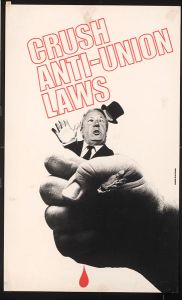
Poster by Ken Spague, 1971: V&A
Even more thorny is the problem of the pensions themselves. Suffice to say the issue is complex, but it is clear enough that the Pensions Regulator and various official rules have made it more difficult to get a clear sense of how much room for negotiation is actually available. As has been expertly discussed by Josephine Cumbo and Michael Otsuka, while these formal structures are not entirely rigid or immovable, they still impose very real boundaries on the options available.
Three or four hundred years ago, workers taking action encountered some similar problems. The economy was of course very different, with very few large-scale employers and many more household-sized economic units. Nonetheless, as I noted in my previous post, there were still ‘strikes’ and other labour disputes. And in most of these conflicts, the broader legal context favoured ‘masters’ (employers) over their workers. Continue reading
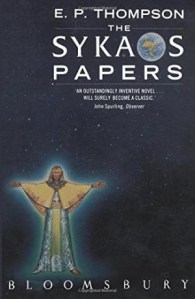 Now I’ve read it. I had low expectations – presumably it had fallen off the radar because it was junk, right? – but I must say I think it is a belter. It is a bit mad, I’ll grant you, but endlessly inventive and stimulating, and at times downright hilarious and at others deeply affecting – neither of which I was expecting. And, I’d say it is much more fluent than his academic writing, which I have heard described recently by a historian who shall remain anonymous as ‘wittering’. I’m not sure I’d go that far, but I take the point, and I was expecting a slog – it wasn’t one. Anyway, I’m no great book reviewer – of fiction at any rate – and you can make your own mind up on this stuff, but I would recommend it to readers of this blog. With Christmas coming up and all that…
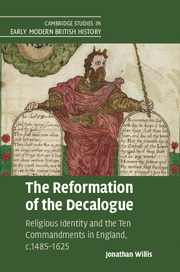 After a brief mid-term hiatus, in this last post marking the publication last month of my latest monograph,

 At first glance, the Ninth Commandment, ‘Thou shalt not bear false witness against thy neighbour’, was rather niche compared to the first four precepts of the second table: honouring parents, and not killing, committing adultery with, or stealing from other people. However, as historians such as Alexandra Shepherd and Craig Muldrew have shown, credit and reputation were vital and powerful forces in early modern English society.
 Nowhere was this aspect of ‘making it up as they went along’ more visible than in discussions of the Eighth Commandment – for while certain sins were pretty much universals of human nature (sins of violence and lust, for example) the realities of economic life in sixteenth century England were very different from those of the ancient Middle East.
  The Seventh Commandment, ‘Thou Shalt Not Commit Adultery’, was one of the most commented upon in the whole Decalogue. ‘Adultery’ was quickly expanded by Protestant authors to include all forms of ‘uncleanness’, in thought, word and deed, alone and with other humans and creatures, both in and outside of wedlock. Fornication, buggery, masturbation and bestiality were some of the headline crimes, but authors also sought to proscribe all ‘occasions’ and ‘enticements’ to sins of the flesh, including mixed dancing, excess consumption of food and alcohol, as well as lewd pictures, cosmetics, alluring gestures and coquettish glances. In contrast to such filthy living, the commandment enjoined chastity, both in and out of marriage: ‘immoderate use of the marital bed’ was as much a sin as pre- and extra-marital sex.
