A Poor Hand-Maid’s Tale: Love, Petitioning and Print in Seventeenth-Century England

The second post in our Postgraduate and Early Career Takeover comes from Scott Eaton, an ECR interested in early modern witchcraft, religion, art and print cultures. His book on the witch-finder John Stearne is available from Routledge now. You can follow him on twitter: @StjEaton.

On 22 August 1651 Christopher Love was executed for treason for conspiring with Royalists to restore the King, Charles II, to the throne. His wife, Mary Love, had worked tirelessly to try and save him. While he was being held in the Tower of London, Love petitioned, ‘stood dailie’ at Parliament’s doors and even sent messages to Cromwell in Scotland (at the cost of £100!) in the hope she might secure her husband’s release. Unfortunately, she failed in her efforts. Shortly after Christopher’s death, however, Mary published her petitions and included letters they had written to each other before he was executed. Her publications can provide insight into petitioning, print and gender roles in seventeenth-century England.  

Petitioning was an acceptable way for the ‘ruled’ to address the authorities and make their voices heard, whether seeking action, intercession or mercy, like Love. The 1640s saw a breakdown over censorship of the press and a rise of female assertiveness in the political arena, allowing printed petitions attributed to women to proliferation more widely than before. Mary Love’s printed petitions obviously came after these events had happened, giving her a precedent to follow.

The Resolution of the Women of London to the Parliament (1642), EEBO
Continue reading

‘The devil will tear me in pieces’: Self-destruction and sympathy in a seventeenth-century witchcraft case

We are delighted to launch our Postgraduate and Early Career Takeover with this post from Imogen Knox. Imogen is an M4C funded doctoral researcher at the University of Warwick whose work focuses on suicide, self-harm and the supernatural in Britain, 1560-1735. Find her on twitter at @Imogen_Knox.

CONTENT WARNING: this post contains discussion of suicide.

Self-destruction was interwoven with the roles of both witch and bewitched in early modern Britain. Witches committed spiritual suicide in signing themselves over to the devil, and in turn the devil tempted his imprisoned servants to self-destruction to secure his grip on their souls. The spiritual and actual suicide of witches, like criminals, reinforced their guilt in the contemporary imagination. Witches also tormented their victims with temptation to self-destruction.

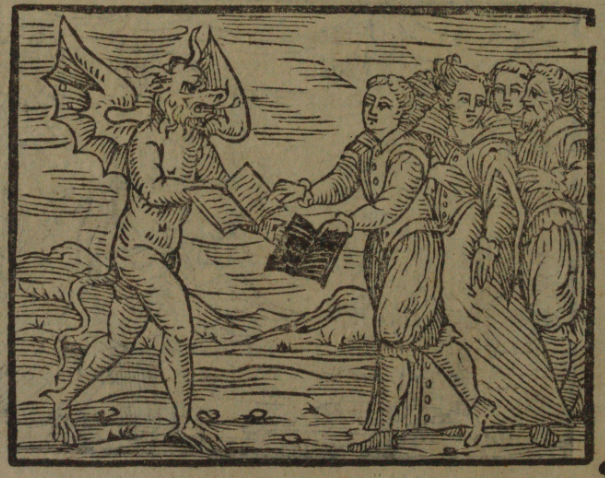
Witches making a pact with the devil. Compendium maleficarum. Wellcome Collection. Attribution 4.0 International (CC BY 4.0)

Both those afflicted by witchcraft and witches themselves expressed self-destructive temptations. One such admission would produce sympathy, the other scorn. In this post I examine the case of the witchcraft of Anne Bodenham and her victim Anne Styles to show how, by mirroring each other’s self-destructive behaviours, the women negotiated contemporary ideas around innocence, guilt, female nature, and spirituality. One would emerge as an innocent victim, the other an unrepentant sinner.

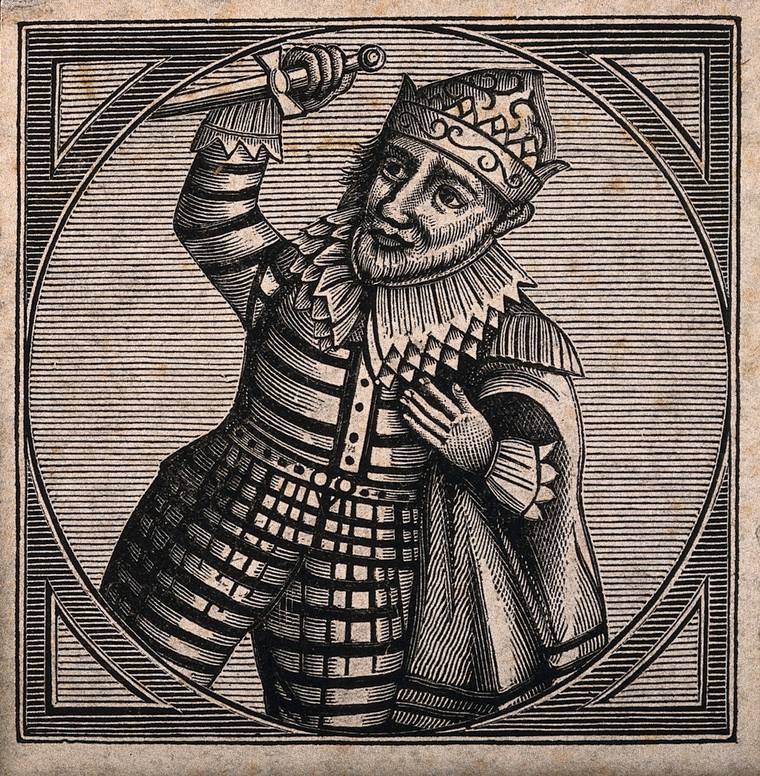
Dr John Lambe, Anne Bodenham’s reputed tutor. John Lambe, an infamous medical practitioner and magician. Wood engraving. Wellcome Collection. Attribution 4.0 International (CC BY 4.0)

Anne Bodenham, of Fisherton Anger, near Salisbury, was a reputed cunning woman. It was her ability to locate stolen goods that first brought Anne Styles to her in 1653. Styles, a young woman employed as a maid in the Goddard household, was illiterate and ‘altogether ignorant of the Fundamentall grounds of Religion’ according to the court clerk Edmund Bower. In contrast, the eighty-year-old Bodenham owned ‘a great many notable books’ and claimed to have been taught by the infamous Dr Lambe. Styles made multiple visits to Bodenham, to consult on various issues for the Goddard family, chief among the fear of Styles’ mistress that she was to be poisoned. After several visits, Bodenham offered to take Styles on, ‘to live with her’ and ‘teach her to doe as she did’. However, when Bodenham transformed herself into a cat, Styles was ‘very much affrighted’. Bodenham, seeing that she had misjudged the situation, let Styles go. To ensure that Styles would not ‘discover her’, Bodenham had Styles sign her name in blood in a book, while two conjured spirits looked on.

Continue reading

Decolonising and Black British History: a teaching resource

Laura Sangha

If you are thinking about decolonising your history module this year, this seminar plan [pdf] might be of use to you. It’s based around ‘Black Lives in Early Modern England’, but with minor tweaking of the reading and primary sources it could be adapted for most modules, whether pre-modern or modern.

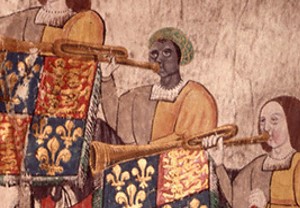
John Blanke (detail from 1511 Westminster Tournament Roll).

The seminar aims to introduce students to some key concepts whilst also encouraging them to think about methodology and historiography. It combines synchronous and asynchronous activities, and is equivalent to four hours of synchronous seminar time (it’s designed for my Special Subject which in non-pandemic years is taught by means of 2 x 2 hour seminars a week).

In this post, I want to share some of my recent experiences which provide some context to where the seminar emerged from.

Continue reading

Evading the hounds: online scholarly collaboration and crowdsourced harassment

The latest post in our #SchOnline: Scholarly Communities Online series addresses the urgent issue of online harassment and abuse. 

Elizabeth Watts

Taking our scholarly collaborations online has opened up a world of conversation – at least for those who have the health and energy for it in a global pandemic, and those who are not impeded by barriers such as inaccessible digital materials or organisers’ time zones. Yet in grounding our collaboration in spaces which are subject to rampant organised harassment and surveillance, the well-known threats that marginalised scholars at in-person events face from individuals are exchanged for the instantaneous threat of abuse at menacing, escalating scale.

Online abuse has been an endemic aspect of public scholarship, above all for women of colour, since social media started collapsing digital communication into a handful of massive, searchable platforms. Marginalised and feminist scholars have been ever more vulnerable to forms of online violence aimed at hounding them and their knowledge out of the public sphere since the 2014 #GamerGate campaign (when anti-feminist internet users subjected them to the same tactics of doxxing and swarm harassment they were already turning on Black women journalists), which some writers argue was even instrumentalised by Steve Bannon to help elect Donald Trump.

Besides these organised campaigns, the ease with which high-profile public figures can expose individuals with much lower public profiles to a mass of followers in derogatory ways creates an intimidating atmosphere for any scholar who has experienced or even witnessed the spontaneous harassment that can result. In my own case, as a white mid-career scholar with an ongoing contract, I was privileged and secure enough that abuse from accounts that did not appear to be linked to any identifiable offline people was no big deal. Coming to the attention of individuals with a wide reach on social media, offline positions of power and the capacity to use their influence to cause me material detriment has been a different level of threat altogether, leaving me anxious that I would not be able to keep up with my core job during another episode. With consciousness that my family’s peace and privacy would also be at risk (an even greater threat for scholars whose families are not cis/heteronormatively traditional), my online life has had to become much more defensive and constrained. Continue reading

#SchOnline: Scholarly Communities Online

In the spring of 2020, as much of the world was plunged into ‘lockdown’ by the advance of a global pandemic, regular forms of face-to-face interaction were swiftly replaced by online alternatives. We all found ourselves coming up with new ways to recreate our scholarly activities online, as the classroom morphed into the online seminar; the conference trip was replaced by a day tucked away in a corner of the bedroom staring at Zoom; the common-room catch-up was transferred to the Departmental WhatsApp group.

As the UK lockdown eased at the end of June, we invited our readers to contribute to this ongoing mini-series reflecting on the best way to build communities online.

Contents

> Laura Sangha & Mark Hailwood, ‘The Virtual Parish: Scholarly Communities Online’

Laura and Mark introduce the series and reflect on eight years of running this blog as an online scholarly community. What do we gain from taking our conversations online? What do we lose? What needs to be improved?

> Will Pooley, ‘Online Conferences: Four Reflections’

Will examines his experience of co-organising an online Zoom conference during a global pandemic. He discusses how things were adapted, what online spaces had to offer, and accessibility.

> Clare Griffin, ‘Time Zones Still Exist’

Many of us are facing the prospect of teaching across time zones in the autumn of 2020. Here Clare Griffin reminds us of the access implications of time zones for online events, and suggests that the move online could provide an opportunity to improve the experience of delegates across the globe.

> Jennifer Farrell, ‘The Digital Delegate: attending on online international conference’

What is it like to attend a huge international conference from the comfort of your own home? Jennifer considers reduced costs, technology, trolls and community.

> Brodie Waddell, ‘Teaching Microhistory: small things, big questions and a global pandemic’

How can we teach students the value in studying small things to answer big questions, online, during a pandemic? Brodie explains what it was like to teach an online MA module on theory and methodology, and gives away the handbook for free!

> Elizabeth Watts, ‘Evading the Hounds: Online Scholarly Collaboration and Crowd Sourced Harrassment’

Taking our scholarly communities online has opened up a world of conversation. Yet in grounding our collaboration in spaces which are subject to rampant organised harassment and surveillance, the well-known threats that marginalised scholars at in-person events face from individuals are exchanged for the instantaneous threat of abuse at menacing, escalating scale. In this post Elizabeth shares her own experience as a victim of online of such online abuse.

> Marianne C.E. Gillion, ‘Cultivating a (Virtual) Conference Community

Marianne discusses what it was like to rise to the challenge of hosting a major conference online. The 2020 Medieval and Renaissance Music Conference created a virtual environment that facilitated the unique combination of scholarship, music, networking, and the sociability integral to the annual event. 

> Laura Sangha, “‘You’re on mute!’: How can we make online meetings better?”

Online meetings have become a common feature of our working lives this year, but many people are frustrated at the amount of time they take up. How do they compare with a face-to-face version – beyond the potential technical pitfalls, might they be an improvement? And what can we do to make them more accesible, inclusive and effective?

> Brodie Waddell, ‘How are we going to teach in Autumn 2020? A Survey of UK Historians.

It’s August, but in many UK institutions there is still much uncertainty about what form teaching will take when term starts next month. Here Brodie offers some thoughts based on a quick informal survey of scholars based in 26 different UK history departments, asking them what proportion of teaching they are planning to conduct face-to-face in the autumn.

> Mark Liebenrood, ‘Serendipities of Online Community’

In this post Mark Liebenrood reminds us that serendipity is not the preserve of archival research: it can be one of the great strengths of online scholarly communities too.

The digital delegate: attending an international online conference

We are delighted to welcome our next guest blogger for our #SchOnline series (scholarly conversations online). Here Jennifer Farrell (@dr_j_farrell) reflects on her experience as a delegate of an online conference.

Jennifer Farrell

Last week saw the return of the International Medieval Congress (IMC) at the University of Leeds. This annual conference attracts thousands of medievalists from all over the world, eager to network with one another, to road-test their research, and to enjoy hearing about the work being done by others in their field. I have attended the IMC numerous times in the past, both as a delegate and as a speaker, but the major difference this year was that I did so from the comfort of my own living room!

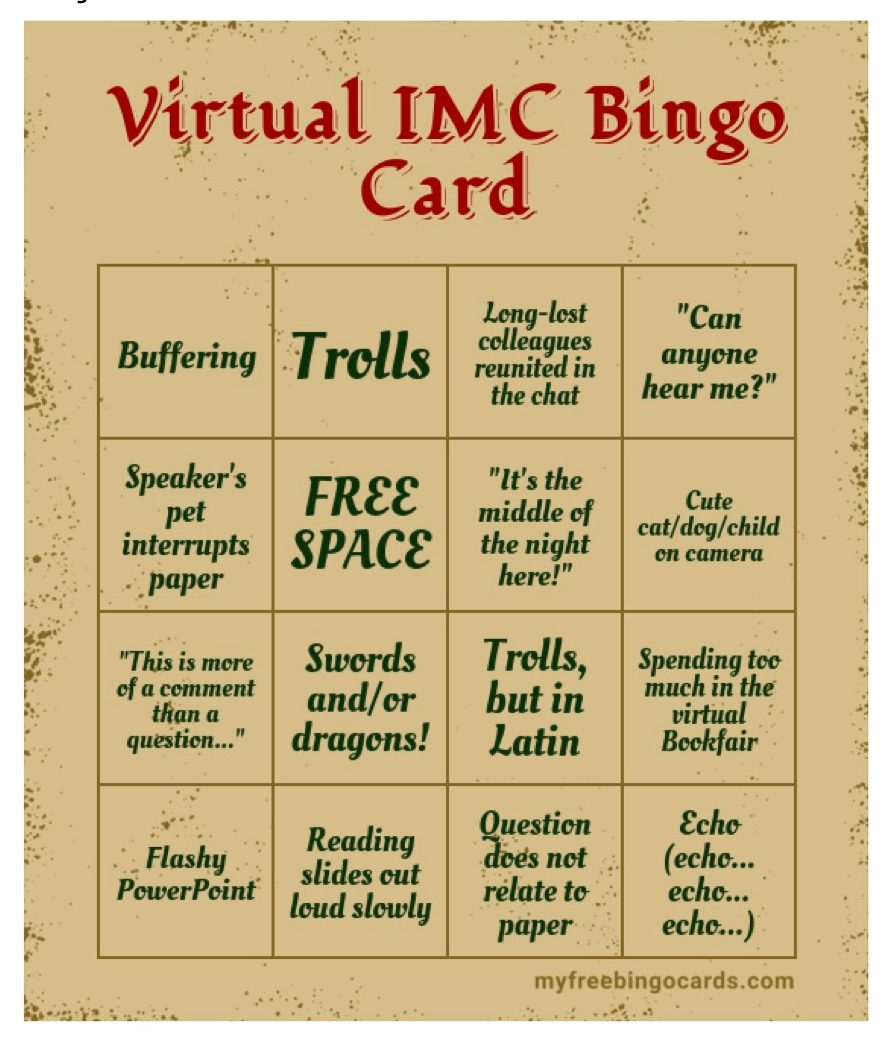
Bingo Card

Sadly moving a conference online will still not stop you spending too much time at the book stalls.

The Covid pandemic has impacted researchers in various ways, but one of the major changes we are seeing is the willingness and indeed tenacity of conference organisers to find ways of facilitating networking and the sharing of research via online platforms. The sheer scale of the IMC means that its move to a virtual conference was nothing short of heroic.  This year the virtual IMC supported the delivery of c.530 research papers, attended by c.3,200 delegates from across 60 countries. The organisers, moderators, panellists, and facilitators deserve to be commended for this.

Speaking purely from the perspective of a delegate, with no need to worry about my paper being interrupted by poor internet connection, bad sound, disruption from trolls, or just the generally odd sensation of talking about your research to a computer screen, my own experiences of the vIMC were very positive. Of course, a virtual environment is by no means the same as experiencing the conference in person, but that is not necessarily a bad thing.  Like many of the changes that have occurred to our working conditions on account of Covid, there are good and bad sides. Continue reading

Isaac Archer’s Sickly Preaching

[In our mini-series ‘A Page in the Life’, each post briefly introduces a new writer and a single page from their manuscript. In this post, Dr Robert W. Daniel of the University of Warwick offers us insights into the diary of the Church of England clergyman Isaac Archer and his experiences of preaching whilst ill. Robert is a Post-Doctorate researcher and General Secretary of the International John Bunyan Society. Follow him at @BunyanSociety]

25 of September [1679] in the night I had an hott fitt of an ague…

28 [September]… [ague] not so bad; and on October 1 worse…

[13 October] Munday discovered it selfe a quartane, which continues stil…

1st [December?], for a fortnight, ’twas tedious [the ague], but I went to Isleham, and tooke physick, and then it shortned, and now I can bear it, only I am not able to preach… 

December 25. I ventured to preach, and so onwards

February 12 [1680]. I have the ague stil… I can officiate [in church]

March 10. I tooke a small journey, and came home wett, upon which my ague came that night… I ventured to preach twice for about a month, but gatt hurt, and my speech was difficult, and my breath shorter than ever I knew it… I agreed to preach only in afternoons…[1]

These are the entries that appear in a page of the diary of the Church of England clergyman Isaac Archer (b. 1641, d. 1700) when he was the resident vicar at Freckenham, Suffolk. His efforts to preach whilst suffering from a nine-month ‘ague’ (likely malaria) are astonishing in part because these attempts, whilst sporadic, were potentially fatal.[2] His sickly preaching exacerbated serious respiratory difficulties which must have been quite unsettling.In light of the recent CFP from the Ecclesiastical History Society on, ‘The Church in Sickness and in Health‘, I was struck by Archer’s experience of illness, and was left with some nagging questions. Did he often preach when ill? If so, what other ailments did he experience while officiating in church? Did he take any sick days? How did Archer rationalize risking his health to preach God’s Word? In this blog post I will attempt to answer some of these questions by examining the motivations and occasions of Archer’s sickly pulpit exertions. Doing so may tell us something surprising about the convictions of, and cost incurred by, England’s pulpiteers.

Continue reading

Mental Illness: An Early Modern Perspective

Jonathan Willis

This week (18-24 May 2020) is ‘Mental Health Awareness Week’ in the UK – May is also US ‘Mental Health Month’, and ‘World Mental Health Day’, in case you were wondering, is a separately-coordinated enterprise, and will be on Saturday 10 October.  The fact that we have events such as these in the twenty-first century tells you two things.  Explicitly it is evidence that, in general, our society pushes itself to recognise the importance of mental health, the prevalence of mental illness, and that signposting the various specialist treatments and https3a2f2fblogs-images.forbes.com2fbernardmarr2ffiles2f20192f052fthe-incredible-ways-artificial-intelligence-is-now-used-in-mental-health-1200x720-1resources that are available for people struggling with any number of specific conditions is an urgent priority.  The implicit message, though, is that mental health and mental illness have long been neglected in our broader political, social and medical public discourse.  While there are valuable and life-saving public health campaigns around specific physical conditions such as various forms of cancer, strokes, heart disease, etc., there is palpably no need for a special day or week or month to remind people that physical illness is, in fact, a ‘thing’.

My motivation for writing this post comes from two sources – firstly, from the project I am working on on the relationship between mental health and the English reformation, and secondly from my own experience of suffering from and receiving treatment for anxiety over the past few years.  By accident rather than design(!), it just so happened during the autumn of 2019 that I read a lot of brilliant work about early modern mental health, mental illness, and the history of the early modern emotions, at the same time as I was working on my own mental health during a course of therapy.  In this context I could not help but reflect upon the used-books-store-2concordances and divergences between how we and our early modern forebears understood the workings of the human mind.  In this post I want to offer some broad reflections on the similarities and differences between early modern and twenty-first century conceptions of mental illness, based largely on secondary literature.  In subsequent posts (for I see this post by way of introduction) I plan to delve more deeply into the specific relationship between religious beliefs and mental illness, using evidence drawn from early modern letters.
Continue reading

A Wandering Story of the Wandering Jew

Laura Sangha

Part I


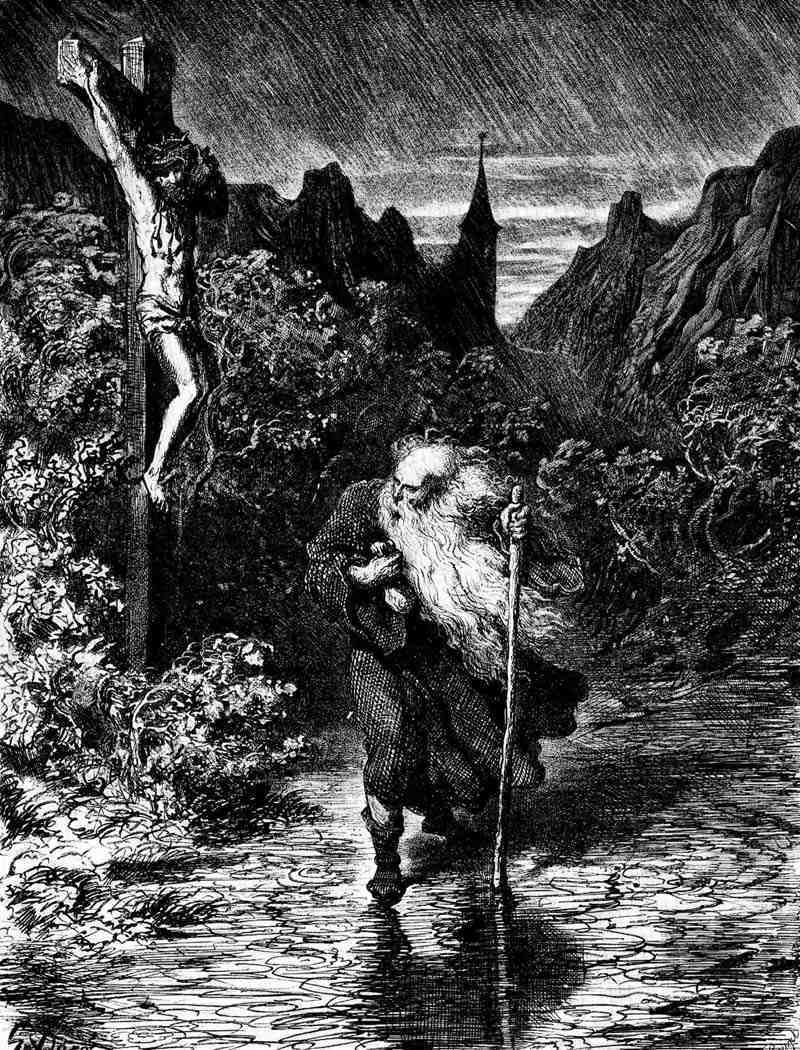
Wandering_jew

Gustave Dore, The Legend of the Wandering Jew: A Series of 12 Designs, c. 1857, V&A Collections.

Story 1

A month or so ago I read Sarah Perry’s wonderful third novel Melmoth. Central to the book is the myth of Melmotka, a woman who witnessed Jesus’ resurrection, but who later denied that she had seen him. Since that time Melmotka has wandered the earth without home or respite, bearing witness to all humanity’s violence and cruelty, as she will do until Christ comes again.

The Stories of Story 1

In modern day Prague Helen Franklin traces the history of Melmotka through a collection of texts that speak of a wraith-like figure who appears at moments of great sorrow. The narratives found in these documents – a seventeenth-century letter, a contemporary manuscript, a twentieth-century journal – put flesh on the bones of Melmotka, a shadow that leaves bloody scarlet footprints where she treads, who is clad in some thin black billowy stuff, who stares with eyes that are like ink dropped into water… Continue reading

Responding to a Crisis: the Black Death, COVID-19, and Universal Basic Income

In this guest post, Professor Jane Whittle of the University of Exeter looks at the governmental response to the Black Death, and advocates a revolutionary new social policy for our own period of crisis. 

Jane Whittle

Unprecedented episodes of disease, such as the current outbreak of COVID-19, are moments of fluidity when parts of existing societies are laid bare as not fit for purpose. Wars create similar moments of flux. The Second World War created the consensus that allowed the founding of the NHS and the Welfare State. Could our current state of crisis lead to something positive and long lasting, amid all the disruption, trauma, and loss?

My research focuses on another such moment, the consequences of Black Death of the fourteenth century. In the midst of the Black Death the English government made the significant decision not to strengthen the institution of serfdom but instead to increase the regulation of waged labour with the Ordinance of Labourers of 1349.

The Black Death was an outbreak of bubonic plague that raged across Europe between 1347 and 1349 and killed an estimated 50% of the English population. Fortunately the mortality rate of COVID-19 looks to be closer to 1% of those infected (and thus lower for the total population). Yet in our highly interconnected modern society its impact is already shaping up to be enormous. Historians have long puzzled over the fact that the immediate social and economic impact of the Black Death appears to have been remarkably slight. Social, economic, and political structures remained in place. However, this is to overlook the innovation of the labour laws. The Ordinance of Labourers of 1349 was a revolutionary piece of legislation. It marked the end of serfdom and beginning of an economy dependent on wage labour, but it signalled that the government’s attitude to wage workers would be far from lenient. Although initially announced as an emergency measure by the monarchy, when Parliament next met in 1351 it was enthusiastically endorsed. The measures remained in force until the early nineteenth century. Continue reading