In this guest post Dr Francis Young examines the relationship between history and nostalgia, particularly how and why nostalgic rhetoric is deployed. Dr Young is a UK-based historian and folklorist specialising in the history of religion and supernatural belief. You can find out more about his work on his website.
The phenomenon of nostalgia – which may be defined, briefly, as a longing for an imagined past supposedly better than an unsatisfactory present – seems to be attested in every age. Clearly, nostalgia is not the same thing as history, since nostalgia celebrates or exploits an imagined past that may never have existed, without studying the evidence. Conservative societies undergoing little change have fewer reasons to be nostalgic, but societies in flux often become sentimental about an imagined former ‘Golden Age’. This was certainly true of early modern England, which was a society obsessed with the past. However, early modern nostalgia was not just an effect produced by a changing society: ironically, early modern nostalgia drove the process of change itself. By longing for the past, people brought in the future.
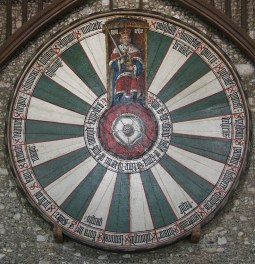
The Winchester Round Table. Image: Martin Kraft (photo.martinkraft.com) License: CC BY-SA 3.0 via Wikimedia Commons
Throughout the Middle Ages, it was commonplace for new monarchs to associate themselves with the ‘good old days’, whether they did this by invoking the laws of St Edward the Confessor, the liberties guaranteed by Magna Carta, or an imagined age of chivalry and the deeds of King Arthur. Perhaps no early modern reign was more infected with this kind of nostalgia than that of Henry VIII, who even had a painted wooden replica of King Arthur’s round table made for him in 1522, which now hangs in Winchester Castle. In a Latin poem to mark Henry’s coronation, Thomas More wrote, ‘When previously order utterly decayed, at once all order was restored in him … what are his virtues had been those of any of his ancestors’. More then went even further and declared Henry’s accession to be the restoration of the Golden Age prophesied by Plato: ‘The golden ages first return to you, prince; o! Plato may thus far be a prophet!’ Continue reading
 That might need some explanation: a BOOC is a new, fully open access platform that allows for multi-form contributions across time. Living books for the digital age, if you will.

 at spinning wheels that were used to illustrate early modern ballads. The term ‘hand-spinning’ describes spinning both by wheel and by distaff or drop spindle, a method which can be used while walking, as in Paul Sandby’s mid-18th century drawing of a woman carrying a distaff (courtesy of the trustees of the British Museum).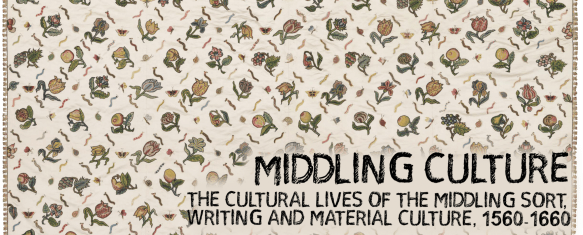
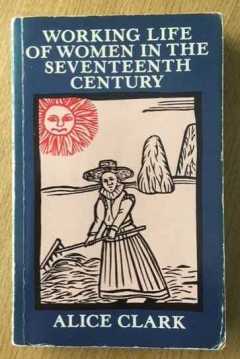 I’m reading the chapter in my 1982 edition of Alice Clark (the only history book I stole from my mother’s bookshelves), complete with a woodcut of a woman haymaking on the cover (although this image has been edited to remove the couple canoodling in the background which is present in the original below). Is this deeply significant? Probably not …
 the many-headed monster