The next post in our Postgraduate and Early Career Takeover is by Dr Robert W. Daniel of the University of Warwick. Robert is a Post-Doctorate Researcher and General Secretary of the International John Bunyan Society. Follow him at @BunyanSociety. In this post, he offers us insights into the petitions and diaries of women who lost their children as a direct result of religious persecution.
CONTENT WARNING: This post contains accounts of miscarriage and stillbirth.
Women who did not conform to the Established Church of seventeenth-century England – labelled ‘puritans’, ‘fanatics’, ‘nonconformists’, ‘plotters’, or ‘dissenters’, paid a heavy, if not the heaviest price, in their fight for religious equality. They resisted religious uniformity by courageously, often peacefully, contesting pecuniary laws prohibiting alternative forms of worship, unjust imprisonments and the distrainment of goods, and the law making weekly parish church services compulsory. In researching the history of this struggle, I was struck at how frequently these women, as mothers, suffered child loss as a direct result of State sponsored religious persecution. Through their diaries, petitions and pamphlets, women depicted the trauma of stillbirths, miscarriages and neo-natal deaths as one of the tragic consequences of their struggle for religious freedom during a period of intense religious intolerance.
In this blog post I want to examine some examples of maternal suffering that need to be re-incorporated into our reading of the history of English religious nonconformity. Doing so will reveal not only the horrific (and underexamined) effects of religious persecution during this period, but also the affective discourse and mediums in which a denominationally and politically diverse cross-section of women (Baptists, Presbyterians, Quakers and Levellers) sought to make these known to a broader audience.
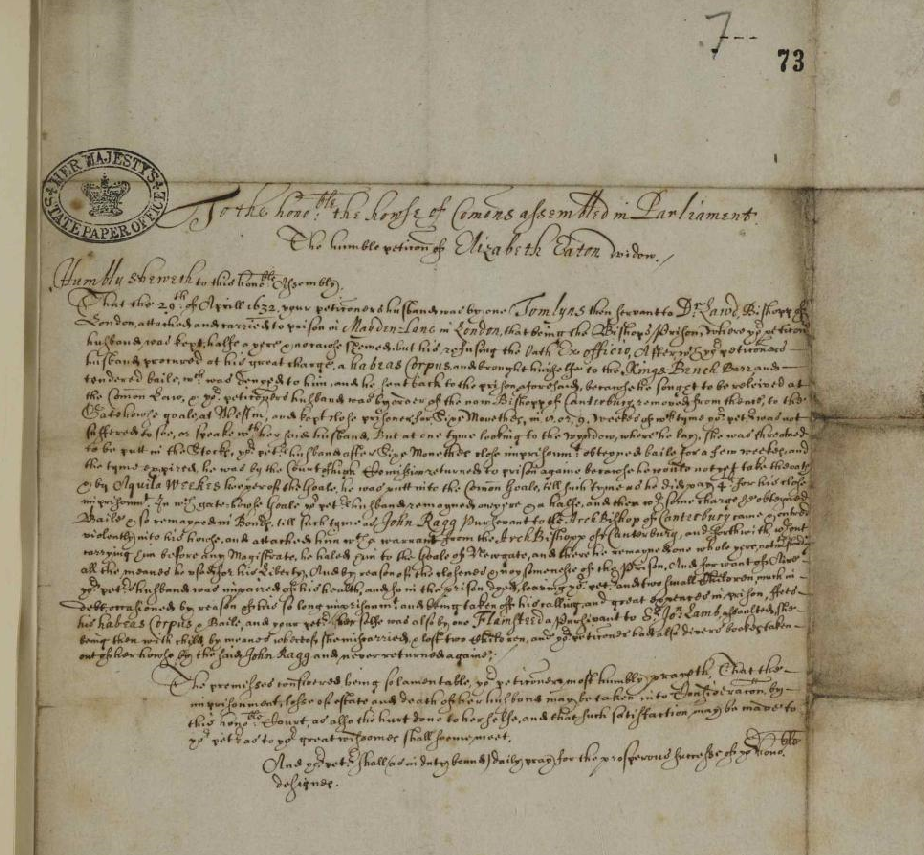
The homes of religious dissenters were constantly under siege. Men, women and children were routinely roused in the middle of the night, chivvied and dragged – at times quite literally – to be interrogated or thrown in prison. The result of such upheavals, if a woman was with child, could be miscarriage or a stillbirth. Elizabeth Eaton (fl. 1632–1641) was an active member of the Baptist Lathrop congregation in London who, along with several other women, was questioned by the High Commission court in the early 1630s. In 1641 she wrote a petition to the House of Commons (see Figure 1). Elizabeth explained that she was now a widow having lost her husband, Samuel Eaton (d. 1639) (who was also a Baptist), by his ‘wrongful imprisonment’. On one of several occasions that Samuel was arrested, Elizabeth describes how one John Ragg, Archbishop William Laud’s pursuivant, ‘violently entered his [Samuel’s] house and … haled him to Newgate’. Elizabeth, ‘being then with child’, was ‘assaulted by Flamsteed, a pursuivant to Sir John Lamb’, which ‘caused her to miscarry’. She was not alone in reporting such violence. Other women of the Lathrop congregation said that their own miscarriages were a result of the rough treatment they had received when arrested. Elizabeth’s petition clearly made an impression on the Commons. It was later included amongst papers relating to the trial of Archbishop Laud, as evidence of his excessive cruelty in prosecuting religious sectaries.